

So, you want to become a coach. You know what you are good at. You have helped people with their careers, confidence, productivity, mindset, or something else. Then someone asks a simple question: “What kind of coach are you?”
That is where things get tricky.
You could say, “I help people with a few different things.” It is honest. But now imagine being the person who needs help. You are struggling with a specific problem, and you land on a coach’s website. Do you immediately know, “This person can help me”?
That is the real job of your niche. It is not about putting yourself in a tiny box or giving up the other things you are good at. It is about making it easy for the right person to recognize that your coaching is for them.
So how do you find that sweet spot? Start with what you already know, connect it to a specific person and problem, then check whether people actually pay to solve it.
That is what we will do in this guide. You will find a coaching niche you can build around, test it with real people, and change it if the market tells you to.
TL;DR
- A coaching niche is one specific person, one problem they keep running into, and one outcome you help them reach.
- Demand comes first when you filter your options. Credibility and personal interest matter, but they cannot rescue a problem nobody pays to solve.
- Most coaches stop at the category level, like career coaching or wellness coaching. Categories do not sell. Situations do.
- When two or three niches survive your filters, score them instead of debating them. Demand, credibility, energy, reach, and pricing power are the five columns that matter.
- A small paid offer validates a niche faster than months of posting. If five people pay for a workshop, the niche works.
- Your first niche is a starting point. Real clients tell you what to sharpen.
What Is a Coaching Niche?
A coaching niche answers three simple questions: Who do you help? What problem do they have? And what result do you help them achieve? If one of these is missing, you probably have a topic or audience, not a clear niche.
For example, “career coaching” tells people what you do, but not who you help or why they should care. “I help engineers who were recently promoted into management become confident leaders” gives them a much clearer reason to pay attention.
The goal is simple. When the right person sees your offer, they should quickly think, “That’s for me.”
Niche vs. Topic vs. Audience
It’s easy to mix these three up. A topic is what you coach about, such as mindset, money, or fitness. An audience is who you want to reach, such as parents, founders, or nurses.
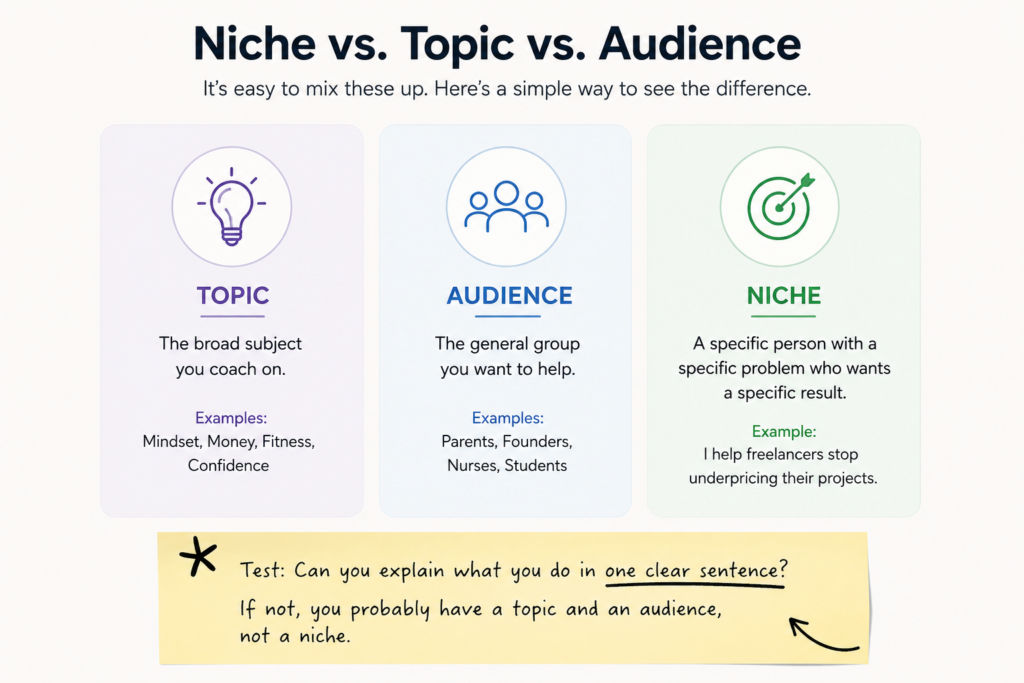
A niche brings both together around a specific problem and result. “Money coaching for freelancers” gives you a topic and an audience. “I help freelancers stop underpricing their projects” gives you a specific problem to solve.
Here’s a quick test. Try describing your niche in one simple sentence. If you need a long list of skills, problems, or audiences, you probably need to narrow it down.
Why Your Coaching Niche Decides How Fast You Get Clients
Your niche decides how quickly someone can tell that you are talking to them. That single factor moves more people from reading to booking than credentials, posting frequency, or how polished your site looks.
The competition math explains why this matters more each year.
The 2025 ICF Global Coaching Study counted 122,974 coach practitioners worldwide, a 15% rise since 2023. Industry revenue reached $5.34 billion USD over the same period.
Demand is growing and so is the crowd chasing it. Your generic promise is sitting next to thousands of identical generic promises right now. A specific one has almost no neighbors.
Three things change for you the moment your niche gets specific. Writing content stops being a chore, because you know exactly who is on the other end of it. Your rates hold up better, since specialists get compared on price far less often. And people start referring you, because “she helps burned-out nurses” is something your friend can repeat at dinner. Nobody repeats “she’s a life coach.”
To be clear, none of this means turning away work that falls outside the niche. Your niche runs your marketing. It does not run your calendar.
How to Find Your Coaching Niche in 5 Steps
The process below moves from what you already have to what the market will pay for, then narrows to a single choice you can test. Run it in order. Skipping to the fun part, which is usually picking a name for your method, is how coaches end up committed to a niche with no buyers.
- Audit what you have actually done
- Match one skill to one person with one problem
- Check that people already pay to solve it
- Filter by who you want on your calendar
- Score your finalists and pick one
Step 1. Audit What You Have Actually Done
Start with results you have produced, not subjects you find interesting. Open a document and list every situation where someone came to you for help and left better off. Include unpaid help, work you did inside a job, and problems you solved for yourself.
Write each one as an outcome rather than a topic. “Career stuff” tells you nothing. “Helped four coworkers rewrite their resumes, three landed interviews within a month” gives you something to build on.
Why this order matters. Credibility is the hardest part of a coaching offer to fake. Clients paying real money want evidence, and the fastest evidence to produce is the kind you already have. Starting from interest instead of evidence means building credibility from zero while you also build a business.
Common mistake. Dismissing informal help because nobody paid for it. The friend who took your advice and got the promotion is a real result. Write it down.
Step 2. Match One Skill to One Person With One Problem
Take your strongest three or four results and turn each into a niche candidate. The formula stays the same every time. One skill, applied to one type of person, solving one problem that keeps coming back.
Frequency is the part people skip. A problem someone faces weekly creates urgency. A problem they face once every few years creates a browser, not a buyer. Daily frustration at work sells better than a life decision they will revisit in 2029.
Say your audit surfaced budgeting help. “Money coaching” is too wide. “I help freelance designers who have irregular income build a monthly baseline they can count on” names a person, a recurring pain, and a result.
Aim for three to five candidates here. More than that and you are guessing instead of drawing on real experience.
Step 3. Check if People Already Pay to Solve It
Look for money that is already moving. Most guides tell you to “research demand” and leave it there, so here is a version you can finish in an afternoon.
Run each candidate through four checks.
- Paid products exist. Search course marketplaces, book listings, and coaching directories for your problem. Products that stay listed for years are products that sell.
- People ask about it publicly. Search the problem in your own words on Reddit, Quora, Facebook groups, and LinkedIn. You want threads where people describe the pain in detail, not just react to a post about it.
- Competitors are visible. Other coaches working this problem is a good sign. An empty market usually means no buyers rather than an opening nobody noticed.
- The buyer can pay. Check whether the person with the problem controls a budget. Plenty of urgent problems belong to people who cannot spend $500 on solving them.
How to read the results. A candidate that passes all four moves forward. A candidate that fails the fourth check can still work, though you will need group or cohort pricing rather than one-to-one rates. A candidate that fails the first two gets cut, no matter how much you like it.
What this saves you. Months. Coaches who skip this step usually find out about missing demand after they have built a site, written twenty posts, and heard nothing back.
Step 4. Filter by Who You Want on Your Calendar
Now apply the personal filter, and apply it last. Coaching puts you inside someone’s problem for months at a time. Working with people who drain you is how a viable business turns into one you quietly abandon.
Ask a plain question about each surviving candidate. Would you happily spend an hour on this conversation with no payment attached? A yes means the work stays sustainable. A no means you are looking at a job you will resent within a year.
Interest belongs at this stage rather than the start. Interest is a tiebreaker between viable options. It cannot turn an unviable option into a business.
Step 5. Score Your Finalists and Pick One
Two or three candidates usually survive, which is where most coaches stall for weeks. Score them instead of debating them. Rate each finalist from 1 to 5 across five columns.
- Demand. How much money is already moving toward this problem?
- Credibility. How strong is your evidence that you can solve it?
- Energy. How much do you want these conversations?
- Reach. How easily can you find fifty of these people this month?
- Pricing power. How clearly can the client measure what solving this is worth?
Reach is the factor coaches underweight most often. A perfect niche you cannot locate is worse than a good niche with an obvious gathering place, like a subreddit, a professional association, or a conference.
Add the scores and take the winner. If two tie, pick the one where you could book a paying client fastest. Speed to a real client beats theoretical fit, because real clients teach you things no amount of planning will.
How Specific Should Your Coaching Niche Be?
Your coaching niche should be specific enough that a stranger knows in one read whether you mean them, and wide enough that thousands of those strangers exist. Almost every coach sits too wide, so assume you need to narrow further than feels comfortable. If describing your niche out loud makes you slightly nervous, you are probably close.
There is a floor, though. “Career coaching for left-handed accountants in Portland” is beautifully clear and will never fill your calendar. Ask yourself whether you could name a few thousand people who fit, online or in your region. If the answer is no, back up one level.
Watch what happens to the wording as it tightens. “Wellness coach” becomes “burnout coach” becomes “I help hospital nurses on rotating shifts get their sleep back.” That last version reaches fewer people, and far more of them write back.
The trade-off worth naming. Narrow niches convert better and reach fewer people. Wide niches reach more people and convert worse. Early on, when you have no audience and need proof fast, conversion is the more useful of the two.
What to Do When You Are Good at Many Things
Look for the outcome that sits underneath all your skills instead of choosing one skill and dropping the rest. Multi-skilled coaches usually have a unifying thread they have never named.
Here is the question that surfaces it. What do all of your interests ultimately help someone achieve? Someone drawn to habits, mindfulness, productivity systems, and journaling is rarely four different coaches. They are one coach helping overwhelmed people feel in control again, using four tools.
Once you name the thread, your skills change roles. They stop being competing identities and become methods. That is also what makes your approach different from someone using a single framework.
When to combine two interests. Combine them when the pairing produces a sharper outcome for one person. Mindset plus career becomes leadership confidence for new managers. Fitness plus accountability becomes consistency for people who quit every February.
When to leave one out. Leave it out when it pulls toward a different buyer. Two audiences means two marketing efforts, and running both at once is what keeps coaches at zero for a year.
Test Your Niche With a Small Paid Offer
You can spend weeks thinking about your niche. Or you can ask people to pay for it. Payment gives you a much clearer answer than likes, compliments, or free calls ever will.
Start by talking to five people who fit your niche. Ask what they are struggling with, what they have already tried, and what they would love to have help with. Don’t try to sell them anything yet. Just listen.
Now take what you heard and create something small. It could be a paid workshop, a short group program, or a mini course focused on that one problem. Keep it simple. You are testing the idea, not building your entire coaching business.
If people pay, you have a strong signal that the problem matters to them. If they are interested but do not buy, your offer or the problem may need more work. If nobody cares, go back and look at your niche again.
Don’t build the big program first. Get a few people to pay for the small version. Then use what you learn to improve the offer, shape the full program, and price it around the result you help people achieve.
You can also turn that small offer into a product you sell alongside your coaching. For more on packaging and selling knowledge, see our guide on how to sell an online course.
And if you are tempted to build everything before finding your first buyers, stop there. That is one of the most common mistakes coaches make when creating an online course. We cover more of those mistakes in our guide to common mistakes in online course creation.
Signs You Picked the Wrong Niche and How to Pivot
Three signals tell you a niche needs changing, and none of them show up in month one. Give any niche three to six months of steady effort before you start reading the tea leaves, because quitting early feels like decisiveness and is usually just impatience.
Qualified leads are not showing up. You have been marketing steadily and the people who reply do not match your ideal client. The problem is often positioning rather than the niche itself, so try narrowing before you abandon it.
You dread the sessions. Your energy drops after every call. Money does not fix this, and coaches who push through it usually stop marketing without noticing they stopped.
Clients keep raising a different problem. You sold mindset coaching and every session turns into career strategy. That is the market telling you where your real niche sits. Follow it.
Pivoting costs less than most people fear. Your skills carry over. Rewrite your site copy, tell your existing network what changed, and run a few sessions in the new direction to gather fresh proof. Most pivots take a month or two, not a fresh start.
What Platform to Use When You Launch Your Coaching Business
Before you compare tools, settle how you plan to deliver the coaching, because that decides everything else. One-to-one work mostly needs scheduling and video. Group and cohort programs need a roster and a way to release content on a timeline. Memberships need recurring billing that runs quietly in the background instead of you sending invoices every month.
Whichever route you take, you need the same four things. Payments that handle one-time and recurring charges. A page where someone can read your offer and pay without emailing you first. Live sessions through Zoom or Google Meet. And somewhere to track client progress that is not a spreadsheet you forget to update.
Plenty of tools cover these. Calendly plus Stripe plus a landing page works fine, especially at the very start, and dedicated coaching platforms handle high-volume one-to-one practices well. The cost of that approach is admin time spread across several logins.
Klasio is worth a look if your coaching sits next to courses or a membership rather than standing alone. Program management, enrollment, Stripe payments, live sessions, and structured content run from one dashboard, and clients can access it all through a mobile app. Cohort and group coaches get the most out of that setup, since client progress and program content live together.
One honest limitation. Klasio has no native booking calendar, so you still need something like Calendly for clients to pick a time slot. A practice built almost entirely around calendar booking and session notes may be better served by a dedicated coaching CRM. If you are still weighing the wider setup decisions, our guide on how to build an online coaching business covers pricing, structure, and client acquisition in detail.
Frequently Asked Questions
Do I need a certification to coach in a specific niche?
To coach in a specific niche, you need a certification only where clients expect one, mainly health, wellness, and executive coaching. The NBHWC credential opens healthcare partnerships, and corporate buyers often screen for ICF credentials before taking a call. In business, marketing, and most skill-based niches, one short case study showing a real before-and-after does more than any certificate.
Can I run two coaching niches at the same time?
You can run two coaching niches at the same time once one of them is already bringing in steady clients. Starting with both means two sets of content and two audiences built from nothing, which is what keeps coaches at zero for a year. Market one niche publicly and quietly accept referrals in the second.
Is the coaching market too saturated for a new niche?
The coaching market is too saturated at the category level and wide open at the situation level. Thousands of people call themselves career coaches. Almost nobody speaks to engineers who just got promoted into management and dread giving feedback. Competitors in your category are good news, since they prove people already pay to solve that problem.
What do I say when someone outside my niche wants to hire me?
When someone outside your niche wants to hire you, say yes if the work interests you and you can help. Your niche runs your marketing, not your client list. Keep your site and your offer pointed at the niche anyway. If the same off-niche request keeps arriving month after month, that is the market pointing at something.
Should my business name match my coaching niche?
Your business name should stay broader than your coaching niche, because renaming a business after a pivot hurts far more than rewriting a tagline. Most coaches sharpen their niche at least once in the first two years. Your own name works fine. Put the niche in your tagline and offer descriptions, where updating it takes ten minutes




Leave a Reply