
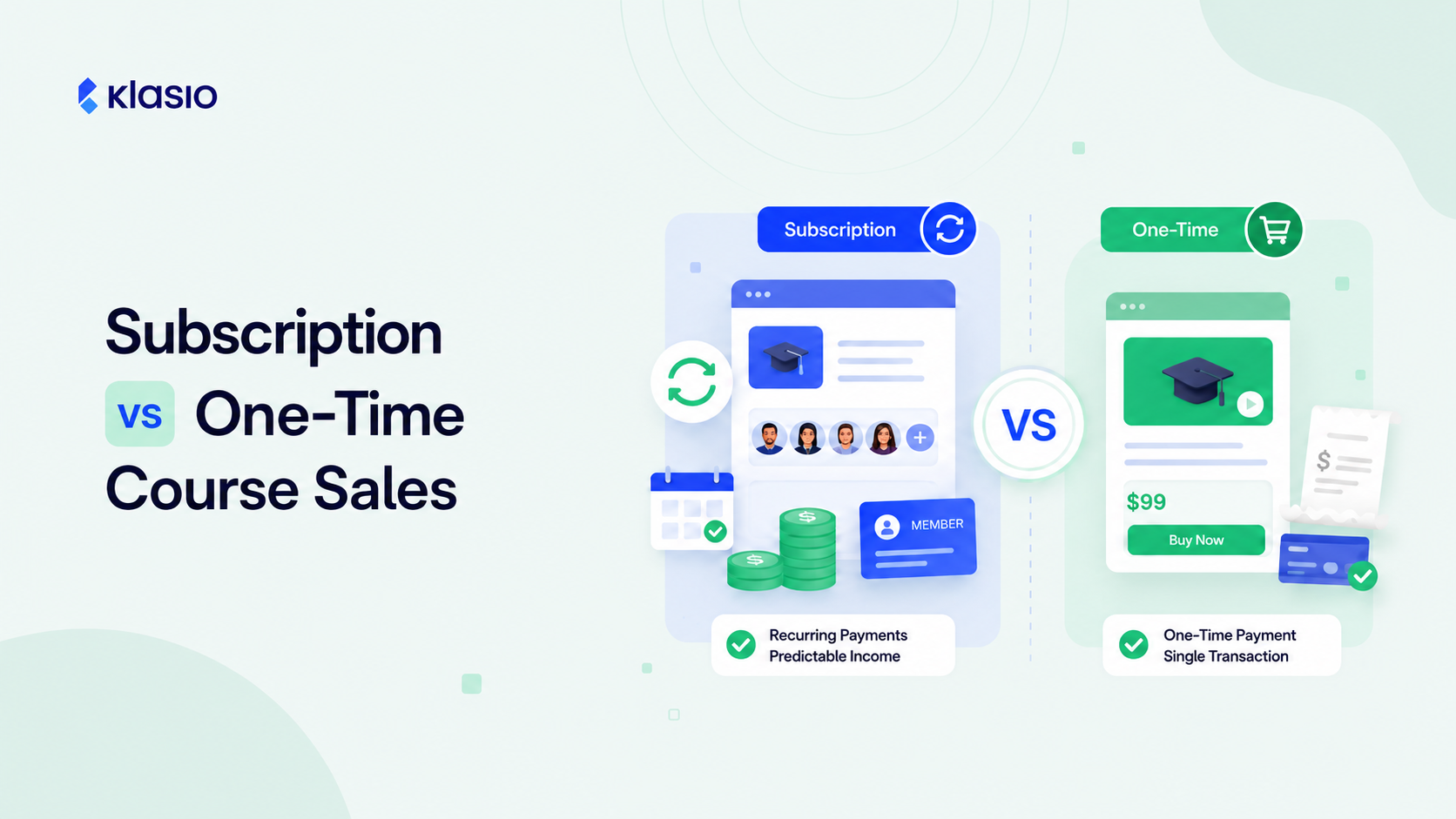
You’ve built a great course, and now you’re stuck on one decision that feels bigger than it should: do you charge once or set up a subscription?
Both sides have loud advocates.
Some creators swear by recurring revenue. Others tell you a clean one-time sale is the only sane way to run a course business.
So you keep going back and forth, second-guessing whichever option you lean toward that day.
That’s why, in this blog, we’ll break down what each pricing model actually does to your revenue, your workload, and the kind of relationship you build with students.
By the end of this blog, you’ll stop guessing. You’ll know exactly which model, Subscription vs One-Time Course Sales, matches your course, your audience, and the business you want to run, and you’ll be able to set your price with confidence.
TL;DR
- Choose One-Time Sales if your course has a clear start, end, and specific outcome – and you want higher conversions without the pressure of constantly creating new content.
- Choose Subscription if you have a growing content library, teach an ongoing skill, and are committed to adding new material regularly to keep students engaged.
- One-time sales convert at a higher rate because a lower ask with a clear endpoint makes the buying decision easier
- Subscriptions generate more predictable income but require you to keep adding new content periodically.
- Most successful creators start with one-time sales and introduce subscriptions later.
- Your content type – not your income goal – should drive this decision.
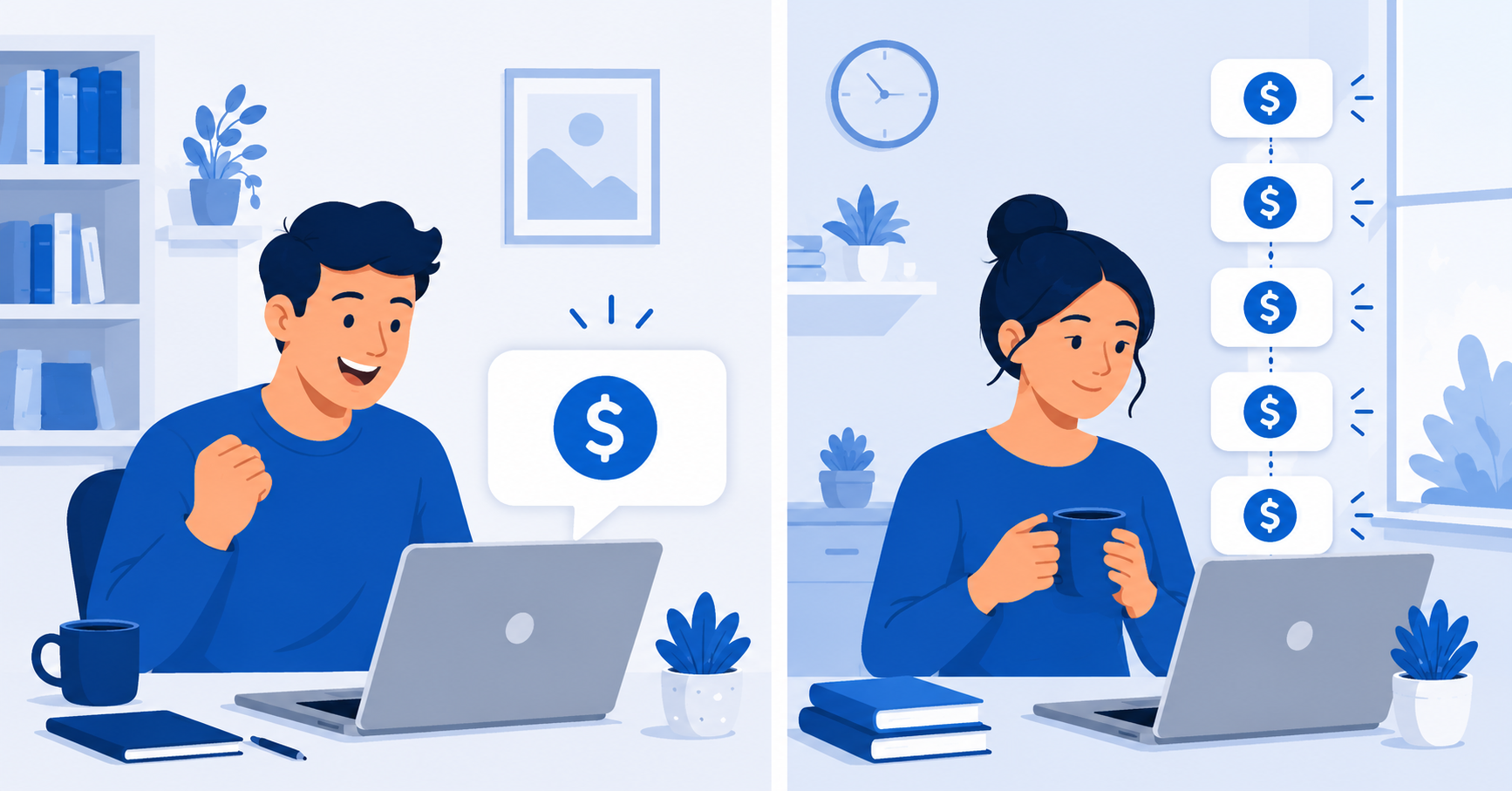
Subscription vs One-Time Course Sales: Quick Comparison Table
| Factors | One-Time Sales | Subscription |
| Revenue type | Upfront payment | Monthly or annual recurring |
| Ease of selling | Easier to convert | Harder to convince |
| Content demand | Build once, keep marketing | Requires new content periodically |
| Student commitment | High – paid in full | Lower – can cancel anytime |
| Income predictability | Unpredictable | Predictable |
| Risk of cancellation | None | Always present |
| Pricing flexibility | Fixed price per course | Monthly, quarterly, or annual plans |
| Best suited for | Single flagship course | Growing content library |
Now, let’s get to know more about the differences between subscription and one-time course sales.
One-Time Pays More Upfront, Subscription Pays More Over Time
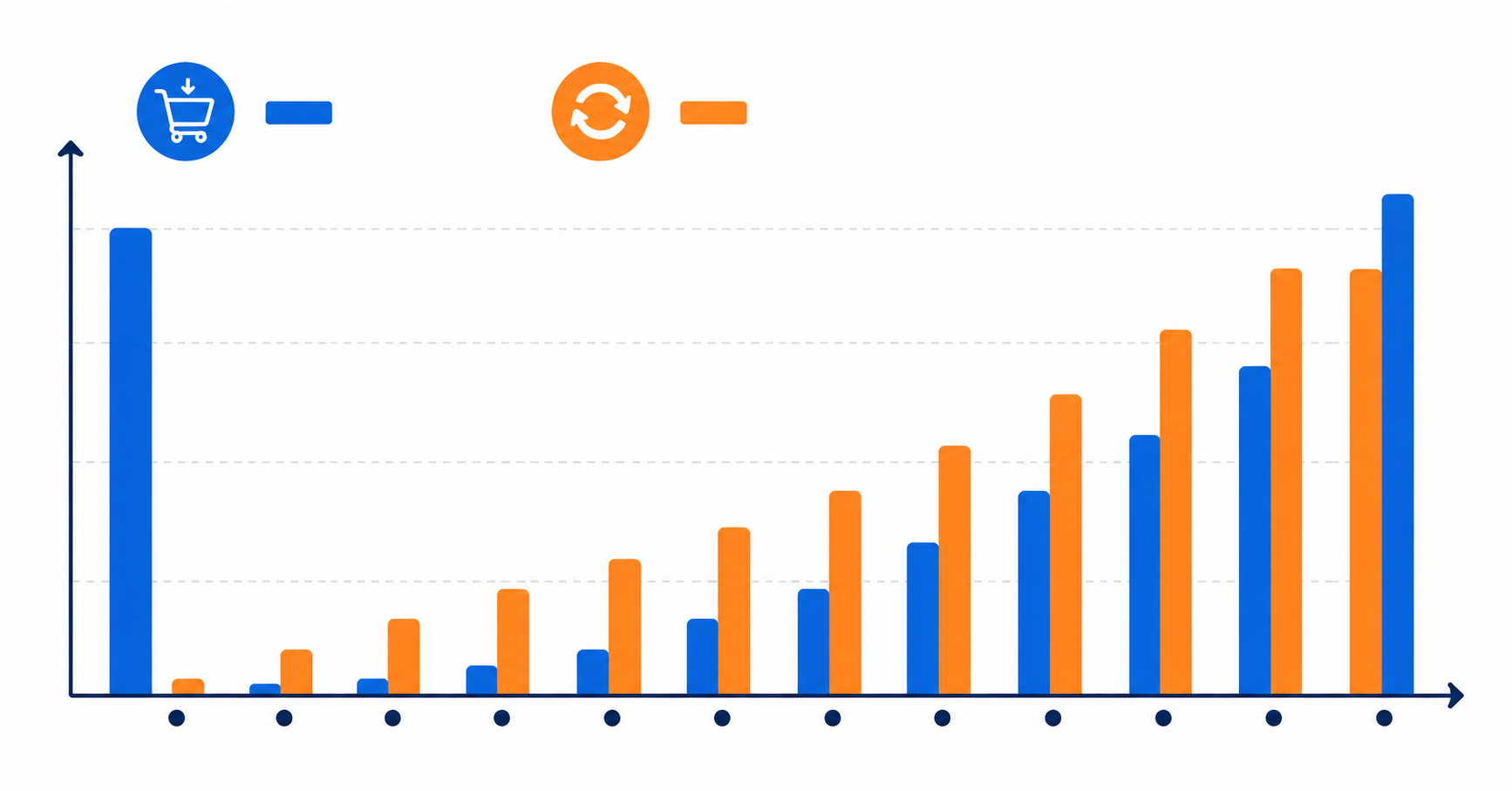
With a one-time sale, a student pays the full price upfront, and the money hits your account immediately. Alternatively, with a subscription, smaller payments come in every month but compound over time.
For instance, a one-time course priced at $200 beats a $20/month subscription if the average student cancels before month ten. But if students stay subscribed for a year or longer, subscription revenue grows far beyond what a single sale brings in.
With one-time pricing models, course creators share the same frustration: income that spikes during a launch and then disappears. You spend weeks preparing, run ads, send emails, students buy, and then it stops. Next month, you start from zero again.
Subscription solves this problem. When students pay every month, your income does not reset to zero. If you have 50 subscribers paying $30 a month, that is $1,500 in revenue before you do a single thing.
Now, the catch is that subscription only earns you more money if students actually stay. According to Kajabi’s 2024 Creator Report, the average course creator earns approximately $37,000 per year. But creators who add subscription models consistently report higher lifetime revenue per student.
So the real question is not which model pays more. It is how long your students will stay subscribed. If you haven’t locked in a price yet, this guide on how to price your online course will help you find the right number before making that call. That depends entirely on how consistently you deliver new content and keep them engaged.
Winner: Subscription for long-term revenue, One-Time for immediate cash flow
One-Time Courses Are Easier to Convert Than Subscription
One-time purchases feel finite. A student knows exactly what they are paying, exactly what they are getting, and exactly when the transaction ends. That clarity makes the buying decision much easier.
Good marketing — especially a well-structured course sales page — can convince a student to pay $200 once. But convincing that same student to pay $20 every month for 12 months requires a completely different level of effort. With one-time sales, you need to convince the student once. With a subscription, you need to do it every month.
That said, subscription has its own conversion advantage for a specific type of buyer. Not everyone can afford to pay $200 upfront. For those students, paying $20 for a month to try the content first is a much easier decision. Subscription lowers the barrier to entry for price-sensitive buyers.
But overall, conversion rates decrease as the financial ask and commitment level increase. A lower ask with a clear endpoint will almost always bring in more buyers faster.
Winner: One-Time Sales
Subscription Requires More Frequent Content Work Than a One-Time Course
With a one-time course, you build it once and focus on marketing. Students still expect your content to be current and relevant but not frequently. With a one-time price, if you update your course in every few years, that would be fine.
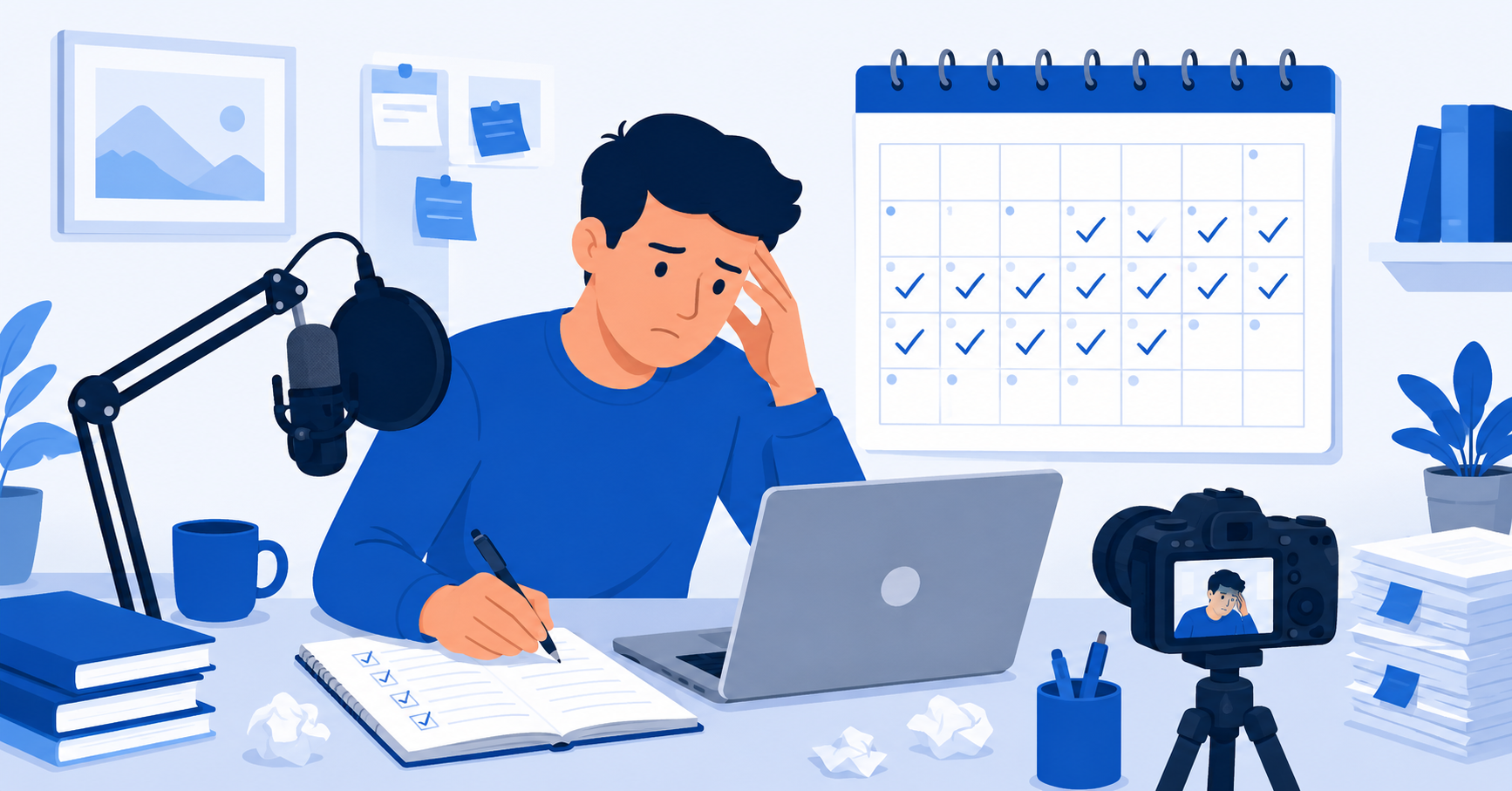
However, a subscription requires a completely different level of commitment. Students who pay a recurring fee expect new content to be added periodically. Not every month, but every few months at minimum.
If your content feels stale, students start questioning whether the subscription is still worth paying for. And when that happens, they leave.
For a solo creator already juggling marketing and student support, that ongoing content commitment can become overwhelming. Before choosing a subscription, honestly ask yourself: can I consistently create new content every few months? If the answer is uncertain, a one-time course is the safer choice.
Winner: One-Time Sales
One-Time Buyers Are More Likely to Complete the Course Than Subscribers
When someone pays a significant amount upfront, they have made a real commitment. That money is gone, and they know it. Most students in this position are more likely to show up and work through the material.
That said, paying more does not always guarantee engagement. Some students pay a high one-time fee and never complete the course. The quality of your content and community matters more than the price tag.
A subscriber paying a smaller recurring fee has a different relationship with your content. The ongoing payment creates a recurring reminder of the value they should be getting. If they are not engaging, they cancel.
Students who pay a higher one-time price do tend to complete courses at a higher rate overall. A high upfront fee forces the student to be serious – they have skin in the game. And a student who finishes your course is far more likely to leave a review and come back for your next one.
Winner: Tie
Subscription Builds a Longer Relationship With Your Students
With a one-time sale, the relationship largely ends after the purchase. A student buys, gets access, and moves on. There is no built-in reason for them to stay connected to you.
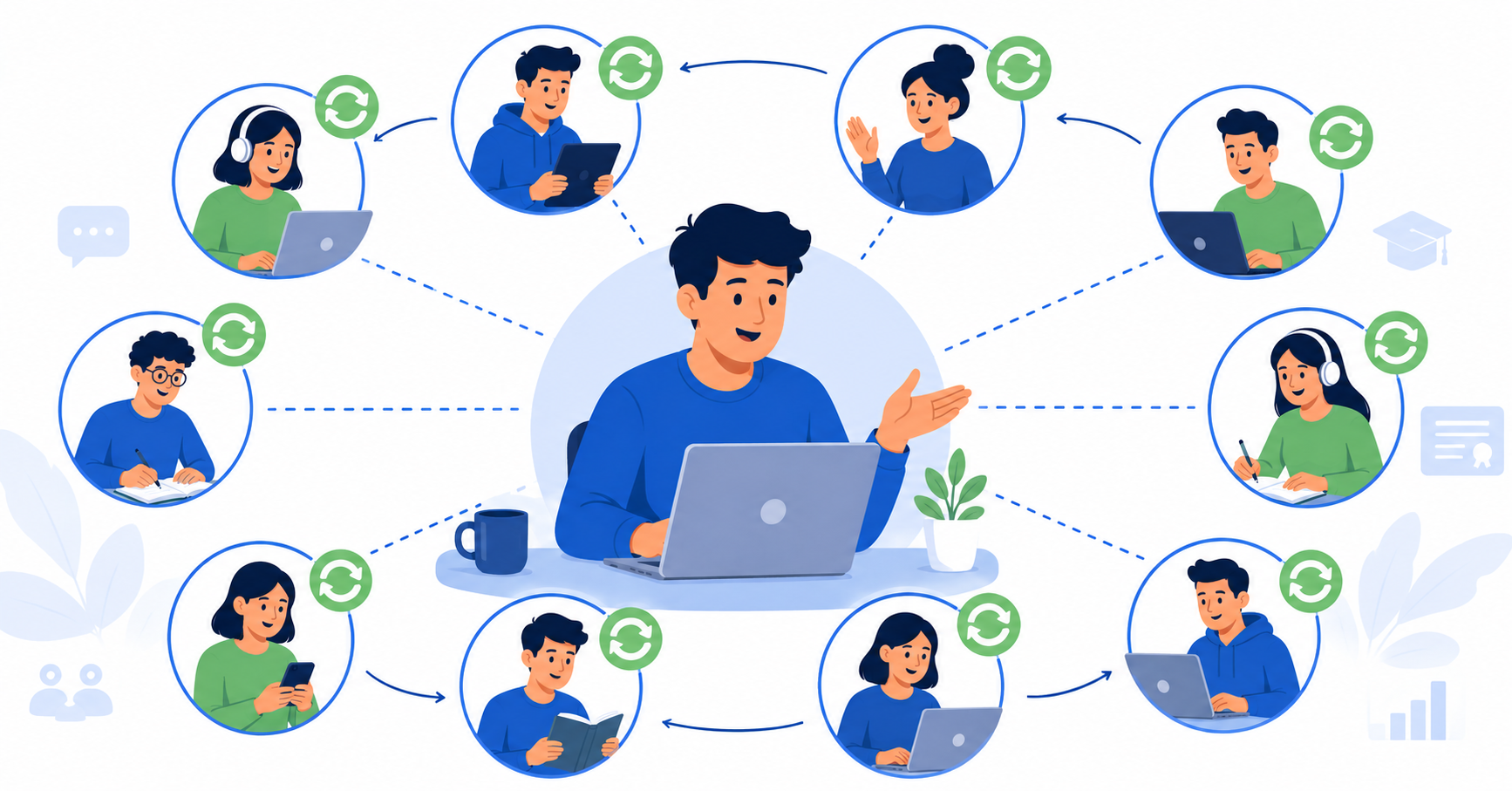
On the other hand, a subscription keeps students in your ecosystem for months or even years. Every month they stay subscribed is another month they are engaging with your content and your brand. That ongoing relationship creates trust over time.
A student who has been subscribed for six months knows your teaching style, trusts your recommendations, and is far more likely to buy anything else you create. One-time buyers rarely have that level of familiarity with you.
This also makes community building much easier. Subscribers show up regularly, participate in discussions, and become advocates for your content. That kind of engagement is very hard to build with a one-time purchase model.
Winner: Subscription
Subscription Offers More Ways to Price Your Offering Than One-Time
With a one-time course, pricing is straightforward. You set a price, students pay it, and they get access. You can also bundle multiple courses together and sell them as a package at a single price.
Subscription gives you additional flexibility on top of that. You can offer monthly, quarterly, or annual plans at different price points. A student hesitant to commit long-term can start monthly, while a more committed student saves money with an annual plan.
You can also bundle courses, digital downloads, and webinars into a single subscription plan. This gives students access to everything for one recurring fee.
This flexibility helps you capture students at different price points. A lower monthly price attracts students who would never pay a high one-time fee. An annual plan brings in more revenue per student over time.
Winner: Tie
Most Creators End Up Doing Both – Here Is Why That Works
Most creators choose a pricing model based on what they want to earn – before they’ve even decided whether to sell on a marketplace or their own LMS, which actually shapes how much pricing control they have. That is the wrong place to start. The right question is: what kind of content are you creating?
If your course has a clear start, end, and specific outcome, a one-time price makes sense. Students are paying for a transformation, and a single fee matches that expectation. Think bootcamps, certifications, or skill-based courses.
If you are building an ongoing course library with regular updates, subscription makes more sense. Students are not paying for one transformation. They are paying for continued access to everything you create.
Many creators start with one-time sales, build an audience, and then introduce subscription alongside their existing courses. A student who buys a single course and loves it is already warm to everything else you offer.
Running both models also captures students at different price points. Some prefer to pay once for a specific course. Others would rather pay a smaller amount periodically for access to everything.
Subscription or One-time: How Klasio Supports Both Models
With Klasio, you do not have to choose one model and stick with it. The platform supports both one-time sales and subscription from the same dashboard.
For one-time sales, you can set a price for any course or offer it for free. Students pay once and get lifetime access to everything included in that course. You can create multiple pricing tiers for the same course, but only the default tier will appear publicly on your course page.
For subscription, Klasio lets you bundle courses, digital downloads, and webinars into a single plan. You can set monthly, quarterly, annual, or custom billing cycles. Students get access to everything included in the plan as long as their subscription is active.
You can also display your subscription plans directly on your site using Klasio’s Page Builder. And from your dashboard, you can track subscribers, view transaction history, and manage access all in one place.

Frequently Asked Questions
What’s the difference between one-time and subscription?
The difference between one-time and subscription is how students pay. With one-time, a student pays once and gets lifetime access to a specific course. With subscription, a student pays a recurring fee – monthly, quarterly, or annually – to access a library of content for as long as they stay subscribed.
What are the benefits of subscription-based courses?
The benefits of subscription-based courses are predictable recurring income, the ability to bundle multiple products together, and longer-term relationships with students. According to Marketing LTB, subscription businesses have a 70% higher customer lifetime value than transactional businesses.
How do subscription courses impact long-term student engagement?
Subscription courses impact long-term student engagement by giving students ongoing access to new content. However, this only works if you consistently add new material periodically. Without fresh content, students lose their reason to stay subscribed.
Which is better, a monthly or yearly subscription?
Annual subscriptions are significantly more profitable for creators. According to Marketing LTB, annual subscribers are 2.4x more profitable than monthly subscribers.
Can I switch from a subscription to one-time sales?
Yes, you can switch from subscription to one-time sales at any time. Many creators run both models simultaneously – one-time for individual courses and subscription for all-access plans.
Why are people canceling subscriptions?
People cancel subscriptions when they feel the content is no longer worth the recurring fee. Common reasons include lack of new content, not using the platform enough, or noticing the charge on their bank statement.




Leave a Reply