

You launched your course subscription. Students are joining. Revenue is coming in.
But every month, a few students quietly disappear. No complaint. No goodbye. Just gone.
One cancellation feels like noise. Two feels like coincidence. By month three, you start doing the math. The number leaving is eroding what you worked hard to build.
This is subscription churn. For course businesses, it is one of the most expensive problems you can ignore.
The tricky part is that churn rarely announces itself. Students do not email saying they are losing interest. Their engagement drops first. Login frequency falls. Lesson completions slow down. The cancel click comes last.
By the time it happens, the decision was already made weeks earlier.
The good news is that churn is manageable. Every subscription business loses subscribers. That is normal. What separates growing course businesses from stagnant ones is how well they understand why students leave and what they do about it before the pattern becomes a problem.
TL;DR
- Subscription churn is the percentage of paying students who cancel within a given period. Every course business has it.
- Two types matter: voluntary churn, where students actively choose to leave, and involuntary churn, where a failed payment ends their access without them deciding to cancel.
- The basic formula: subscribers lost in a period, divided by total subscribers at the start of that period, multiplied by 100.
- No universal acceptable churn rate exists. The most honest benchmark is your own previous period. Are you improving?
- Churn decisions happen before the cancel click. A student who stops logging in is already at risk.
- Fixing involuntary churn from failed payments is the fastest win available. It requires no content changes.
- Long-term retention comes from strong week-one onboarding, consistent content additions, and giving students a reason to stay.
What Subscription Churn Actually Is
Subscription churn is the rate at which paying subscribers cancel or stop renewing within a given period.
For a course business, that means students who were paying you monthly and then stopped. It is measured as a percentage. That percentage tells you how healthy your recurring revenue actually is.
Here is the basic formula: Churn rate = (Subscribers lost / Subscribers at start of period) x 100.
Say you started the month with 200 students on your subscription plan. By the end of the month, 12 had cancelled. Your churn rate for that month is 6%. Simple. But the number behind it matters more than the calculation itself.
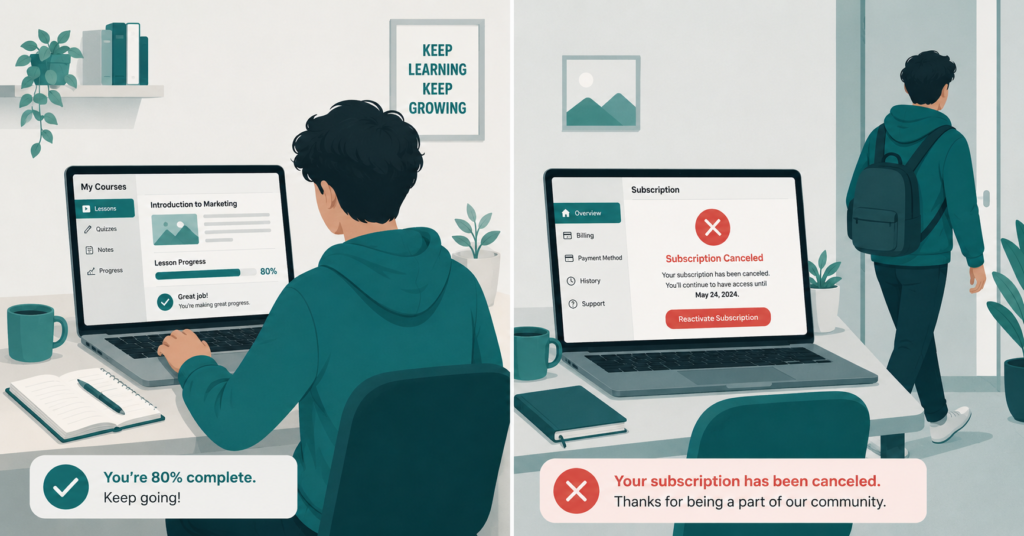
Because churn compounds. A 6% monthly churn rate does not just mean you lose 6% this month. It means you lose roughly 6% every single month. Left unaddressed, that adds up to a significant portion of your subscriber base turning over within a year.
One important thing to keep in mind: churn is not a sign that your course is failing. Every subscription business loses subscribers. Students finish a goal, budgets change, life gets in the way. Some churn is unavoidable.
The problem is not churn. The problem is churn you did not see coming and did not try to prevent.
Why Churn Costs More Than It Looks
Most course creators focus on the front end. Getting more students in. More signups, more enrollments, more revenue from new sales.
Churn is a back-end problem. Back-end problems are quieter, slower, and more expensive in the long run.
Recurring Revenue Only Works If It Recurs
The entire point of a subscription model is predictable, compounding income. Every student who stays adds to a base you can plan around. Every student who leaves takes a monthly payment with them. Not just this month, but every month after.
Losing one student at $29 per month does not feel significant. Losing 15 students over three months at that price means $435 in monthly recurring revenue gone. That number grows quietly while you focus on acquiring new students to replace them.
Retention Costs Less Than Acquisition
Bringing a new student into your subscription costs time, ad spend, content, and attention. Keeping an existing student costs a good experience and consistent value.
When churn runs high, you are forced to spend more on acquisition just to maintain the same revenue. Growing becomes nearly impossible when the floor keeps dropping.
The Cancel Click Is Never the Real Moment
By the time a student cancels, they decided to leave weeks ago. The actual cancellation is the last step of a process that started with disengagement. They stopped completing lessons. They logged in less. The subscription started feeling like an unused charge.
For course businesses, that disengagement window is the real danger zone. A student who has not logged in for two weeks is a churn risk. A student who has not completed a lesson in a month is almost certainly already gone in their mind.
Course Subscriptions Face a Unique Challenge
A SaaS tool gets used because work requires it. A course subscription is optional by nature. Students subscribe because they want to learn. But wanting to learn and making time to learn are two different things.
When life gets busy, the course subscription is one of the first things that feels cuttable. This makes consistent engagement, not just great content, the real retention strategy for course businesses.
Types of Churn That Cost You Most
Not all churn works the same way. Understanding the difference matters because the fix for each type is completely different.
Active Cancellations and What They Signal
Voluntary churn happens when a student actively decides to cancel. They log in, find the cancel button, and end their subscription on purpose. This is the most visible type of churn. It is also the most informative.
When a student chooses to leave, there is a reason. Common triggers include: the student completed their immediate goal, the content stopped feeling fresh, the price stopped feeling worth it, or life got busy and the course became the easiest expense to cut. The pattern behind most voluntary churn is the same. Perceived value dropped below the price.
Recover Subscribers Lost to Payment Failure
Involuntary churn happens when a student loses access not because they chose to cancel but because their payment failed. Expired card. Insufficient funds. Bank block on the transaction.
The subscription renewal attempts to process, fails, and the student gets cut off. Often without fully realising what happened. On Klasio, if a payment fails, access may be suspended and the student receives an email notification. That email is the first recovery touchpoint. Treat it as a signal to follow up personally with high-value students rather than leaving recovery entirely to automation.
Measure Revenue Lost, Not Just Subscribers
Customer churn counts the number of subscribers lost. Revenue churn counts the revenue lost. This matters more when you have multiple pricing tiers.
Losing three students from your $69 plan hurts more than losing three from your $29 plan. Customer churn treats them the same. Revenue churn does not. Once you have more than one pricing tier, track both numbers.
Know Your Numbers Beyond the Headline Rate
Net MRR churn takes revenue lost from cancellations and subtracts revenue gained from upgrades and upsells in the same period. If some students upgraded their plan while others cancelled, net MRR churn gives you the real financial movement.
For most course creators managing a subscription programme, customer churn rate is the number to start with. As your pricing tiers grow and your subscriber base scales, revenue churn becomes the more important number to watch.
Calculate Your Churn Rate Correctly
Knowing your churn rate is not optional. You cannot reduce a number you are not measuring. The calculation is straightforward.
Start With Customer Churn
This tells you what percentage of your subscribers left in a given period.
Formula: (Subscribers lost / Subscribers at start of period) x 100. Example: you start the month with 150 students. By the end of the month, 9 have cancelled. (9 / 150) x 100 = 6% monthly churn rate. Run that same rate for twelve months and the compounding effect becomes a serious problem.
Add Revenue Churn When You Have Multiple Tiers
Formula: (Revenue lost / Total revenue up for renewal) x 100. Example: your total subscription revenue up for renewal is $8,000. You lost $640 from cancellations. (640 / 8,000) x 100 = 8% monthly revenue churn.
Say you have a $29 plan and a $69 plan. Three students cancelled from the $69 tier and two from the $29 tier. Customer churn shows five cancellations. Revenue churn shows you lost $265. A very different picture from what the headcount suggests.
Pick a Reporting Window and Keep It
If every student pays the same price, customer churn rate is enough. One number tells the full story.
If you have multiple pricing tiers, track both. More importantly: pick a reporting window. Monthly works well for most course businesses. Measure the same way every period. Churn data is only useful when you can compare it across time. A trend tells you everything. A single number in isolation tells you nothing.
What a Good Churn Rate Looks Like
This is one of the most searched questions about subscription businesses. The honest answer is: there is no single number that applies to everyone.
Churn rates vary by industry, price point, contract length, and how long a business has been running. A number that signals danger for one business is completely normal for another.
Your Own Previous Period Is the Best Benchmark
Before comparing yourself to any external figure, compare yourself to your own previous period. Is your churn rate lower this month than last month? Lower this quarter than the previous one?
A course business with 7% monthly churn that is trending down is in a healthier position than one with 4% churn that is trending up. Direction matters more than the number itself.
Annual Plans Change the Whole Equation
A student on a monthly plan has twelve opportunities per year to decide whether the subscription is worth it. A student on an annual plan has one.
Annual subscribers are more committed from the start. They made a bigger financial decision upfront and are more motivated to get value from it. Shifting even a portion of your subscriber base from monthly to annual billing is one of the most effective structural changes you can make to reduce churn, before touching a single piece of content.
A Rough Target for Course Businesses
While no universal benchmark exists, course businesses running subscription models should generally aim to keep monthly churn below 5% to 8%. Consistently below 3% is strong for a content-based subscription.
These are directional targets, not rules. The question to ask every month: is the number of new subscribers larger than the number who left? If yes, your subscription business is still moving forward.
Factors That Push Your Churn Rate Up
Churn does not happen randomly. There are specific conditions that push it up and specific conditions that keep it down.
Weak Onboarding Drives Early Cancellations
Students who engage early, complete the first lesson, explore the platform, and understand what they are getting, are significantly more likely to stay past month two.
Students who sign up and do nothing in week one rarely survive to month three. They never build the habit. The subscription never becomes part of their routine. When the next billing cycle arrives, cancellation feels easy because the course never felt essential.
Stale Content Makes Subscribers Reconsider
A subscription implies ongoing value. Students are not paying once for a finished product. They are paying every month for something that should keep giving them reasons to stay.
When content stops updating, the subscription starts to feel like a one-time purchase with a recurring charge. At that point the student’s mental calculation shifts. They ask whether there is anything left to get from this. If you are still deciding which model fits your content type, this guide on subscription vs one-time course sales will help you make that call first.
The Gap Between Price and Perceived Value
Every month when the charge appears, a student makes a fast, often unconscious decision: is this worth it?
If they have been logging in regularly, completing lessons, and making progress, the answer is usually yes. If they have not opened the platform in three weeks, the charge feels unjustifiable. The issue is rarely the price itself. It is the gap between what the student is paying and what they feel they are getting.
Isolated Learners Leave Faster
A student who is part of a group, with peers in the same course, who sees others making progress and feels like they belong, has more reasons to stay than just the content itself.
Community creates switching costs that content alone cannot. Leaving a course is easy. Leaving a community you are part of is harder.
Payment Friction Causes Silent Exits
Involuntary churn rises when payment failures go unaddressed. An expired card or a declined transaction can end a subscription for a student who had no intention of leaving.
The faster a payment issue is caught and resolved, the less involuntary churn costs you. Every day without resolution is a day closer to losing that subscriber permanently.
No Visible Progress Removes the Reason to Stay
Students who can see how far they have come are harder to lose than students who feel stuck or directionless. Progress bars, completion milestones, certificates, and recap emails make results feel tangible.
When a student can see that they have completed 60% of the course, cancelling feels like giving something up. When there is no visible progress, cancelling feels like stopping a charge. The experience of the two is completely different.
Churn Metrics Worth Tracking
Measuring churn rate is a start. But one number alone does not tell you enough to act on. The goal is to understand not just how many students left but when they left, why they left, and what their departure actually cost you.
Customer Churn Rate: Your Baseline
This is the percentage of subscribers who cancelled in a given period. It gives you the headline number and is the first metric to establish before anything else.
Track it monthly. Compare it to the previous month. Look for direction. A single month’s number is noise. A three-month trend is a signal.
Revenue Churn Rate: The Financial Impact
Once you have more than one pricing tier, customer churn rate alone becomes incomplete. Revenue churn tells you the financial impact of the students who left.
Track this alongside customer churn. If your customer churn is holding steady but your revenue churn is climbing, it means you are losing higher-paying students at a disproportionate rate. That is a different problem requiring a different response.
Cohort Analysis: When Students Actually Leave
Cohort analysis measures churn within a specific group of students who joined at the same time. Of all students who subscribed in January, how many cancelled by month two? By month four? By month six?
This tells you exactly where in the subscription lifecycle your students are most likely to leave. Early drop-off in months one to two usually points to onboarding problems. Mid-cycle drop-off around months four to six usually points to content freshness and engagement problems. Knowing which pattern your business has tells you precisely where to focus your retention effort.
Cancellation Reasons: The Most Underused Data Point
When a student cancels, asking why gives you information no dashboard can surface. A simple exit survey with a few options, such as too expensive, not enough time, finished what I needed, or content not what I expected, turns raw churn data into actionable insight.
If 60% of cancellations cite ‘not enough time,’ that is an engagement and scheduling problem. If 40% cite ‘finished what I needed,’ that is a content depth problem. Each answer points to a different fix. Do not guess why students leave. Ask them.
Customer Lifetime Value: The Full Picture
Customer Lifetime Value ties all of the above together. It tells you the total revenue a subscriber generates over the full duration of their subscription.
Formula: LTV = Average monthly revenue per subscriber / Monthly churn rate. A student paying $49 per month with an average subscription length of eight months has an LTV of $392. If your acquisition cost per student exceeds that number, your subscription model has a structural problem no retention tactic can fully fix.
How to Reduce Subscription Churn
Knowing your churn rate and understanding why it happens are the first two steps. This section is the third: what to actually do about it.
The fixes split cleanly by churn type. Voluntary churn and involuntary churn have different causes and need different responses.
Onboard With Intention
The first week determines whether a student reaches month two. Most course businesses send a welcome email and leave the rest to the student. That is not onboarding. That is hoping.
Intentional onboarding gives a new subscriber a clear path from day one: start here, complete this, get this result. Students who get an early win, even a small one, build momentum. Students who feel lost in week one quietly disappear by week three. A welcome email on day one with a specific first step, a check-in on day three, and a progress prompt on day seven is more than most course businesses do.
Keep Content Moving Forward
A subscription implies ongoing value. If your course content has not changed in three months, a student who has completed the existing material has no new reason to stay.
Add new lessons regularly. Host live sessions. Update existing modules when the topic evolves. Even a short new addition signals to subscribers that the subscription is alive and that staying is worth it.
Re-engage Before the Drop-off
Watch for the warning signs. A student who has not logged in for 14 days is a churn risk. A student who has not completed a lesson in three weeks is almost certainly disengaging.
A re-engagement email at the 14-day mark, not a generic newsletter but a direct message that acknowledges the gap and offers a specific next step, can bring a student back before they reach the cancel button.
Make Progress Visible at Every Stage
Students who can see how far they have come are harder to lose. Progress bars, completion percentages, milestone emails, and certificates make results feel tangible and real.
When a student is at 65% completion and can see it, cancelling feels like abandoning something. When there is no visible progress, cancelling feels like stopping a charge. The experience of the two is completely different.
Push Annual Plans to Cut Monthly Reconsideration
A student on a monthly plan reconsiders their subscription twelve times a year. A student on an annual plan reconsiders once. Offer a meaningful discount for annual commitment, not a token 5% but something that genuinely changes the calculation. According to Marketing LTB, annual subscribers are 2.4x more profitable than monthly subscribers. Students who switch to annual plans churn at dramatically lower rates and give you more predictable revenue to plan around.
Act on Failed Payments Immediately
When a payment fails, the clock starts. On Klasio, a failed payment triggers an automatic email notification to the student per the platform’s billing terms. That email is the first recovery touchpoint.
Do not leave recovery entirely to automation. For high-value students, a personal follow-up message from you, direct and without pressure, significantly increases the chance of payment recovery. Make the path to updating payment details as simple as possible.
Use a Grace Period Before Suspending Access
Suspending access the moment a payment fails is the fastest way to turn an involuntary churner into a permanent one. A student who loses access abruptly often does not come back, even if they intended to fix the payment.
A short grace period of three to five days gives the student time to notice the issue, update their details, and continue without feeling punished for a technical problem they may not have caused.
How Retention Leaders Think About Churn
The largest subscription businesses in the world did not get to scale by acquiring their way out of churn. They built systems specifically designed to keep subscribers engaged, recover lost payments, and make cancellation feel like a loss rather than a relief.
The tactics they use are not exclusive to large companies. The logic behind them translates directly to course businesses.
Make Outreach Feel Personal, Not Broadcast
Netflix does not wait for subscribers to get bored. When you have not watched anything in a while, it surfaces content matched specifically to your viewing history. The message is always the same: there is something here for you right now.
For course creators, the equivalent is a targeted message to a specific student based on where they are in the course. A student who completed Module 2 three weeks ago and has not returned gets a message about Module 3, not a general newsletter about something unrelated.
Give Students Data About Their Own Progress
Spotify’s strongest retention tool is Wrapped. It is the annual summary showing every user exactly how they used the platform over the past year. The insight behind it is simple: people stay when they feel ownership over something.
A student who has completed 12 lessons, earned two certificates, and logged 18 hours on your platform has an investment to protect. Showing them that data makes leaving feel like giving something up.
Create Pull With Milestones and Momentum
Duolingo built its retention model around streaks. Missing a day does not just interrupt progress. It breaks something the student was actively protecting. The streak turns a passive user into someone with a reason to return every single day.
Course businesses can apply the same principle. A student working toward a visible milestone, such as 10 lessons completed, a certificate, or progress through a defined learning path, has a pull to keep going. On Klasio, you can build subscription plans around a library of courses and webinars that gives students structured progression to move through, which naturally creates that forward momentum.
The Logic Behind All Three
Netflix does it through personalization. Spotify does it through ownership and reflection. Duolingo does it through streaks and momentum. All three use different tactics but the same underlying logic: make staying feel valuable and make leaving feel like a loss.
For your course business, the question is the same: what does your subscriber stand to lose by cancelling? If the answer is just access to content they have not been using, churn will stay high. If the answer is progress, community, momentum, and a visible result they are working toward, retention becomes much easier to sustain.
Your Subscription Plans, Your Dashboard
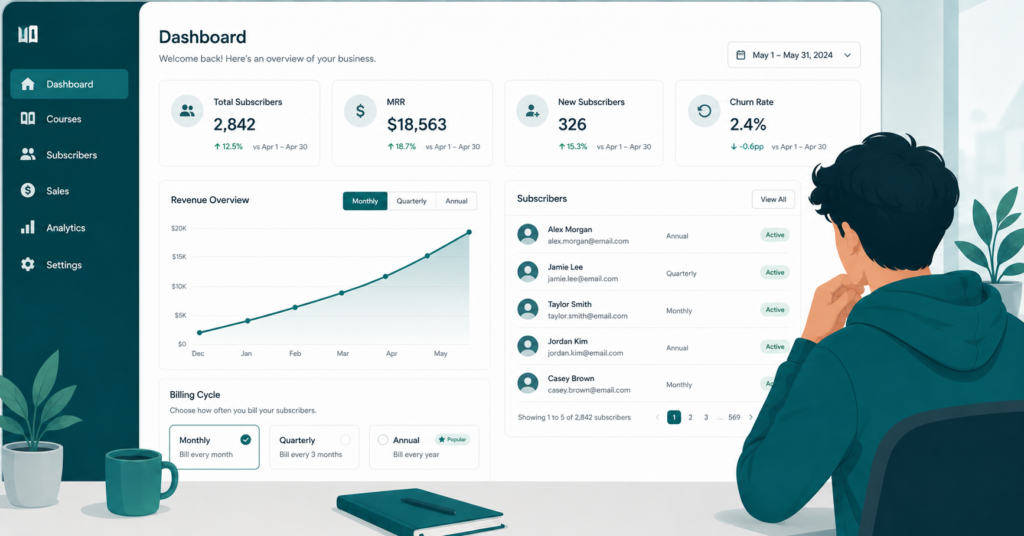
Managing churn starts with having clear visibility into your subscriber base. From your Klasio dashboard, you can track subscribers, view transaction history, and export your data whenever you need it.
For the subscription structure itself, Klasio lets you bundle courses, digital downloads, and webinars into a single plan. You can set monthly, quarterly, annual, or custom billing cycles. Displaying your plans on your academy website is handled through the built-in subscription card in Klasio’s Page Builder. No custom coding needed.
Choosing the right billing structure is one of the simplest ways to reduce churn before you ever change a piece of content. Annual billing reduces how often your students reconsider their subscription. If you have not yet set your pricing, this guide on how to price your online course will help you find the right number before making that call.
Start your free trial on Klasio today.
Frequently Asked Questions
What is subscription churn?
Subscription churn is the percentage of paying subscribers who cancel or stop renewing within a given period. For course businesses, it measures how many students leave your subscription plan each month or year. It is calculated by dividing the number of subscribers lost by the total number of subscribers at the start of the period, then multiplying by 100.
What is the difference between voluntary and involuntary churn?
Voluntary churn happens when a student actively chooses to cancel. Involuntary churn happens when a payment fails. An expired card, insufficient funds, or a bank block causes the subscription to lapse automatically without the student intending to leave. Both types reduce your subscriber count but require completely different fixes.
What is a good churn rate for an online course subscription?
There is no universal number. Churn rates vary by price point, contract length, and how mature the business is. As a directional target, course businesses running monthly subscriptions should aim to keep churn below 5% to 8% per month. Consistently below 3% is strong. The most useful benchmark is your own previous period. Is your churn rate improving over time?
How do I calculate my subscription churn rate?
Use this formula: subscribers lost in a period, divided by total subscribers at the start of that period, multiplied by 100. Example: if you started the month with 200 students and 14 cancelled, your monthly churn rate is 7%. If your subscription has multiple pricing tiers, also calculate revenue churn to understand the financial impact, not just the headcount.
What causes high churn in online course businesses?
The most common causes are weak onboarding in the first week, content that stops updating, low student engagement, and no visible progress for the subscriber. Involuntary churn from failed payments is also a significant and underestimated contributor. Churn usually builds from a combination of low engagement and a subscription that stops feeling worth the monthly charge.
How do I reduce involuntary churn?
Act on failed payments immediately. Notify the student the same day a payment fails and give them a clear, frictionless path to update their payment details. Use a short grace period of three to five days before suspending access so students have time to resolve the issue without feeling cut off. For high-value students, a personal follow-up message alongside the automated notification significantly improves recovery rates.
What is net revenue churn?
Net revenue churn is the revenue lost from cancellations and downgrades in a given period, minus the revenue gained from upgrades and upsells during the same period. If existing subscribers upgraded their plans while others cancelled, net revenue churn gives you the real financial movement rather than just the gross loss. Net revenue churn can be negative, meaning expansion revenue from upgrades outpaced losses from cancellations, which is a strong indicator of a healthy subscription business.
Are subscription businesses more profitable long-term?
Subscription businesses tend to generate more value per customer over time compared to one-time sales models. According to Marketing LTB, subscription businesses have a 70% higher customer lifetime value than transactional businesses. That advantage only holds if your churn rate stays low enough for subscribers to stick around long enough to deliver that value.




Leave a Reply