
You launched a $39 monthly subscription course. Thirty-two students joined in the first week. Three weeks later, five had finished every module and canceled before their second charge. Another twelve barely started, then disappeared. Sixteen students were gone.
The problem? They left for opposite reasons. Some moved too fast. Others moved too slow. But both groups faced content at the wrong time.
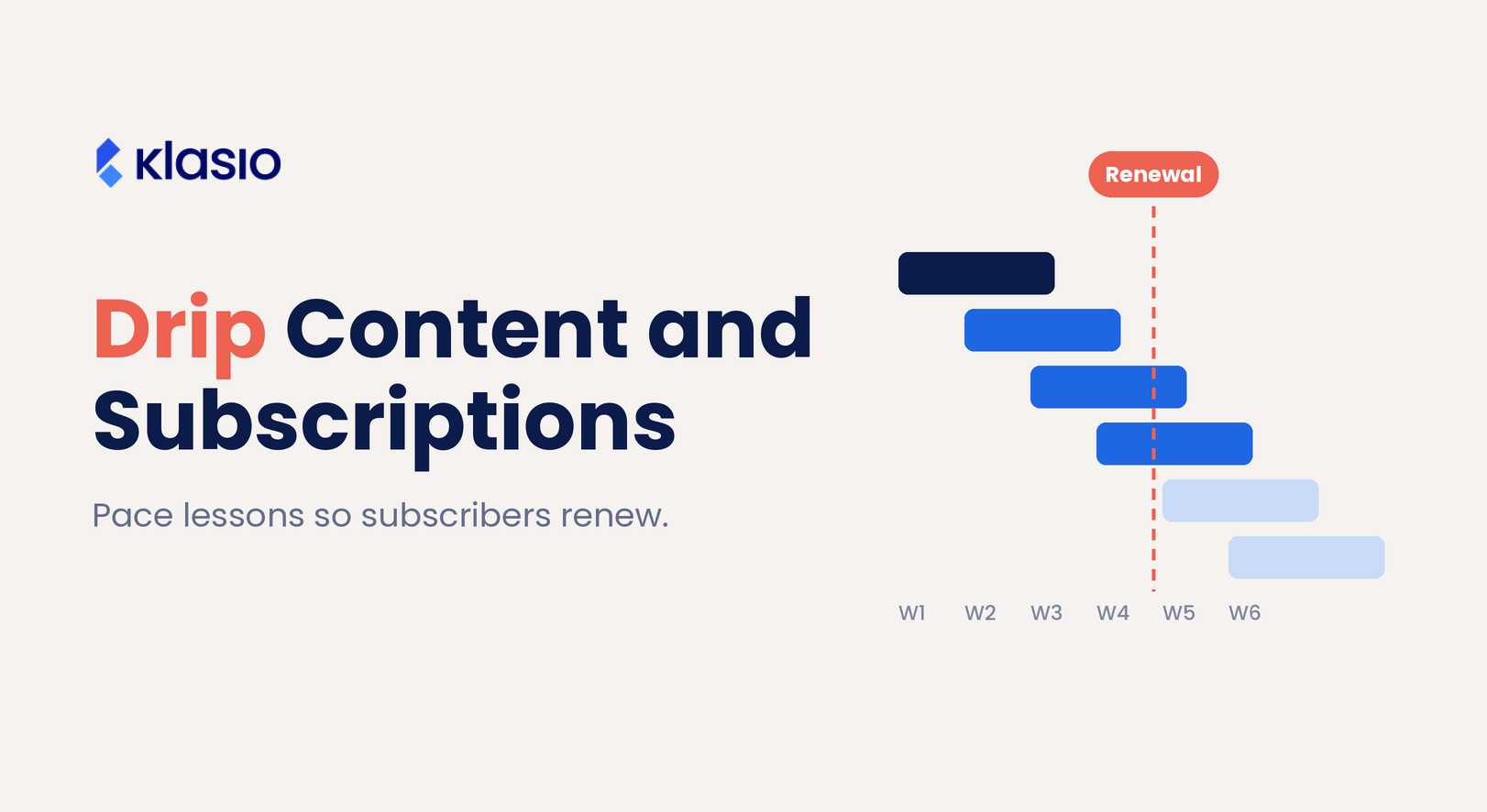
Drip content fixes this by controlling when lessons become available. For subscription courses, that schedule affects more than learning. It can directly impact renewals. This guide shows how to align your drip schedule with your billing cycle so students learn at the right pace and stay subscribed longer.
TL;DR
- Drip content controls when lessons unlock. For subscription courses, the timing directly affects whether students renew or cancel.
- Two pacing mistakes cause most cancellations. If it’s too fast, students consume everything and leave. When it’s too slow, it makes them forget you exist.
- Your drip schedule should connect to your billing cycle. Every billing period needs to deliver enough value to justify the next charge.
- A hybrid approach often works best for many. Keep the core curriculum open. Drip supplementary content like assignments, live sessions, or bonus material.
- Students also need something useful to do between drips. Community threads, practice challenges, or a short live call prevent dead air.
- Not every subscription course needs drip content. Reference libraries and self-paced programs often retain better with full access.
What Drip Content Actually Changes for a Subscription Course
If you’ve ever binge-watched a whole season on Netflix in one night, you already understand the problem drip content solves.
Drip content is simple. Instead of giving students everything at once, you unlock lessons on a schedule. Module one on enrollment day. Module two a week later. Module three the week after. You decide the pace.
Now, if you sell a one-time course, this is purely a teaching decision. You pick whatever schedule helps students learn best. The money side doesn’t change. They already paid.
But the moment you attach a subscription to your course, everything shifts. Every module you hold back gives your student one more reason to keep paying next month. And every module you release too slowly? That’s a week where they see zero new value. That’s when they start wondering why they’re still subscribed.
Think about your own gym membership for a second. If you pay every month but only go once, you cancel. Your course works the same way. If a billing period passes and your student gained nothing new, that payment feels like a waste. They won’t stick around for the next one.
So here’s the tension you’re managing. Your drip schedule needs to give students breathing room to absorb each lesson. At the same time, it needs to deliver enough new value between each payment to justify the next charge. Too fast and students binge. Too slow and they drift away.
Here’s a good test. Ask yourself: what does your student get in month six that wasn’t available in month one? If you can’t answer that clearly, drip content alone won’t save your retention. The schedule matters, but the answer to that question matters more. If you want to dig deeper into how subscription economics work for course creators, the Klasio guide on course subscription business models covers the full picture.
Why Subscribers Cancel When the Pace Goes Wrong
Let’s talk about the three ways bad pacing kills a subscription. You’ve probably already seen at least one of these in your own numbers.
The binge-and-leave problem
You see a student enrolled on Monday. And by Wednesday, they’ve finished every module you had. By Thursday, there’s nothing left. At this point they got what they came for. Why would they pay for another month?
You might think this is rare. It isn’t. Systeme.io reported that one $29/month skill membership saw churn drop from 9% to 4% after switching from full access to a weekly drip. Look at what that single change did to the numbers:
| Metric | Full access (9% churn) | Weekly drip (4% churn) |
| Average student lifetime | ~11 months | ~25 months |
| Revenue per student at $29/mo | $319 | $725 |
| Monthly replacements needed (200 subs) | ~18 students | ~8 students |
One scheduling decision. More than double the lifetime value. Half the acquisition pressure. That’s what pacing can do.
The drift-and-forget problem
This one’s harder to catch because there’s no warning sign.
Your student finishes module two. The next one doesn’t unlock for two weeks. Life gets busy. Your email notification lands in spam. Two weeks of silence is all it takes to break the habit.
You’ll never hear from this person. They won’t complain. They won’t ask for a refund. They’ll just stop logging in. Then the card expires, or they notice the charge on a bank statement, and they quietly cancel.
At least a binge-and-leave student shows up with high engagement before they go. The drifting student? Nothing. They just fade out.
The completion cliff
This is the one almost nobody talks about, and it might be the most dangerous one.
Your course has a last module. Think about what happens the day your student finishes it. Their subscription just lost its purpose.
Say you have eight modules on building a sales funnel. Your monthly subscriber finishes module eight in week ten. Their next billing date is in four days. Why would they stay? They cancel, and you lose that payment.
Flip the scenario. If they finish right after a renewal charge, you collected a full month for content they no longer need. That creates resentment. And a refund request.
Here’s the honest truth: if all the value is available on day one and nothing changes afterward, you don’t really have a subscription. You have a finished product with a recurring bill. The closer your course is to a “finish line” model, the more carefully you need to time that last module against your billing dates.
Match Your Drip Schedule to Your Billing Cycle
Here’s where most drip content advice falls short. Everyone tells you to pick a schedule that supports good learning. That’s fine for a one-time course. But you’re running a subscription. The schedule also needs to make financial sense.
Start with simple math. Take your total modules and divide by the billing cycles you want to earn.
| Scenario | Modules | Release pace | Course duration | Billing cycles earned |
| Weekly drip | 12 | 1 per week | 12 weeks | 3 months |
| Biweekly drip | 12 | 1 every 2 weeks | 24 weeks | 6 months |
| Weekly drip, bigger course | 24 | 1 per week | 24 weeks | 6 months |
| Monthly drip | 12 | 1 per month | 12 months | 12 months |
See the trade-off? The weekly drip with twelve modules gives you three months of revenue. Biweekly doubles it to six. But that longer gap between lessons might lose your students to the drift problem.
The right pace depends on what each module asks from your student. A module with a two-hour hands-on project earns a full week of wait time. A ten-minute video doesn’t. The workload has to justify the gap.
If you’re charging monthly
Your monthly subscribers can cancel after any cycle. Every single month needs to earn its place. That means at least two meaningful content drops per month. One lesson per month feels thin, even if it takes hours to complete.
Here’s why. Students measure value partly by activity. A month with one event feels quiet. It feels like nothing’s happening. A good rhythm is one module per week, plus a practice task or community prompt on the off days. Four touchpoints per month keeps your course in their routine.
If you’re charging annually
The pressure flips when someone pays upfront for a year. You’re not stretching content across billing cycles anymore. You’re trying to deliver enough value across twelve months so they renew.
Dripping the same twelve modules across a full year, one per month? That feels painfully slow. Annual subscribers already committed. They want to see progress. Release the core content faster and fill the remaining months with live sessions, updated material, or community events.
The Klasio comparison of annual vs monthly subscription billing walks through the retention math behind each interval. Your average retention in months tells you exactly how many content drops you actually need.
Can you actually keep this up?
Before you set any schedule, ask yourself one honest question. Can you produce enough content to sustain this?
A weekly drip on a monthly subscription means four meaningful drops every month. Every single month. For as long as students keep subscribing. If you run out of material before your average student churns, you’ve got a production problem, and no drip schedule fixes that.
Plan your content calendar alongside your drip schedule. If the calendar has gaps, fill them with live elements or seriously consider whether a subscription is even the right model for this course.
Five Drip Schedules That Work for Subscription Courses
There’s no one-size-fits-all schedule. The right model depends on how your students enroll, how your billing works, and whether your content has a finish line or keeps growing.
| Schedule type | Best for | Biggest trade-off | Prevents bingeing? |
| Fixed calendar | Cohort courses with shared timelines | Late enrollees feel left behind | Yes |
| Enrollment-based intervals | Evergreen courses, rolling signup | Group activities are hard to coordinate | Yes |
| Progress-based unlocks | Self-paced courses, varying speeds | Fast students can still binge | Only with a time delay added |
| Hybrid (core open, extras dripped) | Courses with live or coaching elements | You need to keep producing extras | Partially |
| Seasonal content drops | Content libraries, not structured courses | Students lack a clear path | No |
Fixed Calendar Releases
Everyone sees the same module on the same date. Module one opens September 1. Module two opens September 8.
This is great for cohort-based subscriptions. Live calls are easier because everyone’s on the same topic. Group discussions stay focused. Peer feedback actually lines up.
But late enrollees struggle. If someone joins two weeks in, they see several unlocked modules and don’t know where to start. Run enrollment windows. Close them before the course gets too far ahead.
Enrollment-Based Intervals
Your student’s clock starts the day they enroll. Module two unlocks seven days after signup. Module three seven days after that. Calendar dates don’t matter.
This is the most popular model for evergreen subscription courses. Set it up once and it runs itself. No cohort windows. No enrollment deadlines.
The downside is isolation. Every student is on a different timeline, so group activities are tough. If community matters to your course, tie discussion threads to each module instead of each week. That way your student finds relevant conversations waiting when they reach a new module.
Progress-Based Unlocks
The next module only opens after the student finishes the current one. No timer. A fast student hits module four in a week. A slower student takes a month.
This respects the student’s pace. Nobody waits because an arbitrary clock hasn’t run down. But it does nothing to stop bingeing. If that concerns you, add a minimum time delay. Require completing module two AND waiting five days before module three opens. That gives students control without letting them burn through everything in 48 hours.
Hybrid: Core Open, Extras Dripped
Give students full access to the main curriculum from day one. Then drip supplementary content on a schedule. Weekly assignments, coaching prompts, live recordings, bonus workshops.
This avoids the biggest complaint about drip content: “I’m paying for this, why can’t I see it?” The core is always available. The dripped extras are what keep people subscribed month after month.
This model works especially well if you sell your finished course as a one-time purchase and add ongoing benefits in a recurring tier. The core stays permanent. The extras renew. Students get full value on day one, and they keep getting fresh reasons to stay.
Seasonal Content Drops for a Content Library
Instead of dripping individual lessons, release a batch of new content each month or quarter. Think of it like a magazine subscription. Each “issue” is a new collection of tutorials, case studies, or resources.
This fits subscriptions that work more like a library than a structured course. A photography library adds ten new videos monthly. A marketing membership drops a new case study every two weeks.
The risk? Students have no clear path. A growing library feels overwhelming. Pair seasonal drops with a “start here” section so new subscribers know where to begin.
Keep Subscribers Engaged Between Drips
Here’s where most course creators lose their subscribers. And it’s not during the lessons.
It’s between them.
Your student finishes a module on Tuesday. The next one doesn’t unlock until Monday. That’s six days of silence. Six days with no reason to open your platform. Six days where your course slides further down their priority list.
By the time Monday arrives, the habit is already broken. So how do you fill those gaps?

Run a weekly live session
A 30-minute Q&A call or casual office hour does more for retention than you’d expect. You don’t need a polished presentation. Just answer questions. The consistency matters more than the content. A recurring event on the calendar keeps your course in their weekly routine. That routine is your best defense against drift.
Seed your community with specific prompts
A “share your thoughts” thread gets ignored. A specific prompt tied to the current module gets responses. Try: “Post your first course outline draft and tag one person for feedback.”
That gives your student a task, a social obligation, and a reason to come back tomorrow. One prompt creates three interactions. None of them required new content from you.
Send emails that actually tell people what to do
Compare these two notifications:
| Generic | Useful |
| “New content is available. Log in to view.” | “Module 3 is live. You’ll build your first email sequence this week. Budget about 90 minutes. Module 4 drops next Thursday.” |
The first tells them nothing. The second sets expectations, creates urgency, and gives a clear next step.
Give them something to do between modules
A worksheet that takes 30 minutes extends a module’s value by days. A short quiz gives your student a feeling of progress even when nothing new has dropped. If your module covers email marketing, include a fill-in-the-blank template. Twenty minutes of customization, almost zero effort to create.
When Drip Content Hurts Your Subscription
Let’s be honest. Drip content isn’t always the right call. Sometimes it can actively hurt your subscription. Knowing when to skip it matters just as much as knowing how to use it.
Reference libraries don’t need drip
If a student subscribes to a design tutorial library, they need the color theory video now. Not in three weeks when your schedule unlocks it. Making them wait means they find the answer somewhere else. Or they feel like you’re holding their own purchase hostage.
Watch out for the “payment plan in disguise”
If you wrote all your content upfront and you’re dripping it over six months just to keep people subscribed, you’re not running a subscription. You’re running a payment plan with a marketing label.
Memberful’s Drew Strojny says it bluntly: if you’re not committed to adding new content at the rate of your renewal, sell it as a one-time purchase. He’s right. Drip content should exist because the student benefits from pacing. If the only reason you’re holding content back is to delay cancellations, the schedule serves your bank account, not your student.
Some learners genuinely need self-pacing
You’ve probably had students like this. They want to spend an entire Saturday ripping through four modules. Then they want two weeks off. A rigid drip schedule blocks that natural rhythm and turns your most motivated learners into frustrated ones.
The MembershipGeeks team argues that the real fix for overwhelm isn’t a time lock. It’s a guided learning path. Tell students what to do next and in what order, and you get the benefits of structure without the frustration of artificial delays.
Ask yourself one question
Does the gap between modules serve your student? Or does it only serve your numbers? If you can’t point to a real learning reason for the wait, you’re spending goodwill and getting nothing back.
Track Whether Your Drip Schedule Is Working
You’ve set up your drip schedule. Now you need to know if it’s actually doing its job. Here are the five numbers to watch.
| What to track | What it tells you | Red flag |
| Module completion rate | Are students finishing what you unlock? | Sharp drop after a specific module |
| Time from unlock to completion | Is the gap between drips too long or too short? | Same-day completion means the gap is too long |
| Churn by cohort | Is the schedule affecting revenue? | Drip cohort churns at the same rate as full-access |
| Email open rate on drip notifications | Are students still paying attention? | Below 30% means they’ve checked out |
| Direct student feedback | What the data can’t tell you | “I wanted to keep going but couldn’t” |
Module completion rate is your first check. If 80% finish module one but only 30% make it to module four, something broke at four. Was the content too heavy? Was the gap before it too long? Was the topic just not interesting enough to bring them back?
Time from unlock to completion tells you about your pacing. If students finish a module the same day it unlocks, they were ready days ago. You’re making them wait for no reason.
Churn by cohort tells you the most about money. Compare drip students against full-access students. Compare different intervals against each other. The schedule with the lowest churn and the highest completion rate wins.
Email open rates on drip notifications work as an early warning. If your “new module available” emails drop below 30%, students are tuning out. That usually means the emails are too generic, the content isn’t landing, or the gaps already caused them to mentally check out.
And don’t skip direct student feedback. A survey after module three or four catches things metrics can’t. “Did the pace feel too fast, too slow, or about right?” Simple question. Useful answers.
Frequently Asked Questions
How many modules should I drip per month on a monthly subscription?
You should drip two to four modules per month on a monthly subscription. How many depends on length. A 90-minute module once a week fills a month well. A 15-minute module needs companions to feel worth the price. The rule is simple: every billing period should deliver enough progress that your student feels they got more than they paid for.
Does drip content reduce refund requests on subscription courses?
Drip content can reduce refund requests because students can’t consume everything and immediately ask for money back. Someone who’s seen three of twelve modules is less likely to claim the whole course was worthless. But drip doesn’t fix bad content. If your first few modules are weak, students cancel instead of requesting a refund. The schedule protects against binge-and-refund behavior, not against quality problems.
Can I change my drip schedule after students have already started?
You can change the schedule for new enrollees at any time. For students already in the course, communicate clearly. People who planned their week around a Tuesday release will notice if it moves to Friday. Give at least a week’s notice. If possible, grandfather active students on their original schedule and apply the new timing to new signups only.
Should I drip content differently for students on a free trial?
Front-load your best material during a trial. If your strongest module is module three but trial students only see module one, they’re judging your course by its weakest content. Unlock two or three modules immediately during the trial. Then switch to the regular drip once paid billing starts.
How do I handle students who complain about locked content?
Set expectations before enrollment. Show the drip schedule on your sales page. Explain why pacing exists and what students get each week. People who understand the schedule upfront rarely complain. The frustration almost always comes from surprise. If someone expected full access and found locked modules after paying, the lock feels like a broken promise. Make the schedule visible before checkout.




Leave a Reply