
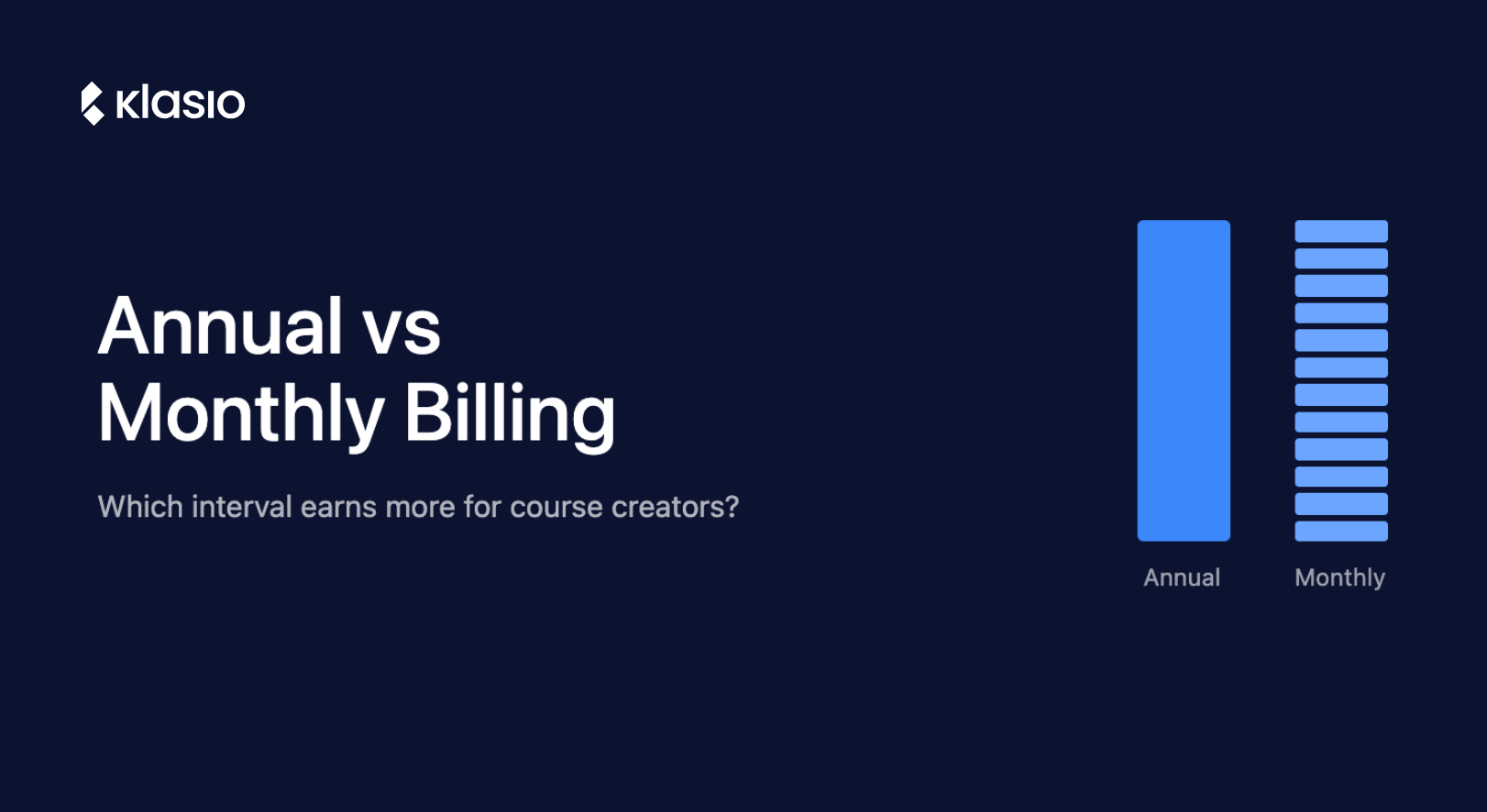
So, should you charge your students monthly or ask them to pay for a full year upfront?
If you’ve been looking at other course businesses, you’ve probably seen both. Some swear by monthly plans because they’re easier to sell. Others push annual plans because students stay longer and you get the money upfront.
And that’s where things get confusing for someone trying to mimic them. Both sides have a point.
Monthly billing can get more students to say YES at checkout. Annual billing can keep those students around for longer. So if you’re trying to work out which one will actually make you more money, looking at the price alone won’t get you there.
You need to look at two numbers instead: how many students you can get to join, and how many months they usually keep paying. Once you know those numbers, choosing an annual price becomes much easier.
TL;DR
- Monthly billing lowers the barrier to purchase, while annual billing increases revenue per student when retention is short.
- Annual pricing should be based on your actual retention, not a standard discount.
- Courses with a clear finish line can benefit more from annual billing than courses with continuously updated content.
- Quarterly billing works best for higher-priced offers where annual payment creates too much sticker shock.
- Annual plans perform better when they are clearly highlighted while monthly billing remains available.
- Existing students are stronger annual upgrade candidates after they reach meaningful engagement milestones.
- Annual renewals need early reminders, payment recovery, and a clear refund policy to prevent avoidable revenue loss.
What annual and monthly subscription actually change for your course business
Before we touch the data, let’s clear up something that trips up more creators than you’d think. When a plan says “$25 per month, billed annually,” the actual charge is $300, taken once on signup day. The smaller number only exists to make comparison easy. Your student needs to understand that, and so do you, because that single charge changes how your whole business behaves.
For starters, all your cash arrives on day one instead of trickling in across the year. Your student is also committing to a full twelve months upfront. And most importantly, your renewal turns into a single yearly event that you either win or lose.
That renewal event is the scary part if you’re running things alone. Imagine a student’s card expires quietly during the year. On a monthly plan, that failed charge costs you $25 and you notice within weeks. On an annual plan, the same expired card wipes out $300 in one shot, a risk Dodo Payments calls out directly in their billing research.
Monthly billing spreads that same risk across twelve smaller payments, so no single failure can take out a full year of revenue. The trade is that your student also gets twelve chances to walk away instead of one.
There’s a quiet benefit hiding in those twelve payments, though. Every charge that goes through tells you your course is still worth paying for. If something goes wrong in month three, you’ll see it in month three. You’ll never wake up in month eleven and discover a problem that started back in spring.
So neither option is truly safer than the other. They simply put the risk in different places. Annual stacks it all onto one date a year, while monthly keeps it thin and constant. Your job is to pick the shape your business can actually absorb.
Annual vs monthly subscription: what the retention data shows
Monthly billing looks cheaper to the student, but it can create a new cancellation decision every single month. Annual billing removes that decision for twelve months. For course creators, that difference can have a major impact on revenue, retention, and customer value.
Annual billing changes that completely. The student pays once and, assuming they don’t ask for a refund, there is no new payment decision sitting in front of them next month. You get twelve months of revenue from one checkout decision.
Sounds like annual is the obvious winner, right? Not so fast.
There’s a reason students are more comfortable with monthly plans. Paying $29 today feels very different from paying $174 today. They haven’t seen the course yet. They don’t know whether they’ll finish it. Asking them to commit to a full year means asking them to trust you before you’ve earned that trust.
That’s where monthly billing has an advantage. It lowers the risk of saying yes. A student can try your course without feeling like they’ve made a huge financial commitment. If they love it, they keep paying. If they don’t, they can leave.
Now look at the same decision from your side. Suppose your average monthly student stays for five months. At $29 a month, that student is worth $145. An annual student who pays $174 upfront is already worth more, even though you’ve given them a discount compared with twelve monthly payments.
But there is a catch. You only get that $174 if the student chooses annual in the first place.
That’s why the question isn’t really “Which one is better?” It’s “How much does annual billing improve customer value without hurting your conversion too much?” Once you look at it that way, the decision becomes much easier.
You don’t need someone else’s pricing benchmark to answer it. Look at your own students. How many choose monthly? How long do they stay? How many choose annual? How many renew? Those numbers tell you what your billing strategy is actually doing.
| What you are comparing | Monthly billing | Annual billing |
| Student commitment | Low, cancel any month | Twelve months, paid upfront |
| Cash timing | Spread across the year | Collected on day one |
| Cancel decisions per year | Twelve | One |
| Conversion at checkout | Higher | Lower |
| Revenue per student over time | Lower | Higher |
| Refund exposure per student | One month | Up to a full year |
| How fast you spot a problem | Within weeks | Often not until renewal |
| Best fit | New courses, prices under $20, retention you have not measured yet | Finished curricula, proven delivery capacity, students who complete fast |
The completion problem nobody warns course creators about
Netflix never runs out of episodes, and Spotify never runs out of songs. Your course, on the other hand, will definitely run out of modules. The day a student finishes the last one, their subscription quietly loses its reason to exist.
Dan Layfield has a useful name for this. He ran growth at Codecademy while its yearly revenue climbed from $10M to $50M, so he’s watched the problem play out at scale. He calls these short-lifecycle products, where “users leave when they’ve gotten what they came for.” Think exam prep, learn-to-code platforms, weight loss apps, and yes, most online courses.
You can actually see this pattern hiding on real pricing pages. Layfield’s pricing guide points out that DataCamp charges $28 a month or $168 a year, which works out to a 6x ratio. Headspace charges $12.99 monthly or $69.99 annually, a 5.39x ratio. Neither company offers the polite 17% discount you see elsewhere, because neither expects the average monthly user to reach month twelve.
Netflix takes it a step further and sells no annual plan at all. Layfield reads that as pure confidence. Their users already stay past twelve months without any price incentive, and when your retention is that good, you have nothing left to discount for.
So here’s the question to ask about your own course. Does your curriculum have a finish line, or does it refill? A fixed eight-module course has a finish line. A monthly cohort refills, and so does a live Q&A or a content library that grows every month.
The answer moves your annual price further than any benchmark will. A finish line makes annual billing more valuable to you, because you get to collect months your student was never going to pay for. Refilling content makes annual less urgent, since your students already have a reason to stay past month twelve. And if you’re still working out which model fits your course in the first place, the Klasio guide to the course subscription business model covers the structure underneath this whole decision.
How to price your annual plan using your own retention number
Most creators price their annual plan by copying a convention. They offer two months free, which works out to roughly a 17% discount, because that’s what everyone else seems to do. To be fair, the convention works fine when students stay close to twelve months, since you’re only discounting money they were going to pay you anyway.

The problem is that course retention rarely looks like that, and Layfield’s rule exists to fix it. Instead of discounting down from a full year, you price your annual plan slightly above what your average monthly subscriber actually pays you in total. The whole formula fits on one line.
Annual price = monthly price × (average months a student stays + 1 or 2)
Let’s run it with real numbers. Say you charge $29 a month and your students stay five months on average. That means each student is worth about $145 to you right now. Price your annual plan at six months and it costs $174. Price it at seven months and it costs $203.
Look at what that does for both sides. A student who was going to pay you $145 and disappear just paid you $174 instead. Meanwhile, they got a genuine deal compared to the $348 a full year of monthly payments would have cost them. Everyone walks away happy, and your revenue per student just rose by 20%.
Now compare that to the convention on the same course. Two months free would put your annual plan at $290, and almost nobody takes that offer. To a student who hasn’t finished your course yet, $290 feels like a full year of risk. So they stay monthly, you keep collecting your $145, and the discount accomplishes nothing.
If you’re unsure how many months to add, start with plus one. You can always raise the price later as your retention improves, but going the other direction is harder. Layfield warns that cutting a price after launch reads as a concession to everyone who already paid more.
And if you have no retention data yet, sell monthly only for now. Layfield suggests waiting until you have six to twelve months of subscriber history before adding an annual tier. If you already track churn, dividing one by your monthly churn rate gives you roughly the same retention number. The Klasio guide to pricing an online course can help you set the monthly price that feeds this whole formula.
One last thing worth noticing here. Your retention number also answers the question of how big your discount should be. A discount that looks reckless on a pricing page is often exactly right for a course, because the alternative was losing that student in month five anyway.
Can you actually deliver twelve months?
Annual billing sells a year of your time, and that’s the part most creators skip over. They obsess over the money and never look at the calendar. Then month seven arrives, nothing new has shipped in six weeks, and the first refund request lands in the inbox.
So before you accept a single annual payment, try a simple exercise. Put every deliverable you’ve promised onto a twelve-month calendar. Mark your holidays and your launch weeks, and flag the months you already know will be chaos.
Then count the real hours behind each month. Two lessons, student questions, a live session, and the admin around all of it stack up faster than you’d expect. If your schedule only survives in a perfect month, you’ve broken the promise before you’ve even sold it.
Vague promises make this worse, by the way. Something like “ongoing content” is easy to sell and impossible to defend eleven months later, and “exclusive material” has the same problem. A year-long commitment needs a much sharper promise than a monthly plan ever did.
Get this wrong and refunds become the bill. PayRequest’s billing guide explains why annual billing hides the warning signs so well. An unhappy student on an annual plan usually stays silent until renewal time, and by then the refund request may already be written.
The stakes are bigger too. A monthly student who leaves costs you $29, while an annual student who bails in month seven can ask for $174 back in a single week. Decide your refund policy before launch and print it right on the checkout page.
Where Quarterly Fits, and Where It Does Not
Quarterly billing genuinely splits the experts, so it’s worth hearing both sides before you add a third column to your pricing page. Piano’s data says yes. Their quarterly subscribers averaged $7.97 per month, which beats annual at $6.62 and monthly at $6.57, and their four-year retention hit 9.2% against 4.4% for monthly.
Layfield says no. In his view, quarterly misses the commitment and upfront cash of annual while also giving up the easy entry of monthly. On top of that, a third option adds decision paralysis to a page that was already asking a lot.
The honest answer is that both are right in different situations. Even Layfield makes room for quarterly when the annual price causes sticker shock. A $900 cohort program is a hard yes at checkout, while four payments of $225 is a much easier one.
At small prices, though, quarterly mostly clutters the page. Take a $19 course as an example. Even a generous 15% quarterly discount only saves your student about $8.55 every three months, and that saving can’t buy back the confusion a third option creates.
The good news is you can test this instead of guessing. Klasio supports monthly, quarterly, annual, and custom billing intervals, so adding a quarterly plan is one setting change. Run it for a quarter and check where those students came from. If quarterly stole buyers who would have gone annual, the experiment cost you money and you can switch it off.
How to present both options without cannibalizing either
Here’s the part almost everyone underestimates. Your pricing page layout moves more revenue than your discount does. Dodo Payments found that most customers simply accept whichever option you pre-select for them. Default the page to monthly and fewer than 20% switch over to annual. Default it to annual and 40% to 60% stay right there.
Beyond the default, show your annual plan as a monthly number with the total underneath. Take our $29 course and its $174 annual plan. Writing “$14.50 per month, billed annually at $174” feels much smaller than “$174 per year,” even though the price is identical. That feeling is what decides things at checkout.
State the saving in dollars while you’re at it. Piano’s testing found that dollar framing beats percentages, so “save $174” lands harder than “save 50%.” Your student shouldn’t have to do math to feel the deal.
At the same time, keep your monthly option plainly visible. Hiding it looks like a trick, and it costs you the students who would have started small and upgraded later. Give annual the badge and the highlight, then let monthly sit right beside it in plain form.
You can also handle the commitment worry right on the page with a single line. Something like “Not ready for a year? Start monthly and switch anytime” does the job. A refund window works too, and Layfield notes that most people who commit to a year never actually ask for one.
One last tip before you copy anyone’s price. Test it. Piano watched TechCrunch drop its annual price from $150 to $99, and the results were striking. Conversion doubled, annual revenue grew 28%, and the share of annual signups jumped 92%. The lower price grew everything at once.
And if you’re still torn between recurring plans and one-off sales entirely, the Klasio comparison of subscription and one-time course sales walks through that bigger decision.
When to move a monthly student to annual
The upgrade offer fails at signup and works at a milestone, and once you see why, you’ll never pitch it at checkout again. A brand-new student has zero proof that your course deserves a year of their money. A student who just finished module four has all the proof they need.
That means you should trigger the offer on behavior and ignore the calendar. Finishing the course, attending a third live session, earning a certificate, or logging in steadily for ninety days all say the same thing. This student has already decided your course works.
When you make the pitch, use their own numbers in it. Something like “You’ve paid $87 over three months. Switch to annual for $174 and the next nine months cost you $87” is hard to argue with. Layfield’s guide backs this up, since specific figures beat a generic pitch about saving money every time.
One warning before you hit send, though. Skip the mass email. It reaches your unhappy students too, and it reminds them they could cancel today. Segment by engagement first, and only pitch the students who show the signals above.
It also helps to set a target so you know when to stop pushing. Dodo Payments suggests aiming for 40% to 60% of new subscriptions on annual, and treats anything below 30% as a pricing or presentation problem. If you’re above 80%, take a hard look at your monthly option instead, because you may have priced out the students who needed a small first step.
Finally, remember what your monthly students are worth on their own. They convert better, they give you faster feedback, and Piano’s split showed how much revenue they carry. Converting every last one of them was never the goal.
The renewal cliff, and how launches make it worse
Course creators tend to sell in launches. You open the doors, promote hard for a week, and ninety students join within five days. It feels great in the moment. Then twelve months pass, and all ninety of those renewals land inside the same five days.
That pile-up turns a routine month into a cliff. A 70% renewal rate looks perfectly healthy in a spreadsheet, but it feels very different when twenty-seven students leave in one week and your income drops by a third overnight.
The fix is to treat the renewal window like a campaign instead of a date. Dodo Payments suggests sending reminder emails 14 and 7 days out. Use them to show each student what they actually got this year, like the modules they finished and the sessions they joined, and then let the charge go through.
While you’re at it, fix the card problem early. Twelve months is plenty of time for a card to expire, and a failed charge looks exactly like a cancellation in your dashboard. Send a payment update prompt a month ahead and chase every failure that slips through.
You can also soften the cliff by staggering enrollment where possible. Evergreen signups spread renewals across the whole year, so one cliff becomes twelve small steps, and quarterly launches do the same thing on a smaller scale. The Klasio guide to structuring a course business for recurring revenue goes deeper on that rhythm.
Setting up both intervals in Klasio
If you’ve read this far and started worrying about the rebuild, the good news is there isn’t one. Every interval in this guide lives inside a single plan setting in Klasio. The week your retention data arrives, adding an annual option takes minutes, and the quarterly test from earlier works exactly the same way.
You can also bundle courses, digital downloads, and webinars into one plan. Products go in one at a time or by whole category, whichever suits you. This matters more than it sounds for annual pricing, because a plan with a live element gives students a reason to stay past the last module.
Expiry policies handle the awkward question of what happens when a subscription lapses. Set them before launch and that access conversation never has to happen. They also stop a failed renewal from locking a student out in the middle of the curriculum.
Your subscriber dashboard holds the exact number the pricing formula needs. You can track subscribers, review transaction history, and export the list anytime, which means you can count how many months your average monthly student actually stays. Price your annual plan from that figure and you get to skip the industry benchmarks entirely.
Your plans get a proper home on your site as well. Klasio’s Page Builder includes a subscription card that displays monthly and annual side by side, and you can see the full setup on the Klasio subscriptions page.
Which interval should you choose
In the end, the annual vs monthly billing question comes down to your own numbers, and three profiles cover most creators.
Lead with monthly if you launched recently, charge under $20, or can’t name your average retention in months yet. At this stage you need signups and data more than you need a lump sum in the bank.
Lead with annual if your course has a clear finish line, your students complete it in under six months, and you can defend a twelve-month promise on a real calendar. You’ll collect months you were otherwise going to lose.
Everyone else should run both. Price your annual plan from your retention number, default the page to annual, and keep monthly plainly visible beside it. Then make the upgrade offer at a milestone, because checkout is too early.
Klasio fits this setup if you want all four intervals in one dashboard without a separate billing tool, and you can sign up free with no card needed. That said, if your current platform already handles flexible intervals and clean reporting, stay put and spend the time on the pricing math instead. That decision will earn you more than any platform switch.
Frequently asked questions
Can I change my subscription billing interval after students have already joined?
You can change the billing interval for new students at any time. Existing students usually stay on their current plan and price until renewal. If you change their terms, tell them before the new price or interval takes effect.
What happens to a student’s course access if their annual payment fails?
A student’s access depends on your expiry and grace-period settings. Give them time to update their payment method before removing access. This helps prevent a failed card from looking like a voluntary cancellation.
How do I handle a refund request from an annual subscriber in month seven?
You should handle a month-seven refund according to the policy you set before launch. Some creators stop future renewals, while others offer a prorated refund. Put the rule on your checkout page so students know what to expect.
Does annual billing change how much sales tax or VAT I collect?
Annual billing can change when and how much tax you collect in a single transaction, but it does not automatically change the applicable tax rate. Tax rules vary by location, so check your obligations before launching an annual plan.
When should I raise the price of my annual plan?
You should raise your annual price when your retention improves enough to support it. If students now stay longer, recalculate your price using your updated retention number. Apply the new price to new students rather than changing existing subscriptions.
Should my annual plan include more than my monthly plan, or exactly the same thing?
Your annual plan should usually include the same core content as your monthly plan. The lower effective price is already the incentive. If you want to add something, test a simple bonus such as an onboarding call or workbook.




Leave a Reply