
Say you launched a course last year and made $8,000 in two weeks, and then sales went quiet. Income only arrived when you were actively promoting, and the moment you stopped, so did the money. So you did the obvious thing and added a $29 monthly plan on top of the course you already had.
Signups looked healthy in week one. By month three, people started cancelling, and when you asked why, the answer was almost always the same: they’d finished the course, so there was nothing left to log in for.
The course wasn’t the problem here, because a course is supposed to end – that’s what makes it a course. The problem is that your billing kept running on a schedule while the thing it was charging for had stopped moving, and that gap between the two is where nearly all of your churn came from. Closing it takes more than a better price or a longer cancellation flow. It takes a structure that keeps producing reasons to stay, and that’s what the rest of this guide walks through.
TL;DR
- Build in four layers: a free lesson that earns you an email, a one-time course that funds your production, a recurring core, and a top tier that sells your direct time.
- Before you turn on billing, answer this in one sentence: what does a student get in month six that they couldn’t get in month one? If you can’t, they’ll cancel on the second charge.
- Run the durability test. Whatever you’re selling has to stay engaging past three billing cycles, though what counts as “material” changes depending on whether you’re running a library, a membership, or a cohort.
- Choose your recurring model around what you can realistically deliver every month rather than around the revenue you’d like to hit. A library wants new courses quarterly, a membership wants your presence, and a cohort wants a calendar you never miss.
- Price the recurring tier at 10% to 20% of your flagship course, then divide the launch revenue you’re trying to replace by that price. The subscriber count you get back settles the debate faster than any pricing framework.
- Sort out your failed payments before you touch your content, because those students never actually decided to leave, which makes them the cheapest churn you’ll ever win back.
What Recurring Revenue Actually Means for Online Course Business
Before getting into structure, it’s worth being precise about the term, because a lot of what gets called recurring revenue isn’t.
Recurring revenue is money that arrives on a schedule without you making a new sale. Your student already made the decision, the billing runs on its own, and your only job in a given month is delivery. That’s a genuinely a different business from the one most creators are running, even when the annual totals look similar.
Consider a creator who sells three courses to the same student over two years. That’s repeat business, and it’s worth having, but each of those sales needed its own launch, its own emails, and its own decision from the buyer – so the income never became something you could count on ahead of time.
Predictability is the entire point of the exercise. When forty students pay you $35 a month, you start the month with $1,400 already committed, which means you can hire an editor, fund a course update, or run a paid ad test against a number you can actually see rather than one you’re hoping for.
There’s a real cost attached, though, and it’s better to name it now than to discover it in month eight. Recurring revenue trades flexibility for predictability: you’re obligated to deliver something every single billing cycle, and that obligation doesn’t pause when you’re sick, travelling, or buried in client work. Whether the trade is worth making comes down to whether your business is built to carry it – and most aren’t, for reasons that have very little to do with effort.
Why Most Course Businesses Never Get Past the Launch Cycle
When a subscription fails, it usually isn’t because the creator got lazy or the content was weak. It’s because three specific gaps were built into the structure from day one, each sitting at a different level of the business.
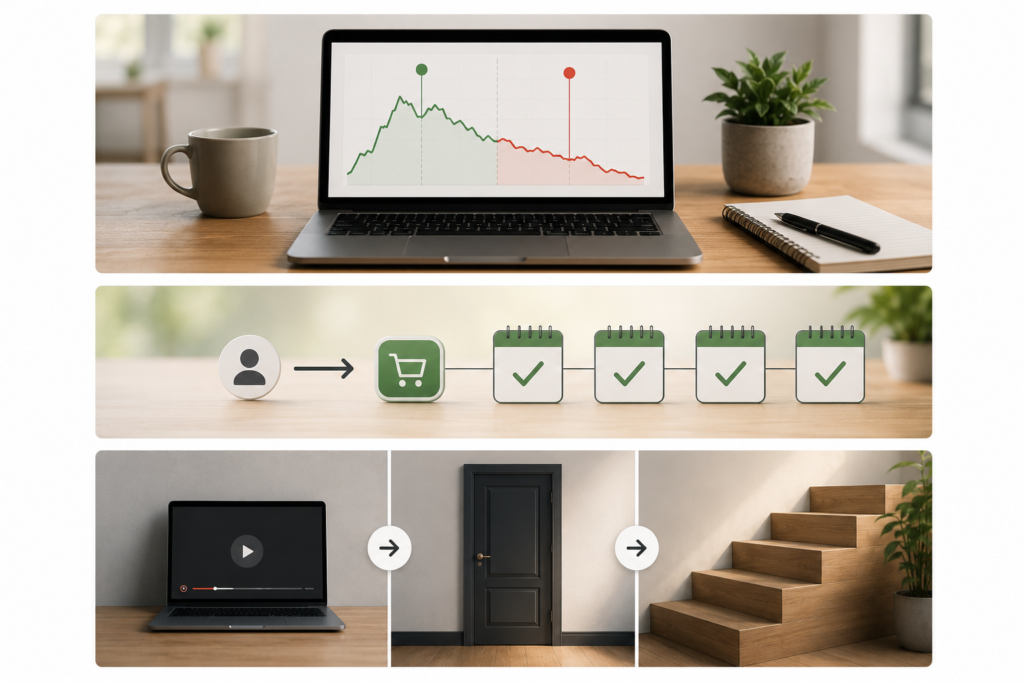
The first gap sits in the middle, where nothing keeps moving. A finished course has an ending, but a subscription doesn’t, so once a student watches the last lesson, your monthly charge turns into an unexplained line on their bank statement. This is the failure most creators eventually notice, though usually around month three when it’s already happening.
The second sits at the entry point, where there’s only one price. If a student is curious about your teaching but not yet convinced, you’ve given them no low-risk way to find out whether you’re any good – every prospect faces the same yes-or-no decision at the same number, and most of them say no.
The third sits at the top, where there’s nowhere left to spend. Your most engaged students, the ones who finish everything and reply to every email you send, have already bought all you sell. That’s your highest-margin revenue walking out the door, and it would have cost you nothing to acquire.
What makes all three worse is how little time you have to fix them. Churn benchmarks compiled from Recurly, Churnkey, and Paddle data put roughly 44% of subscription cancellations inside the first 90 days, which means your structure gets about three billing cycles to prove itself. That’s why everything below is a design decision rather than something you bolt on once you notice the churn.
The Four Layers of a Course Business Built to Renew
The fix is to stop thinking of your offer as a product and start thinking of it as four stacked layers. The bottom one costs nothing and builds your audience, the top one costs the most and serves the fewest people, and your recurring revenue sits in the middle – where it only holds up if the layers above and below it exist.

You won’t build all four in your first year, and you shouldn’t try. Most creators start with layer two because it pays immediately, then work outward from there. What matters right now is knowing where each layer goes and what job it does, so you’re not surprised later by a gap you could have planned for.
Layer One: A Free Entry Point That Earns an Email
The free layer exists to turn a stranger into someone you’re allowed to contact again. A short free course, a workshop recording, or a single lesson that solves one real problem will do this far better than a PDF checklist, because it shows the person how you teach rather than just proving that you know the subject.
This matters more for recurring revenue than it does for one-time sales, and the reason is worth sitting with. A subscription asks someone for an open-ended commitment with no clear end date, and that kind of trust is much cheaper to build before you ask for a card than after.
The good news is that you can build this from material you already own. Pull the strongest 30 minutes out of your paid course and rebuild it as a standalone lesson with a real outcome attached. Since the whole job here is proving competence, pick the piece that produces a result the student can see for themselves.
The failure mode is giving away something so thin that it proves nothing at all. A free lesson that solves an actual problem will sell your paid layers for you, while a free lesson that lists ten tips quietly convinces people you’re not worth paying.
Skip this layer if you already have a warm audience of a few thousand people who know your work, and build it if you’re starting from a cold list.
Layer Two: A One-Time Course That Funds Everything Else
Your flagship course is the layer that pays for the rest of the structure. It has a clear start, a clear finish, and a specific outcome a student can name before they buy, and once they’ve paid for it they own it.
It’s doing two jobs at the same time, which is easy to miss. It brings in the cash that lets you build your recurring layer without rushing it, and it turns a buyer into someone who now has a reference point for what your teaching is actually like. That second job matters more than it sounds, because someone with a reference point is exactly the person who’ll subscribe later, while someone without one is being asked to commit blind.
Price this course at a level that requires a real decision. Cheap courses attract browsers who buy on impulse, never open the material, and have no reason to stay subscribed to anything – while a price that makes someone think tends to bring in students who show up, work through it, and finish. Those finishers are your subscriber pool, which is why the price of your one-time course quietly determines the quality of your recurring one.
Keep selling it after the recurring tier goes live, because the two offers work together rather than competing. The full case for running both is covered in this guide on subscription vs one-time course sales.
The failure mode is killing the one-time offer the day the subscription launches. You’ve just removed the entry point for every buyer who will never commit to a monthly charge, and those are the same buyers who were funding your content production in the first place.
Layer Three: The Recurring Core
This is the layer where predictable revenue actually lives, and it sells continued access to something that keeps moving – a growing library, a live session calendar, a community, a program that releases in stages, or a credential that expires and has to be renewed.
There’s one test that tells you whether you have a real recurring offer, and it fits in a single sentence: what does a student get in month six that they couldn’t have gotten in month one? If you can’t answer that quickly and concretely, what you have isn’t a subscription – it’s a course with a payment plan attached to it, and your students will work that out faster than you’d like.
Notice what the test doesn’t ask about, though. It never mentions how many videos you’ve published, because access to you, feedback on a student’s own work, a group of people at the same stage, and a reason to show up on a schedule all satisfy that test just as well as new content does. Some of them hold people longer than another module would. How much of your answer needs to come from content specifically depends on which model you choose, and that’s the next section.
Set the price comfortably below your flagship course so it reads as the easier decision of the two. A student who once paid $300 in a single go will look at $39 a month and see something small, even though they’ll cross $300 before the year is out.
Don’t build this layer yet if your topic is genuinely finished. Some subjects have a complete answer, and that’s fine – teaching a software tool that ships updates every quarter supports a subscription naturally, while teaching a fixed certification exam usually doesn’t.
Layer Four: A Tier That Sells Your Direct Time
Your top layer is defined by one characteristic, and being strict about it will save you a lot of confusion: it spends your calendar. Small-group coaching, done-with-you programs, portfolio reviews, and standing office hours all belong here, because in every case the student is paying for access to you specifically.
That’s also the line between this layer and the one below it. A certification program or a company seat licence keeps renewing on its own once you’ve built it, so both of those belong in your recurring core rather than up here – if an offer can grow without adding hours to your week, it isn’t layer four.
The reason to build this layer is capacity, not just margin. Ten students paying $200 a month brings in the same revenue as fifty students paying $40, but ten is a group you can genuinely serve well, and fifty is a support load. It also lifts retention across the whole business, because someone who sits in a monthly small-group call has a concrete reason to stay that no amount of content can manufacture.
Build this only after your recurring core runs itself, since it consumes the one input you can’t scale. Selling ten coaching seats while your subscription still needs firefighting every week leaves you with no hours left to fix the subscription, and then both layers suffer.
What it costs you to skip it: expansion revenue simply doesn’t exist in your business. Your most committed students already trust you and already pay you, which makes them the cheapest revenue you will ever earn, so every dollar they’d have spent on more access either stays in their pocket or goes to a different teacher.
Pick the Recurring Model That Matches What You Teach
The four layers look the same for everyone, but layer three doesn’t – it takes one of about five shapes, and choosing between them should come dowhe four layers look the same for everyone, but layer three doesn’t. It takes one of five shapes – an all-access library, a membership built around community, an ongoing cohort, a certification that renews, or seat licensing sold to companies – and each one asks something different of you every month.
Please choose based on your subject and your capacity rather than on the revenue number you’re aiming for. A library requires new courses quarterly, a membership requires your presence, and a cohort requires a calendar you never miss. Picking the model whose monthly demand you can’t meet is the most common way this whole structure will fall apart.
Whichever you land on, the rest of this guide applies the same way. If you haven’t settled it yet, this breakdown of the six course subscription models covers what each one demands, the margin profile, and how each one typically fails.working.
Run the Durability Test Before You Turn On Billing
Once you’ve picked a model, the next question is whether you have enough to launch it – and the usual version of that question is the wrong one. “How many courses do I need?” gets contradictory answers everywhere you look, with some sources insisting on twenty and others telling you to launch with five subscribers and figure it out as you go.
A better question is how long a committed student can stay engaged with what you have right now. If someone can exhaust your entire offer inside a single billing cycle, you’re not ready, and it doesn’t matter how many courses that represents.
What you’re aiming for is material that outlasts three billing cycles, plus a visible pipeline of what’s coming next. Three cycles is what carries a student past the 90-day window where most cancellations happen, and the pipeline is what carries them beyond it once they’re through.
The part that trips people up is that “material” means something different in each model, which is exactly why the course-count question misleads so many creators:
In a library model, you measure in catalog hours, because the catalog genuinely is the offer. Add up your total hours and divide by four hours a week, which is a realistic pace for a working adult with a job – so fifty hours will last roughly three months, while twelve hours runs out in three weeks.
In a membership, you can launch with two courses and be perfectly fine, because the live calendar and the group are carrying the value. Your durability test here is your session schedule, not your library.
In a cohort, you can launch with only the first module built, since the schedule itself is the promise you’re making. Durability means a release plan you’ve committed to publicly and can actually hit.
In a certification, durability is built into the design, because the renewal date does the work for you – but only if the credential is recognised outside your own business.
If you come up short, launch as a founding-member offer at a lower price with a stated release calendar attached. You’re selling the roadmap honestly rather than overstating a catalog that isn’t there yet, and the early members who join on those terms will tell you exactly what to build next.
Build a Publishing Rhythm You Can Keep for Two Years
The durability test covers what you have on the day you launch, but what arrives after that is a separate problem, and it’s the one that ends most subscriptions. Ask any creator who shut theirs down why it happened and the answer is nearly always that they promised a pace they could sustain for two months and not for twelve.
Because of that, cadence is a structural decision rather than an operational one, and it belongs before pricing in your planning. What you can reliably ship every month determines both what you can charge for it and how long people stay.
Start by finding your smallest reliable unit – one lesson, one live call, one teardown, one written breakdown, whatever fits your format. The thing to look for is what you could still produce during a bad week, not what you can manage when everything’s going well.
Batch your production wherever you can. Recording four sessions in a single day rather than one a week means one setup, one lighting check, and one editing pass, and most creators cut their production time close to half this way. Batching also gives you a buffer, so a rough month doesn’t immediately become a missed release.
Let live sessions carry the calendar for you. A monthly live Q&A costs you an hour and no editing time at all, and it leaves behind a recording you can add to the library afterwards – so a single hour produces both the cadence and the asset.
Repurpose rather than inventing. The questions your students already ask you are a content list you own outright: a question that keeps coming back becomes a short lesson, and a detailed reply you’ve already written becomes a written guide.
Publish the calendar where members can see it. Someone who can see what’s arriving next month has a concrete reason to stay through this month’s charge, and you’ve given yourself a deadline that keeps you honest.
When you have a slow month, ship something small and say so. A short update with a note about what’s coming holds far more trust than going quiet, because members will forgive a light month but they won’t forgive disappearing without explanation.
Design the First 30 Days Deliberately
Cadence protects you over the long run, but there’s a much shorter window that decides whether a subscriber ever gets far enough to benefit from it. Since most cancellations land inside the first 90 days, the opening weeks deserve as much design attention as your pricing page – and a student who logs in once and never comes back is already gone, with the actual cancellation arriving weeks later as paperwork.
Three touches cover most of what’s needed here. Give every new member one specific first step within 24 hours, small enough that they can finish it in a single sitting. Check in around day three, which is when the initial motivation wears off and other things start competing for their attention. Then send a progress prompt in week one that points at what they’ve already completed rather than at what’s left.
That sequence costs you three emails and will move your 90-day retention further than almost any content you could produce in the same time. It’s also the only retention work that pays off before your third billing cycle, which happens to be exactly when you need it most.
Price Your Recurring Tier So the Math Works
With cadence settled, you finally know what you’re able to deliver every month, and that’s the input pricing depends on. Pricing a subscription is a different exercise from pricing a course, because the number has to survive a fresh review inside your student’s head twelve times a year rather than once.
Anchor to your flagship course first. A recurring price somewhere between 10% and 20% of your one-time price tends to read as reasonable to a buyer who’s seen both, so a $300 course comfortably supports a $30 to $60 monthly tier. This only works as a sanity check if your flagship is priced properly to begin with, though – 15% of a $19 course isn’t a business, it’s a rounding error.
Then check that number against your capacity. If four hours of new material a month is what you can genuinely produce, price for four hours. A $99 tier delivering $29 worth of output generates cancellations you’ll spend the next year trying to explain away.
Run the replacement math before you commit to anything. Take the launch revenue you’re trying to replace and divide it by your monthly price: replacing $3,000 a month at $39 means 77 active subscribers, while the same target at $79 means 38. Putting those two numbers side by side settles most pricing debates faster than any framework will.
Don’t price at the bottom of the market. A $9 tier needs hundreds of subscribers before it matters, your support load grows with every one of them while revenue per student stays flat, and the audience size required is usually much larger than the one you actually have.
Push the annual option harder than feels natural. A monthly subscriber reconsiders the decision twelve times a year while an annual subscriber reconsiders once, and the gap this creates is significant – Buffer’s numbers, published by Baremetrics, showed monthly customers churning at around 7% per month against an equivalent 2.4% for annual, with annual subscribers staying roughly 40 months versus 14 for monthly. Just make the discount big enough to actually change someone’s decision, because a token 5% won’t move anyone.
If you haven’t settled your one-time course price yet, do that before any of this, since it’s the anchor everything else hangs on. This guide on how to price your online course covers the costing work underneath it.
Set Up Access, Billing, and Renewals Before You Launch
Pricing decides what you charge, but your billing configuration decides how much of it you keep – and most creators only discover this after something breaks. That’s an expensive way to learn, because the first thing that usually breaks is a student’s access to content they’ve already paid for.
Decide your billing intervals first. Monthly and annual will cover most course businesses, and quarterly is worth adding if your content ships on a quarterly rhythm, since the billing cycle then lines up with the delivery cycle and the charge feels earned rather than arbitrary.
Define what happens when a plan lapses. If access ends the second a payment fails, you’ve turned an expired card into a permanent loss, whereas a grace period of three to five days gives the student room to fix it without feeling locked out of something they were happy to keep paying for.
Treat failed payments as a revenue line rather than an admin task. Billing-platform research from Recurly and Paddle puts payment failures at 20% to 40% of total churn, with the share running highest on lower-priced plans. These are students who never decided to leave in the first place, which makes this the cheapest churn you’ll ever recover and the reason to sort it before you touch your content.
Make cancelling clean and obvious. A buried cancel button earns you chargebacks and public complaints, while a student who leaves easily and without friction is someone who might come back in six months – and reactivating them costs you nothing.
Plan how the plans display, too. Your recurring tiers need a page where a visitor can compare them and see what each one includes, because tucked inside a course page they’ll simply be missed by buyers who’d have said yes.
It’s worth checking all of this while you’re still choosing a platform rather than after you’ve committed to one. Grace periods, custom intervals, and lapse behaviour are configuration details that quietly determine how much revenue survives to your bank account. This roundup of affordable LMS platforms to sell online courses is a useful place to compare what different tools actually include.
Track Five Numbers That Show the Structure Is Working
Once the structure is live, you need a way to tell whether it’s holding, and five numbers will tell you almost everything worth knowing.
Monthly recurring revenue is your committed income before any new sales come in, and you should track it as a single line every month. The direction matters more than the figure itself – if MRR stays flat while signups climb, churn is eating everything you’re bringing in.
Churn rate is the number of subscribers you lost divided by the number you started the period with, multiplied by 100. Recurly’s benchmark research across thousands of subscription businesses puts average monthly churn at around 3.27%, but treat that as a floor set by mature companies rather than a target for a business in its first year. Your own previous month is a far more useful comparison.
Customer lifetime value is your average monthly revenue per subscriber divided by your monthly churn rate, so a $49 subscriber churning at 8% is worth roughly $612. That 8% is a realistic early-stage figure, which is precisely why a new course business shouldn’t plan against the cross-industry average above it. If it costs you more than $612 to acquire that student, no retention tactic will rescue the math.
Cohort retention groups students by the month they joined and tracks how many are still around at month two, four, and six. When people drop off early, the problem is your onboarding; when they drop off mid-cycle, the problem is content freshness. This single number will point you at whichever part of the structure needs work.
Expansion revenue is the share of your income coming from upgrades into higher tiers. If it’s sitting near zero, then either your top layer doesn’t exist yet or it isn’t visible to the students most likely to buy it.
Structural Mistakes That Quietly Kill Recurring Revenue
The mistakes worth warning you about are the ones that surface months after launch, which is exactly what makes them expensive – by the time you can see the damage, it traces back to a decision you made during setup.
Launching the recurring tier before you have an audience. A subscription needs a warm list to launch into, and selling one to strangers takes months of trust building during which you’re paying for content production with no revenue coming back. Build layer two and sell it first – the guide on how to sell an online course covers the audience work this depends on.
Treating the subscription like a launch. A one-time course needs a launch push, but a subscription needs consistent delivery for years, and those are almost opposite temperaments. Creators who run one big launch and then go quiet tend to see cancellations arrive in a wave around month three.
Building the top layer too early. Coaching and small-group programs pay well, which is exactly what makes them tempting, but they consume the hours you need for everything else. If your recurring core still requires weekly firefighting, adding a tier that demands your calendar will drag both layers down together.
Skipping the exit question. When someone cancels, ask them why, and give them four options rather than an open text box: too expensive, not enough time, finished what I needed, content wasn’t what I expected. Each answer points at a completely different fix, and guessing between them wastes months on the wrong one.
Build Your Recurring Structure on Klasio
If you’re setting this up now, the practical question is whether your platform can run both halves of it. Klasio handles the one-time layer and the recurring layer from the same dashboard, so you don’t need to stitch two systems together to build the structure above.
For your recurring core, you can bundle courses, digital downloads, and webinars into a single subscription plan, adding products either one at a time or by entire category – which keeps a growing library manageable as it expands. Billing intervals can be set to monthly, quarterly, annual, or a custom cycle, and you can define what happens as a subscription nears its end or lapses, so access management follows a rule you’ve chosen rather than a default you inherited. Your plans display on your academy site through the subscription card in Klasio’s Page Builder, and the dashboard tracks subscribers, transaction history, and data export.
Klasio is the right fit if you want one place to run a one-time catalog and a recurring tier side by side. If you’re specifically building the membership model, plan on pairing it with a dedicated community tool, since deep forum functionality sits outside what Klasio handles today – as does SCORM content.
Start your free trial on Klasio and set up your first subscription plan.
Frequently Asked Questions
How long does it take to build recurring revenue from an online course business?
Building recurring revenue from an online course business usually takes six to twelve months. The first few months focus on building your audience and flagship course. Stable revenue comes after several renewal cycles, not after the first payment.
Can I earn recurring revenue without a monthly subscription?
You can earn recurring revenue without a monthly subscription. Certification renewals, company seat licensing, and retainer coaching can all create repeat income. These models work well when monthly content is not practical.
Should I move my existing one-time students onto a recurring plan?
You should not remove access students have already paid for. Keep their original purchase intact and offer the recurring plan as an additional product. Past students are strong prospects because they already trust your teaching.
What is a good MRR growth rate for a small course business?
A good MRR growth rate keeps new subscribers ahead of cancellations each month. Percentage growth can be misleading when your subscriber base is small. Track net subscriber growth and watch when cancellations start matching new signups.
How do I sell recurring access to a company instead of an individual?
Sell the offer around a business outcome, such as faster onboarding or stronger employee skills. Package access as company seats under a fixed-term agreement. Include completion reports and simple billing to make internal approval easier.
Do I need a community to make a recurring model work?
You do not need a community for every recurring model. It works best when students need feedback, peer support, or help with specific situations. If you cannot keep it active, regular content and updates can work better.




Leave a Reply