
Three courses. Roughly $60,000 a year. On paper, the business looks healthy.
The problem is that almost all of that money arrives during two or three exhausting launches. For the rest of the year, revenue slows down, so you start thinking about the obvious fix: put the courses inside a $29 monthly subscription.
It sounds simple. But the arithmetic changes the picture.
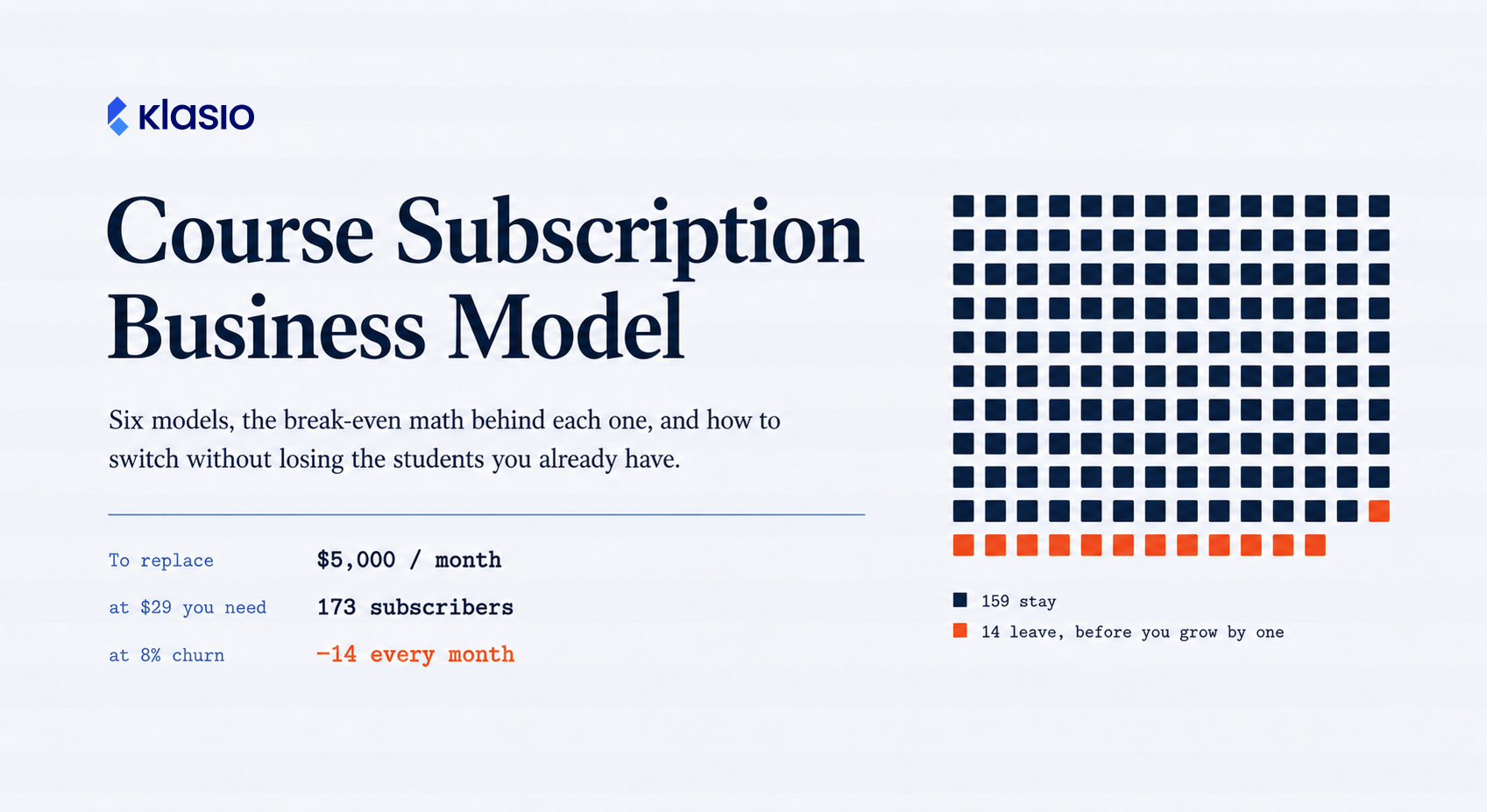
To replace $5,000 in average monthly revenue at $29, you need 173 active subscribers. If 8% cancel every month, you lose around 14 of them before you’ve grown by a single person. Subscriber number fifteen is where growth finally begins.
That doesn’t make the subscription model a bad idea. It means recurring revenue isn’t automatic revenue. You need an offer people still value after the first month, a price that can support the work, and enough demand to replace the people who naturally leave.
This guide will help you decide whether a course subscription fits your business, choose the right model, work through the numbers, price it, and protect existing students while making the switch.
One note on the numbers. Every calculation below is worked in full so you can substitute your own figures instead of taking ours. Where we cite an external benchmark, it’s linked, and we’ve flagged the places where the underlying data comes from SaaS rather than course businesses. Those aren’t the same market, and treating them as one is how creators end up planning against numbers that were never about them.
TL;DR
- The subscriber count you need is your target monthly revenue divided by your price. Lowering the price doesn’t just reduce revenue per person, it multiplies the number of people you have to recruit, support, and replace.
- Your churn rate sets how long the average subscriber stays, and therefore what each one is worth. A few percentage points of churn change the economics more than a price increase does.
- Choose a subscription only if you can answer one question clearly: what will a student receive in month six that wasn’t available in month one?
- Price the subscription at roughly 10–20% of your flagship course price as a starting point, then test it against your real content and support costs.
- Keep one-time purchases and subscriptions together if your catalogue contains both finished outcomes and ongoing value; this hybrid model is often the safest option for solo creators.
- Never remove access that was sold as “lifetime access.” Put new recurring benefits in a separate tier and leave the original promise intact.
What a Course Subscription Business Model Actually Is
A course subscription business model gives students continued access to an evolving learning offer in exchange for recurring monthly, quarterly, or annual payments.
The important word here is evolving.
You aren’t simply dividing the price of a finished course into smaller payments. You’re promising that the offer will keep giving students a reason to stay. That reason could be new courses, regular live sessions, updated resources, certification renewal, community access, or ongoing support.
If the entire value is available on day one and nothing meaningful changes afterwards, you probably don’t have a subscription. You have a finished product with a recurring bill attached to it.
That difference is where many course businesses get into trouble.
Subscription vs Membership vs Payment Plan vs Cohort
These four models can all involve repeated payments. But the student isn’t buying the same thing in each one.
| Model | What the student is buying | What ends it | What you owe each month | Typical churn profile |
| Subscription | Continued access to an offer that keeps developing | The student cancels or the plan lapses | New or refreshed value, reliable access, and a reason to continue | Ongoing churn; cancellations rise when new value slows down |
| Membership | Access to people, community, guidance, or status | The member cancels or the community closes | Interaction, moderation, live access, and an active member experience | Often tied to participation; a quiet community can cause a sudden spike |
| Payment plan | Financing for a fixed product with a fixed total price | The balance is paid | Delivery of what was already purchased | This isn’t normal subscription churn; the main risk is failed installments or defaults |
| Cohort | A scheduled learning experience with a defined group and calendar | The program reaches its end date | Teaching, feedback, deadlines, and delivery against the schedule | Usually measured as completion or renewal into another cohort, not open-ended monthly churn |
The most common structural failure is treating a payment plan like a subscription.
Imagine a student joins at $39 a month and can watch every lesson immediately. By month three, they have completed the course. They don’t cancel because the teaching was poor. They cancel because the product is finished.
If dozens of students joined during the same launch, those cancellations arrive together. What looks like a churn problem is really an offer-design problem.
The Six Course Subscription Models
There is no single way to build a course subscription. The right model depends on what keeps changing, how much of your time students need, and where the margin comes from.
| Model | Works best when | Monthly demand on you | Margin profile | Main failure mode |
| All-access library | You have a deep catalogue and add or update content regularly | Medium | High once the library is built | Students binge the useful content and leave |
| Membership (community-led) | Access to you and other members is part of the value | High | Medium; moderation and live time continue | The community becomes quiet or repetitive |
| Ongoing cohort or rolling program | Progress depends on deadlines, feedback, and live teaching | Very high | Medium to low unless priced well | Delivery becomes exhausting or inconsistent |
| Certification with renewal | Knowledge, standards, or credentials need regular updating | Low to medium | High when renewal value is real | The renewal feels like a fee with no added value |
| Company seat licensing | Organizations need repeatable training for changing teams | Medium | High, especially with larger contracts | Admin, reporting, and support become too manual |
| Hybrid | Some outcomes are finite while support or fresh content continues | Medium and controllable | Usually strong | Buyers can’t understand what’s one-time and what recurs |
All-Access Library
An all-access library puts several courses, templates, downloads, or workshops behind one recurring price. Students stay subscribed because the catalogue is broad enough to solve more than one problem and keeps improving over time.
This model works well for topics with a natural learning path. A design academy might offer courses on typography, branding, Figma, client management, and portfolio building. Finishing one course creates a reason to start another.
The work doesn’t stop after uploading the first library. You still need to refresh outdated lessons, add useful material, and guide students toward the next course. Otherwise, many people will join, consume the two resources they wanted, and cancel.
Skip this model if you only have one or two short courses and no realistic content roadmap. A small catalogue can still sell well, but calling it “all access” doesn’t make it deep.
Membership (Community-Led)
A membership sells access to people as much as it sells content. The course library may help students get started, but the recurring value comes from office hours, peer conversations, accountability, feedback, networking, or direct access to you.
That makes a membership harder to automate. Someone has to welcome members, answer questions, guide discussions, handle conflict, and keep the space active. A community with 300 names and no useful conversation isn’t a benefit.
The main failure happens when the creator assumes members will create the value for one another. Some eventually will. In the beginning, though, the energy usually comes from you.
Skip this model if you dislike live interaction or don’t have time to moderate consistently. A community isn’t a checkbox you add to a subscription page.
Ongoing Cohort or Rolling Program
An ongoing cohort combines recurring payment with a repeated teaching calendar. New students might enter every month, or the same group might continue through progressive stages.
Students are paying for structure: deadlines, live lessons, feedback, assignments, and forward movement. This can create strong retention because there’s always a next milestone. It can also support a higher price than a content-only library.
The downside is delivery load. If every new group needs the same live energy from you, growth creates more work instead of leverage. Missed sessions or an unclear calendar can damage trust quickly because the calendar is the product.
Skip it if your availability changes often or if students can get the same result from a self-paced course.
Certification With Renewal
Certification subscriptions work when the credential or the knowledge behind it needs to stay current. Students may pay annually to keep their certification active, complete updated modules, pass a renewal assessment, or access continuing education.
The model is attractive because the renewal cycle is easy to understand. It also gives you a natural reason to update the curriculum when regulations, methods, or industry standards change.
The danger is charging a renewal fee without creating renewal value. If students only receive a new date on the same certificate, the model begins to feel like a tax.
Skip it if the credential has no recognition outside your own website or if the subject doesn’t change enough to justify reassessment.
Company Seat Licensing (B2B)
With company seat licensing, an organization pays for a number of employees to access your training. Billing may be monthly or annual, and the contract can expand as the team grows.
The continuing value isn’t only the content. Companies may need onboarding for new hires, updated compliance material, learner progress reports, admin controls, and a consistent way to train people across locations.
Margins can be strong because one sale brings several learners. However, business buyers expect reliable support, reporting, invoicing, and sometimes custom requirements. A $2,000 contract that quietly creates $4,000 of manual work isn’t a good contract.
Skip B2B licensing if you can’t support team administration or if the course is built entirely around one individual’s personal transformation.
Hybrid: One-Time Catalogue Plus a Recurring Tier
For many solo creators, the hybrid model is the safest place to start.
You continue selling finished courses for a one-time price. Alongside them, you offer a recurring tier for benefits that genuinely continue: monthly workshops, office hours, updated templates, feedback, community access, new mini-courses, or a growing resource vault.
This gives buyers a clear choice. Someone who wants one result can buy one course and leave with no recurring commitment. Someone who wants ongoing guidance can join the subscription. Your launch revenue doesn’t disappear while the recurring side is still finding its feet.
It also protects the value of your flagship course. Instead of putting a $500 program inside a $19 plan and encouraging people to binge it in a weekend, you can keep the program as a one-time purchase and use the subscription as the next step.
The hard part is explaining the boundary. If the subscription appears to include everything the one-time buyer receives, plus more, at a much lower entry price, the one-time offer becomes difficult to defend.
A clean hybrid might look like this:
- $299 one-time: complete food photography course with lifetime access
- $39 a month: monthly critique session, new styling breakdowns, updated shot lists, and member discussion
- $499 bundle: the course plus six months of the recurring tier
Skip the hybrid only if both offers solve exactly the same problem in exactly the same way. In that case, two prices create confusion rather than choice.

Run the Numbers Before You Build Anything
Recurring revenue sounds calmer than launch revenue. But it only becomes calmer after you’ve enough subscribers, low enough churn, and a reliable way to replace cancellations.
Before you record another lesson, open a spreadsheet.
The Replacement Calculation
Start with the average monthly revenue you want the subscription to replace.
Subscribers needed = monthly revenue target ÷ monthly subscription price
Suppose your launches generate $60,000 a year.
$60,000 ÷ 12 = $5,000 average monthly revenue
At $29 a month:
$5,000 ÷ $29 = 172.41
You can’t have 0.41 of a subscriber, so you need 173 active subscribers.
Now run the same calculation at $79:
$5,000 ÷ $79 = 63.29
That means you need 64 active subscribers.
The higher price cuts the required subscriber base by almost two-thirds. Of course, a $79 offer may be harder to sell. But that’s the trade-off you need to see before choosing a price because it “feels affordable.”
What Churn Does to That Number
Churn is the percentage of subscribers who leave during a given period.
If you start the month with 200 subscribers and 16 cancel, your monthly subscriber churn is:
16 ÷ 200 × 100 = 8%
A useful shortcut for estimating average subscriber lifetime is:
Average lifetime in months = 1 ÷ monthly churn rate
At 8% churn:
1 ÷ 0.08 = 12.5 months
This formula assumes churn stays constant, so treat it as a planning estimate rather than a prediction.
Now return to the $29 plan with 173 subscribers:
173 × 8% = 13.84
You will lose roughly 14 subscribers in an average month. Your first 14 new subscribers only refill the bucket. Growth begins with subscriber number fifteen.
This is the part most recurring-revenue screenshots leave out.
Churn is also the number you have the most control over. Our breakdown of the seven reasons students cancel a course subscription covers what actually drives that percentage and which causes are worth fixing first.
Lifetime Value and What You Can Afford to Pay for a Subscriber
Customer lifetime value, or LTV, estimates how much revenue an average subscriber produces before leaving.
A simple subscription formula is:
LTV = average monthly revenue per subscriber ÷ monthly churn rate
At $29 a month and 8% churn:
$29 ÷ 0.08 = $362.50 LTV
A common planning guideline is to keep LTV at least three times higher than customer acquisition cost, or CAC. Under that rule, a $362.50 LTV supports a CAC of roughly $120.
But don’t treat $120 as permission to spend immediately. The simple LTV formula ignores payment fees, refunds, support time, live delivery, and the time it takes to earn the full $362.50.
If your LTV: CAC ratio is below 3:1, you’ve four practical options:
- reduce churn by improving onboarding and recurring value
- raise the price or move suitable subscribers to annual billing
- lower acquisition costs by using content, referrals, partnerships, or your existing list
- reduce delivery costs without weakening the experience
If none of those moves works, the offer may not have enough margin to scale through paid acquisition.
The $5,000 MRR Break-Even Table
Churn doesn’t change how many active subscribers produce $5,000 in monthly recurring revenue. It changes how many people you must replace every month to stay there.
The second column is fixed by price alone. The four columns after it show how many people you have to sign up every month, indefinitely, just to stay level.
| Monthly price | Active subs for $5,000 MRR | Replace at 3% | Replace at 5% | Replace at 8% | Replace at 10% |
| $19 | 264 | ~8/mo | ~13/mo | ~21/mo | ~26/mo |
| $29 | 173 | ~5/mo | ~9/mo | ~14/mo | ~17/mo |
| $49 | 103 | ~3/mo | ~5/mo | ~8/mo | ~10/mo |
| $79 | 64 | ~2/mo | ~3/mo | ~5/mo | ~6/mo |
| $99 | 51 | ~2/mo | ~3/mo | ~4/mo | ~5/mo |
Read one row across and you see what churn costs you. Read one column down and something more useful appears: at 8% churn, the $19 plan needs 21 new people every month before it grows at all, while the $99 plan needs 5. Same revenue. Four times the acquisition work, forever.
The table makes the $9 or $19 plan look less harmless. A low price doesn’t only reduce revenue per person. It creates a much larger population to onboard, support, retain, and replace.
Editorial asset note: Add an interactive calculator beside this section. Inputs: monthly price, monthly churn, target MRR, starting subscribers, and expected monthly signups. Outputs: active subscribers needed, replacements required, estimated lifetime, simple LTV, and a 12-month subscriber/MRR projection.
Where Your Real Costs Sit
Course content has high gross margins because delivering one more video lesson costs very little. A course subscription, however, has costs that grow with the number of active people.
The main ones are:
- Payment processing: Every renewal creates another transaction fee. Fixed fees take a bigger share of cheap plans.
- Support: Password problems, billing questions, cancellations, access issues, and student guidance grow with subscriber count, not just revenue.
- Production: New lessons, workshops, templates, editing, and guest instructors all require time or money.
- Refunds and disputes: Recurring charges create more chances for a student to forget the purchase, question a renewal, or file a chargeback.
- Your time: Live sessions and personal feedback can make the offer valuable, but they can also turn growth into a heavier calendar.
Consider two businesses at roughly $5,000 MRR. One has 51 subscribers paying $99. The other has 556 paying $9. The second business has almost eleven times as many accounts to support for roughly the same revenue.
That’s why subscription support cost per dollar can be materially higher than it’s for a one-time course.
Do You Actually Qualify for This Model?
The subscription model isn’t a reward you unlock after publishing several courses. It only works when your students have an ongoing reason to pay.
Use the following checks before you commit.
The Month-Six Question
Ask yourself:
What does a student get in month six that they could not get in month one?
“Continued access” isn’t always a strong answer. If the student has already finished the useful material, access to the same library may not matter.
A better answer sounds like this:
- a new advanced module is released every six weeks
- members get two live critique sessions each month
- the certification is updated when industry standards change
- new employees are added to the company training account throughout the year
- the template library changes as tools and workflows change
If you can’t describe month-six value in one sentence, don’t build the checkout yet.
Measure Content Durability by Model
Different models need different proof that they can last.
- All-access library: Divide your useful catalogue hours by roughly four study hours a week. A 40-hour library gives an active student around ten weeks of material. A 100-hour library gives roughly 25 weeks. This isn’t a promise of retention, but it shows whether the catalogue can physically support the time horizon you’re selling.
- Membership: Measure the forward session calendar, not the size of the video archive. Before launch, you should be able to show at least the next 8–12 weeks of live activity.
- Ongoing cohort: Publish the stages, release schedule, and deadlines for the next three to six months. Students need to see where the journey continues.
- Certification: Tie the subscription to a genuine renewal date, updated standards, continuing education, or reassessment.
- B2B seats: Show how the account supports new hires, recurring compliance, reporting, or updated team skills over the contract period.
Content volume alone isn’t the answer. Two useful workshops a month can retain the right audience better than 200 hours of unorganized video.
Check Your Audience Floor
There is no honest universal number of followers you need. Your price, conversion rate, and starting MRR target determine the audience floor.
Suppose you want to open with 50 members and expect 2–5% of a genuinely warm audience to join.
- At a 5% conversion rate, you need around 1,000 warm contacts.
- At a 3% conversion rate, you need around 1,667.
- At a 2% conversion rate, you need around 2,500.
These should be people who know your teaching, open your emails, attend your sessions, or have bought from you before. A list of 5,000 cold giveaway signups isn’t the same as 1,000 engaged readers.
Below roughly 500 warm contacts, a low-priced subscription is unlikely to begin at meaningful MRR unless your conversion is unusually high. That doesn’t mean you can’t launch. It means you should set a smaller validation target instead of expecting the subscription to replace your income immediately.
If the audience is the gap, build that first. A subscription launched into a cold list burns content production for months with no revenue behind it, which is a slower and more expensive way to learn the same lesson. Our guide on how to sell an online course covers the audience work this depends on.
Run the Finite-Topic Test
Some subjects have a complete answer.
A certification-exam preparation course ends when the student passes. A beginner tutorial on one software feature ends when the student can use it. A course on filing one specific form ends when the form is filed.
Trying to stretch a finite outcome into an endless content stream usually creates filler. Students notice.
These topics often work better as a one-time course, a fixed cohort, or a payment plan. You can still add a recurring offer later if a genuine ongoing need appears, such as continuing education, updates, or expert feedback.
If three of the following are “no,” stay with one-time sales for now:
- Does the subject keep changing?
- Do students need continued feedback or accountability?
- Can you name a meaningful month-six benefit?
- Do you’ve enough warm demand to reach the first revenue milestone?
- Can the price cover recurring delivery and support?
Our comparison of subscription vs one-time course sales will help you choose the better alternative.
How to Price a Course Subscription
Pricing isn’t about finding the smallest number people will accept. It is about finding a number that matches the continuing value and leaves enough room to deliver it well.
Anchor to Your Flagship Course
A useful starting point is 10–20% of the price of your flagship one-time course.
If the flagship course costs $300, that gives you an initial subscription range of $30–$60 a month. This is only an anchor. A content-only library may sit near the lower end, while live feedback or coaching may justify much more.
Then test the price against three things:
- how many subscribers you need for your MRR target
- how long a typical student is likely to stay
- how much content, support, and live time the plan requires
If the price only works when nobody ever cancels and you work for free, it doesn’t work.
This anchor is only as good as the flagship price underneath it. If you haven’t done that costing work yet, start with our guide on how to price an online course and come back to the subscription number afterwards.
Monthly vs Annual, and Why the Gap Is Bigger Than It Looks
Monthly billing makes the first decision easier. Annual billing improves cash flow and gives the student more time to build a habit before facing another purchase decision.
The retention difference can be large. Baremetrics reports that Buffer’s monthly customers churned at 7% per month, while annual customers had an equivalent monthly churn of 2.4%. That’s SaaS data, not a universal benchmark for course businesses, but the direction is useful: annual customers tend to stay longer because they make fewer renewal decisions.
Your annual discount needs to be large enough to change the choice. One month free is only 8.3% off and may not feel meaningful. Two months free is roughly 16.7% off. That’s why “pay for ten months, get twelve” is so common.
Don’t force annual billing simply because the cash is attractive. If students don’t yet trust the offer or can’t manage a large upfront payment, a monthly or quarterly option may convert better.
When Tiers Help and When They Cannibalize
Two tiers are usually enough:
- a lower tier for content and resources
- a higher tier for access to your time, feedback, or live support
Three tiers can work when the top one serves a clearly different buyer. For example, $29 for the library, $79 for group feedback, and $249 for limited personal review.
What usually fails is creating three tiers that differ only by the number of videos. Buyers begin comparing rows instead of choosing an outcome.
Tiers also cannibalize when the cheapest plan contains the main reason people would buy the expensive one. If live feedback drives the result, don’t quietly include unlimited feedback in the entry plan.
Founding-Member Pricing and How to Exit It
Founding-member pricing rewards the first group for taking a chance on an unproven offer. It can help you validate demand, gather feedback, and build early testimonials.
Make the terms clear from the beginning:
- Is the price locked for as long as the member stays subscribed?
- Is it locked for six or twelve months?
- Will future benefits be included at the old price?
- What happens if the member cancels and returns?
The simplest option is to grandfather active founding members and charge the new price to future members. This protects trust, but it has a cost: your longest-standing members may remain on the least profitable price.
If you need to raise existing prices later, give plenty of notice, explain what has changed, and offer a respectful choice. A sudden increase can create a churn spike even when the new price is fair.
The $9 Trap
A $9 plan feels easy to sell. It also requires 556 active subscribers to produce $5,000 MRR.
Every one of those subscribers can need onboarding, billing help, support, moderation, and cancellation handling. Meanwhile, the fixed portion of every processing fee takes a larger percentage of the payment.
Low pricing can work for a simple, automated product with a large audience. It is usually a poor match for a small creator offering live sessions, feedback, or personal support.
Before choosing $9, ask a better question: can this experience still feel good when 500 people are inside it?
Moving From One-Time Sales Without Burning Your Existing Students
Your existing students aren’t an obstacle to the new model. They are the people who trusted you before recurring revenue was part of the plan.
Treat that trust as an asset.
Keep Every Lifetime-Access Promise
If someone bought lifetime access, they keep lifetime access to what you sold them. Don’t revoke the course, put existing lessons behind a subscription, or redefine “lifetime” because your pricing strategy changed.
You can charge for genuinely new, ongoing value. You can’t quietly charge again for the same promise.
This means you may need to separate the original course from the new recurring tier. Past buyers keep the course. The subscription adds future workshops, new resources, community access, feedback, or additional courses.
Choose a Grandfathering Option
You have several ways to handle past buyers:
| Option | What past buyers receive | Honest cost to you |
| Full grandfathering | Original purchase plus the new recurring benefits indefinitely | Highest long-term delivery cost; no recurring revenue from your warmest users |
| Original access only | Everything originally promised, with the subscription sold separately | Clearest economics; requires careful explanation of the new boundary |
| Limited complimentary access | Original access plus 3–12 months of the new tier | Gives buyers time to experience the value, but some will leave when billing begins |
| Loyalty upgrade | A permanent or time-limited discount on the recurring tier | Lower ARPU, but easier conversion and stronger goodwill |
For most creators, original access plus a discounted optional upgrade is the cleanest choice.
Run Both Offers in Parallel
One-time courses and subscriptions can serve different buying situations.
The one-time buyer wants a specific result and a clear finish line. The subscriber wants ongoing access, variety, updates, or support.
Keeping both offers also prevents the subscription from carrying the whole business before it’s proven. Launch revenue can fund content production while recurring revenue grows gradually.
Make the difference obvious on your sales pages. Don’t force buyers to calculate whether six months of the subscription is secretly the same as buying the course.
Sell the Recurring Tier to Past Buyers
Past buyers are your warmest possible audience. They already know your teaching style, your course quality, and whether you deliver what you promise.
The message should not be, “The thing you bought is now a subscription.”
It should be, “You still have everything you purchased. We have built a new way to continue after the course.”
Then show the new value clearly:
- what’s being added
- how often it will happen
- who it’s for
- what past buyers pay
- what happens to their existing access
If the distinction takes five paragraphs to explain, the offer probably needs more work.
Plan for Refunds and Chargebacks
A transition creates confusion if the checkout, emails, and account pages use different language.
State the billing interval, renewal behavior, cancellation process, and refund policy beside the purchase button. Send a receipt that repeats the terms. Send renewal reminders where required, and consider sending them even where they aren’t.
Also watch the first two or three billing cycles closely. If disputes rise, don’t assume customers are acting in bad faith. The announcement or checkout may be unclear.
Make the Announcement Boringly Clear
Give existing students at least a few weeks of notice before the new model begins.
Your announcement should answer:
- What is changing?
- What isn’t changing?
- What do existing buyers keep?
- What new benefits are inside the subscription?
- When does it begin?
- Do existing students need to take any action?
Avoid promising an exact content cadence forever unless you know you can maintain it. “A new masterclass every month for life” sounds exciting today and becomes a burden later.
The Operating Reality: Billing, Access, and Renewals
The subscription experience isn’t only what happens inside the course. Billing, access, failed payments, and cancellation are part of the product too.
Intervals, Grace Periods, and What Happens When a Plan Lapses
Decide what happens after each billing event before accepting payments.
- Does access end immediately after a cancellation, or at the end of the paid period?
- How many days of grace does a failed payment receive?
- Can a former subscriber rejoin at the old price?
- What happens to completed lessons, certificates, and submitted work?
- Can students pause instead of canceling?
In most cases, a cancellation should leave access active until the paid period ends. A failed payment can trigger a short grace period while the system retries the charge and asks the student to update the payment method.
The detailed setup belongs in your operating plan. The important point here is to decide the rules before the first exception arrives.
Failed Payments Are a Revenue Line, Not an Admin Task
A student can want to stay and still disappear because a card expired, a bank declined the charge, or the account had insufficient funds.
This is involuntary churn, and it’s larger than most creators assume. Estimates vary, but billing-platform research compiled from Recurly and Paddle data puts payment failures at roughly 20–40% of total churn, with the share running highest on cheaper plans — which is one more argument against the $9 tier. Stripe reports that its automated recovery tools recover 55% of failed payments on average.
Both figures come from SaaS and subscription-commerce datasets rather than course businesses specifically, so treat them as a starting hypothesis and measure your own.
That makes payment recovery part of growth, not housekeeping.
A simple dunning sequence could look like this:
- Before renewal: notify the customer if a saved card is about to expire
- Immediately after failure: explain that the charge failed and link directly to payment update
- Day 3: retry the charge and send a short reminder
- Day 7: retry again and explain when access will pause
- Final day: confirm the lapse, preserve account data, and show how to reactivate
Keep the tone helpful. The customer may not know anything went wrong.
Make Cancelling Clean
A buried cancel button may delay a cancellation. It can also buy you an angry support ticket, a chargeback, and a customer who never trusts you again.
Let students cancel without contacting you. After they click, show a short exit survey with four fixed options:
- too expensive
- not using it enough
- finished what I needed
- missing a feature, topic, or type of support
Add an optional text field for context, but don’t force the student to write an essay before leaving.
The goal isn’t to trap a subscriber. It is to learn why the value stopped matching the price.
Auto-Renewal Disclosure Rules You Are Probably Subject To
This section is general information, not legal advice. Subscription rules change and vary by country, state, customer type, and offer. Get qualified advice for the markets where you sell.
Regulatory position last reviewed: August 2026. Two of the frameworks below are actively moving — the FTC reopened its rulemaking in March 2026, and the UK regime has been delayed twice. If you’re reading this well after the review date, verify before you rely on it.
At a practical minimum, your checkout should clearly show:
- that the plan renews automatically
- the amount charged and billing frequency
- when a free or discounted period becomes paid
- the minimum commitment, if there’s one
- how and when the customer can cancel
- how refunds and access work after cancellation
In the United States, the Restore Online Shoppers’ Confidence Act, or ROSCA, requires clear material terms, informed consent before charging, and a simple way to stop recurring charges. The FTC’s broader “click-to-cancel” rule was vacated in 2025, and the agency reopened negative-option rulemaking in March 2026. Don’t rely on an old summary that treats the vacated federal rule as current law.
California’s Automatic Renewal Law goes further. The amended law, effective July 1, 2025, covers clear offer terms, affirmative consent, acknowledgements, cancellation, and reminder requirements. The California Attorney General has published a consumer alert on the updated law.
California matters here for a reason beyond California. Roughly thirty US states now have their own automatic-renewal statutes, several of them stricter than federal requirements, and they apply based on where your student lives rather than where you do. For a solo creator selling to a national audience, the practical consequence is that you end up building to the strictest state rather than tracking thirty of them.
EU consumers generally receive clear pre-contract information and a 14-day withdrawal period for many distance contracts, although the treatment of digital content can depend on when access begins and what the consumer agreed to. The EU’s consumer guidance explains the 14-day cooling-off framework.
In the UK, existing consumer rules still apply while a more specific subscription regime under the Digital Markets, Competition and Consumers Act is being implemented. The government’s 2 April 2026 response confirms the regime will require clearer pre-contract information, renewal reminders, straightforward online exit, and cooling-off rights at renewal — but secondary legislation is still required and commencement has been pushed to spring 2027, a further delay from the previously expected autumn 2026.
The date is worth knowing for planning, but not for waiting. If you sell to UK consumers, the direction is already clear enough to build toward now, and the CMA has direct consumer enforcement powers under the existing rules in the meantime.
The safe operational habit is simple: make renewal impossible to misunderstand and cancellation easy to complete.
Tax on Recurring Digital Sales
Recurring billing doesn’t remove your tax obligations. It repeats the taxable event.
Depending on where you and your students are located, you may need to collect VAT, GST, sales tax, or another consumption tax. The rate can depend on the customer’s location, the nature of the course, whether teaching is automated or live, and whether the buyer is a consumer or a business.
For example, EU business-to-consumer electronic services are generally taxed where the customer resides. The VAT One Stop Shop can let eligible sellers register in one EU country and report covered cross-border sales through one portal.
Recurring plans add operational questions:
- What happens when a tax rate changes between renewals?
- Is tax included in the displayed price or added at checkout?
- Does the invoice show the right customer location and tax amount?
- How are refunds and partial periods recorded?
Klasio includes tax-rate setup and reporting, including a workflow for setting up and checking subscription tax. That can reduce manual work, but you still need to know which tax rules apply to your business.
Selling Subscriptions Outside the US and Europe
Many subscription guides assume every student has an internationally enabled credit card and every payment method supports automatic renewal. That isn’t how much of the world pays.
In markets with lower card penetration, the offer may be good and the student may want to stay, but the payment rail itself breaks the recurring model. The World Bank’s Global Findex database has long shown a large gap in credit-card ownership between high-income and developing economies, even as account ownership and digital payments grow.
Local gateways can improve checkout conversion because students recognize and trust them. But “supports online payment” doesn’t always mean “can automatically charge the same customer every month.” Some methods require the customer to approve or initiate each payment.
Before promising automatic renewal, ask the gateway:
- Can it tokenize or securely reuse a payment method?
- Does it support merchant-initiated recurring charges?
- What customer authentication is required on each renewal?
- What happens after a failed payment?
- Can the platform receive reliable renewal and cancellation events?
Stripe also notes that in markets such as Brazil and Indonesia, recurring invoices or reminders for customer-initiated payment can be common even when automatic card billing is available. The billing experience needs to match local behavior, not only your software settings.
There’s a constraint worth naming plainly here, because it applies to most course platforms and not only to ours. A platform can support a wide set of local payment methods for one-time course sales and still route automatic recurring billing through a narrower set of gateways. Those are two different capabilities, and platform marketing pages rarely separate them.
So check the specific combination you need before you build a launch plan around it: this gateway, in this country, for automatic renewal. If your market’s preferred payment method only supports one-time charges, you have three honest options — sell the recurring tier to the segment that does hold an internationally enabled card, run manual renewal invoices and accept the extra churn that creates, or sell fixed-term access as a one-time purchase and renew it by campaign rather than by billing engine. The third is less elegant, and in several markets it converts better than a recurring plan that half your audience physically cannot pay for.
Consider Quarterly Billing as the Middle Option
Annual billing is efficient for you, but a large one-time charge can be the exact barrier that stops a student from joining.
Monthly billing lowers that barrier but creates twelve payment attempts a year. Quarterly billing creates four. It can be an honest middle option in markets where students can manage a moderate payment but may hesitate at a full annual fee.
Don’t hide the total. Show the amount, interval, and renewal terms in the student’s currency wherever possible.
Price in Local Terms
A clean currency conversion doesn’t automatically produce a sensible local price. A $49 plan can sit in a very different part of someone’s monthly budget in Dhaka, Lagos, or Jakarta than it does in New York.
Use local currency display when your payment setup supports it. Test price points against local purchasing power, competing education options, payment fees, and refund behavior.
Also be careful with churn benchmarks. Most widely quoted subscription figures come from US- or Europe-heavy SaaS and app datasets. Your regional payment mix, income patterns, and student behavior may produce very different results. Use external benchmarks as a starting hypothesis, then build your own cohort data.
Five Numbers That Tell You It Is Working
You don’t need a dashboard full of numbers. Start with five.
- Monthly recurring revenue (MRR): Add the monthly value of every active recurring plan. Convert quarterly and annual contracts to their monthly equivalent rather than counting the full cash payment as one month’s MRR.
- Subscriber churn: Subscribers lost during the month ÷ subscribers active at the start of the month × 100.
- Lifetime value (LTV): Average monthly revenue per subscriber ÷ monthly churn rate. Use this as a directional estimate and improve it with gross margin when your data is ready.
- Cohort retention: The percentage of each signup group still paying after month one, month three, month six, and beyond. Cohorts show whether newer versions of the offer retain better.
- Expansion revenue: Extra recurring revenue from upgrades, additional seats, add-ons, or higher tiers among existing subscribers.
MRR tells you the size of the business. Churn tells you how fast it leaks. LTV tells you what a subscriber may be worth. Cohorts show whether the experience is improving. Expansion shows whether value grows after the first purchase.
For a fuller operating dashboard and review cadence, see our guide on structuring a course business for long-term recurring revenue.
When to Shut It Down, and How
Not every subscription deserves to be saved.
Closing a recurring offer can be the right decision when the subject is finite, the audience prefers one-time purchases, or the delivery model is taking more from the business than it returns.
Watch for these signals:
- monthly churn remains above roughly 10% after nine months, even after you’ve fixed obvious onboarding, billing, and value problems
- you’ve missed the promised content or live cadence twice and can’t see how to make it sustainable
- signups continue, but MRR stays flat because new members only replace departing ones
- support and live delivery consume the margin
- students repeatedly say they finished what they needed in the first few months
The 10% figure is a warning line, not a universal law. Your price, audience, model, and acquisition cost matter. But at 10% monthly churn, the simple estimated lifetime is only ten months. You need strong margins and reliable acquisition to keep that treadmill moving.
Wind It Down Without Destroying Trust
Give subscribers clear notice. Thirty to sixty days is a reasonable starting point for many offers, but your contracts and local rules may require more.
Then:
- stop accepting new subscribers
- honor every period that has already been paid
- explain the final billing date and access date
- provide exports or downloads where appropriate
- complete any promised live sessions
- offer a fair refund if you can’t deliver the paid period
You may be able to convert the finished library into a one-time product. Existing active subscribers could receive permanent access, a discount, or credit based on how long they have paid.
The subscription may end, but you keep the useful assets: your email list, the content, student feedback, finished courses, and the knowledge of what people valued enough to pay for.
Build a Course Subscription on Klasio
Klasio lets you combine courses, digital downloads, and webinars inside one subscription plan. You can add products individually or by category, then charge monthly, quarterly, annually, or on a custom interval.
You can also configure what happens when a plan expires or lapses, display plans through a subscription card in Page Builder, manage subscribers, review transaction details, and export subscriber data. Klasio’s subscription toolkit and built-in tax management cover much of the billing and access work discussed in this guide.
There are honest limits, and they’re better stated before you commit than after.
If a deep community forum is the core of your offer, you’ll still want a dedicated community tool alongside Klasio. Klasio doesn’t support SCORM packages at the time of writing.
And to close the loop on the section above: while Klasio supports a range of gateways and local payment methods for regular course sales, automatic recurring billing currently runs through Stripe. If Stripe doesn’t serve your students’ country, the honest answer is one of the three options listed earlier rather than a workaround. Confirm current gateway support before you announce a subscription to an audience that may not be able to pay for it.
If the model and the numbers in this guide fit your business, create your free Klasio account and build the first version of your subscription. No credit card is required.
Frequently Asked Questions
What is a course subscription business model?
A course subscription business model charges students a recurring fee for continued access to an evolving learning offer. The value may come from new courses, updated resources, live sessions, feedback, community, or certification renewal.
What is the difference between a course subscription and a membership site?
The difference between a course subscription and a membership site is that a course subscription primarily sells continuing access to learning products, while a membership primarily sells ongoing access to people, community, support, or status. The two can overlap, but the main reason a student stays determines which model you’re actually running.
How many courses do I need before I can launch a subscription?
The number of courses you need before you can launch a subscription is not fixed. One deep program can support recurring payment if students receive ongoing feedback, updates, or live delivery, while ten short finished courses may still be easy to consume and cancel. Measure the continuing value, not the course count.
How much should I charge for a course subscription?
A practical starting point is 10–20% of your flagship one-time course price per month. Then check how many subscribers the price requires, what it costs to serve them, and whether the plan still makes sense at your expected churn rate.
Is a subscription model more profitable than selling courses individually?
A subscription can be more profitable than selling courses individually when students stay long enough for lifetime revenue to exceed the one-time price and delivery costs remain controlled. If students cancel after consuming a finished course, one-time sales may produce more revenue with less ongoing work.
Can I sell one-time courses and a subscription at the same time?
Yes, you can sell one-time courses and a subscription at the same time. A hybrid model lets you sell finite outcomes once and charge recurring fees for continuing benefits such as live support, new resources, updates, or community access. Make the boundary between the two offers easy to understand.
What is a good churn rate for a course subscription?
A good churn rate for a course subscription is one that leaves enough subscriber lifetime and margin to recover acquisition and delivery costs. As a working rule, below 5% monthly churn is a strong target, 5–8% deserves close monitoring, and persistent churn near or above 10% usually signals a structural problem. Compare your own cohorts because course-specific benchmarks vary widely.




Leave a Reply