
Most course sales pages follow the same pattern. A headline, a list of modules, a few testimonials, and a buy button. And most of them do not convert as well as they should.
The problem is not the course. The problem is the order of information. When you lead with what is inside your course before the reader believes you understand their problem, you are asking them to trust you too early.
The course creators who consistently sell do something different. They lead with a story. Not a vague inspiration story, but a specific, structured narrative that makes the reader feel like the page was written for them personally.
This guide breaks down exactly what they are doing, why it works, and how you can apply the same approach to your own course, especially if you are just getting started.
TL;DR
- Lead with your buyer’s struggle, not your course modules. The reader needs to see their own problem on the page before they will care about your solution.
- Pick one story type: founder story, student success story, or origin story, and build your sales narrative around it consistently.
- Pull out the specific details from your story: the timeline, the numbers, the failed attempts, and the turning point. Vague stories do not convert.
- Use the 5-part framework to structure your sales page: before state, failed attempts, turning point, course as the bridge, and proof with a clear CTA.
- When you share student results or income claims, always include a disclaimer that results are not typical or guaranteed.
Why Storytelling Works So Well for Online Course Sales
Here is something worth understanding before you write a single word of your course sales page.
When someone reads a well-told story, something interesting happens in their brain. Researchers call it narrative transportation. The reader mentally steps out of their current situation and into the world the story describes. They stop being a skeptical buyer and start imagining a different version of their life.
This matters a lot for online courses specifically, because a course is an intangible product. Your buyer cannot hold it, test it, or return it like a pair of shoes. All they have is a promise. Storytelling makes that promise feel real and concrete.
There is another reason it works: story lowers resistance. When a reader sees their own struggle reflected in your copy, they stop questioning whether the course is worth it. Instead, they start asking, “Could this work for me too?”
That shift in question is where sales happen.
What Top Course Creators Are Actually Doing
After studying leading course landing pages, four storytelling patterns show up again and again.
They Make the Reader the Hero
The biggest shift you will notice on high-converting course sales pages is this: the buyer’s struggle comes first, not the creator’s credentials.
The story opens with pain, confusion, frustration, or ambition, whatever the reader is already living with.
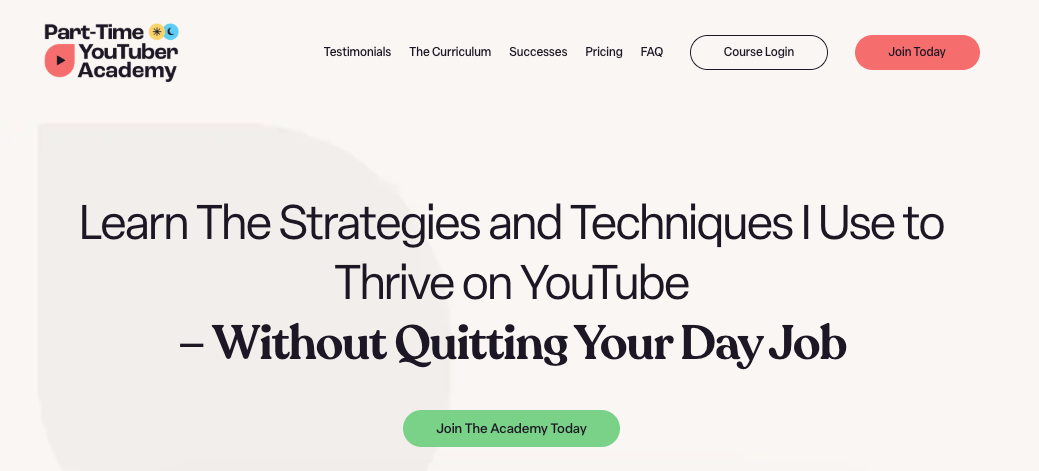
Ali Abdaal does not open with “here are my lessons.” His promise is built around a specific, relatable situation: growing on YouTube without quitting your day job. The reader sees their own life in that framing before they ever read a module name.
They Sell a Future Identity, Not Just Information
Look at Marie Forleo’s B-School page, and you will notice she is not selling training modules. She is selling freedom, prosperity, and a fundamentally different relationship with your business and life.
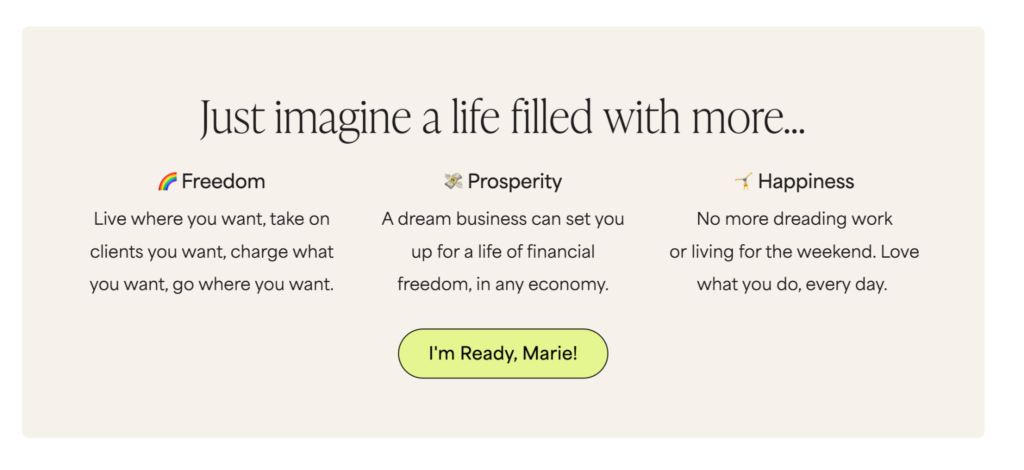
This is an important distinction. Information is everywhere. What your buyer is actually purchasing is a version of themselves they want to become. When you position your course as the vehicle for that identity shift, it becomes much harder to scroll past.
They Use Student Stories as Proof
Amy Porterfield‘s course pages are dense with before-and-after student narratives, and there is a clear reason for that. A founder’s success story only proves it worked for one person. Student stories prove it can work for different people, at different starting points, with different constraints.
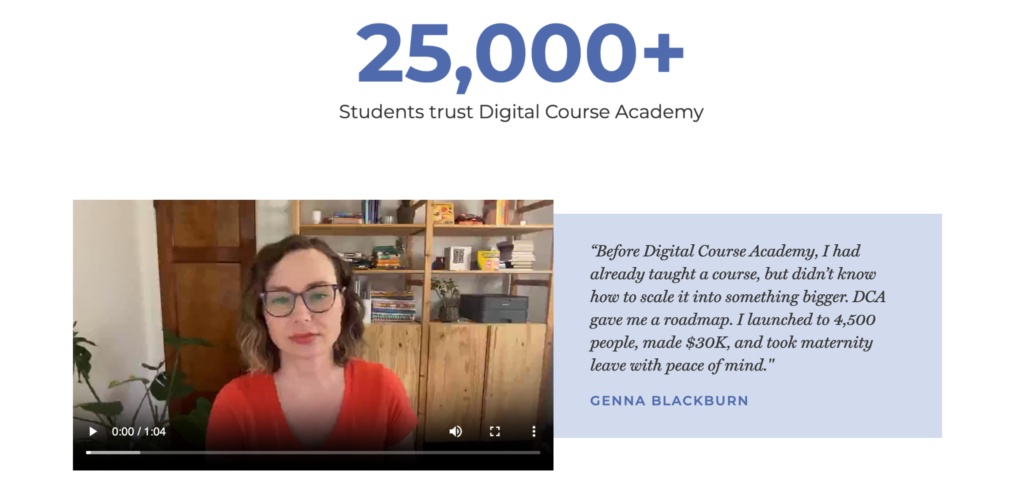
This is why user-generated stories tend to be especially persuasive. When a potential buyer reads about someone who started exactly where they are now, the transformation stops feeling like a highlight reel and starts feeling achievable.
They Balance Story With Hard Proof
A story alone is not enough. Justin Welsh is a good example of a creator who pairs personal narrative with concrete, specific numbers.
Marie and Amy do the same. Underneath the emotional storytelling, there are testimonials, outcome metrics, and scale indicators.
This combination is the key pattern to understand: the story opens the loop by creating curiosity and identification. Proof closes it by making the outcome believable. You need both.
The 5-Part Storytelling Framework Every Course Creator Can Copy
Once you understand why storytelling works, the next question is how to actually structure it on your sales page. Here is the framework that holds most high-converting course narratives together.
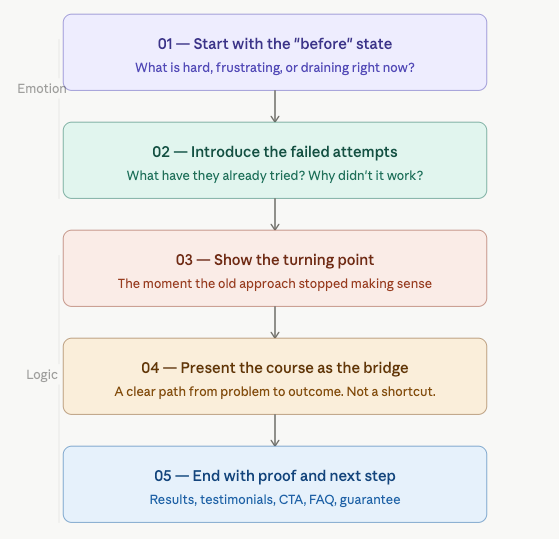
Start With the “Before” State
Your sales page should open inside your reader’s current reality. What is hard, frustrating, or draining for them right now? What is costing them money, time, or confidence?
The key here is language. Do not describe their situation in your words; use theirs. Pull from community posts, DMs, discovery call notes, or student feedback.
When a reader sees their exact words reflected back at them, they immediately feel understood. And a reader who feels understood keeps reading.
Introduce the Failed Attempts
Your reader has almost certainly tried to solve their problems before. They have bought another course, watched hours of YouTube tutorials, or attempted a DIY approach that went nowhere.
Acknowledging those failed attempts does two things.
First, it validates why they are still stuck. It was not their fault; the method was wrong.
Second, it creates the logical setup for your solution. You are not asking them to try something new out of nowhere. You are offering them a reason why this time will be different.
Show the Turning Point
Something stopped working the way it was supposed to, and that moment of failure pointed directly to what needed to change.
This is where your method enters the narrative. Not as a product launch, but as a direct response to what the old approach was missing. You are not introducing your course out of nowhere. You are showing the reader exactly why it had to exist.
That is what makes a turning point so useful in your sales story. It gives your course an origin; a logical reason for being built the way it was. And a course with an origin is far more believable than a course that simply lists what it covers.
Present the Course as the Bridge
Your course is not magic, and it is not a shortcut, and if you frame it that way, skeptical buyers will tune out immediately.
What it is is a clear, structured path from where your student is now to where they want to be. Name the steps. Show the progression. Help them see that the outcome is reachable because the route is logical, not because you are promising overnight results.
End With Proof and Next Step
Once the story is told, the reader needs to move from belief to decision. This is where you layer in student results, testimonials, and your curriculum breakdown.
If you have a guarantee, this is where it belongs. Close with a CTA and an FAQ that handles the last remaining objections.
Think of this final section as the handoff. The story did the emotional work. Now the proof and structure do the rational work. Give your reader both, and then make it very easy for them to say yes.
How to Use Storytelling Across the Whole Course Funnel
Your sales page is not the only place storytelling does its job. The most effective course launches use narrative consistently across every touchpoint. So, by the time a reader lands on the offer, the story already feels familiar.
- Lead magnet or free lesson: This is where the story begins. Your goal here is identification. The reader should finish your freebie thinking, “this person understands exactly what I am dealing with.”
- Email sequence: Use this space to deepen the problem and build belief. Each email can add a layer: a student story, a reframe, a common mistake, that moves the reader closer to seeing your course as the logical next step.
- Webinar or video: This is where you expand the transformation story in real time. Seeing and hearing you tell it builds a level of trust that written copy alone rarely achieves.
- Sales page: This is where everything connects. Your founder story, student stories, the offer, the proof, and the CTA all work together in one place.
Each touchpoint continues the same story. None of them stands alone.
How to Write Your Own Course Sales Story Step by Step
Do not wait until your sales page is due to figure out your story. Work through these steps first, and the copy will be significantly easier to write.
Step 01: Define Your Student’s “Before”
Ask yourself: before they find my course, what are they stuck with? What have they already tried? What is the frustration they have probably been sitting with for months?
Write it down in their language. Pull from comments, DMs, or conversations you have had with your audience. The closer your copy sounds to how they already describe their own problem, the faster they will trust you.
Step 02: Define Their Desired “After”
Now ask: what does success look like in concrete terms? Not “they feel more confident”, but what are they actually doing, earning, building, or experiencing differently?
How much time are they saving? What does their day look like now? What have they stopped worrying about? Specificity here is everything. A vague after state produces a vague sales page.
Step 03: Choose the Right Story Type
You have a few options depending on what you have available:
- Founder story: You had the problem, you solved it, now you teach it
- Student success story: Someone else went through your method and got results
- Origin story: Why this course exists and what problem it was built to solve
- Comeback story: a failure, a reset, and a better path forward
- Belief-shift story: the reader is operating on a wrong assumption, and the story corrects it
Pick the one that most directly connects your student’s before to their desired future. You do not need all five. One well-told story used consistently will outperform five scattered ones.
Step 04: Pull Out Specific Details
Vague stories do not convert. Go back through your chosen story and extract the following:
- Timeline: How long did this take? When did things start to change?
- Numbers: Revenue, hours saved, students helped, results achieved
- Failed attempts: What did not work before this, and why
- Emotional stakes: What was actually on the line? Confidence, income, relationships, time?
- Turning point: The exact moment the old approach stopped making sense
These details are what make a story feel real rather than manufactured. If you cannot find them, go back and have deeper conversations with your students or revisit your own journey more carefully.
Step 05: Translate the story into sales copy
Now you have the raw material. Structure it in this order:
Hook
Open inside the reader’s current problem. Your first line should make them think, “This is written for me.” Use the specific frustration you identified in their “before” state. If they are a beginner course creator who cannot get anyone to buy, say that. Do not open with how long you have been in the industry.
Example:
“You have been eating clean and working out five days a week for three months. The scale has barely moved, and you are starting to wonder if your body just does not respond the way other people’s do.”
Struggle
Show you understand what they have been through. Name the failed attempts. Acknowledge what they have already tried and why it did not work. This is not about dwelling on pain. It is about proving that you understand their situation well enough to actually help.
Example:
“So you hired a personal trainer. You tried intermittent fasting. You cut out sugar for six weeks. Each time, there was a little progress and then a plateau. And then back to square one. The problem was never effort. You had plenty of that.”
Shift
Introduce the turning point that changed everything. This is where the old approach breaks down, and your method enters. Keep it grounded. One clear realization is more persuasive than a dramatic transformation story.
Example:
“The issue was not discipline. It was that every plan was built for a generic body, not for how your metabolism actually works. Once that changed, so did the results.”
Method
Present your course as the logical outcome of that shift. Walk them through what they will learn and why each part exists. Connect every module back to the problem you opened with. The curriculum should feel like a direct answer to everything they have been struggling with.
Example:
“Week 2 is entirely about building your personal nutrition baseline, not a template, but a number that is specific to your body, your schedule, and your activity level. That is the number everything else is built around.”
Proof
Bring in student results, testimonials, and outcomes that make it believable. Do not just drop screenshots. Give each piece of proof context: who this person was before, what they did, and what changed. A result without a story behind it is easy to dismiss.
Example:
“James had been stuck at the same weight for two years before joining. Eight weeks in, he was down 11 pounds, but more importantly, he had stopped feeling like he was constantly failing at something.”
Invitation
Write a clear, direct CTA with no ambiguity about what happens next. Tell them exactly what to do, what they get, and what happens after they click. This is not the place for clever copy; it’s for clarity.
Example:
“Click enroll below. You will get instant access to all eight weeks of the program, the nutrition calculator, and the weekly check-in tracker. Start today, follow the plan, and see where you are in 30 days.”
The Biggest Storytelling Mistakes Course Creators Make
Knowing the framework is not enough if you are making one of these storytelling mistakes:
Making yourself the hero instead of the student
This is the most common storytelling mistake course creators make. Your story, your journey, your results — none of that is what closes the sale.
The reader needs to see themselves in the narrative, not you. Your story only earns its place on the page when it serves as proof that your student’s outcome is possible.
Telling a dramatic story that never connects to the course
A compelling story that has no logical link to what you are selling creates curiosity without direction. Every story element on your sales page should point toward the offer. If it does not, cut it.
Using vague inspiration instead of a specific transformation
“Change your life” and “reach your potential” are not transformations; they are placeholders. Your reader needs to know exactly what will be different, by how much, and in what timeframe.
Leading with earnings screenshots without context
A screenshot of a big revenue number with no story behind it does not build trust; it creates skepticism.
Who is this person? Where were they before? What did they actually do? Without that context, the number means nothing.
Forgetting ethical disclaimers when sharing results
If you are sharing income claims or dramatic transformation stories, you need to clearly state that results are not typical or guaranteed. Major creators like Amy Porterfield and Justin Welsh include these disclaimers on their pages.
You should do it not just because it is legally responsible, but because it is the honest thing to do.
Tell the Story Behind Your Course
Storytelling is not something you add to your sales page to make it feel warmer. It is the mechanism that makes the whole thing work.
Most beginner course creators treat it as a branding exercise. A way to seem more relatable or build a personal connection. That is not wrong, but it is incomplete.
The real job of a story is to move someone from “this sounds interesting” to “this is exactly where I am, and this course is my next step.”
People do not buy courses because information exists. There is more free information available right now than anyone could consume in a lifetime. What they are buying is belief. The belief that change is actually possible for them, specifically, given where they are starting from. A well-told story is what creates that belief.
That is what the best course pages do. They show the reader a better version of themselves that feels within reach. And then make it very easy to take the first step toward it.
So start there. Pick one story, work through the framework, and write the first draft. It does not have to be perfect. It just has to be true.




Leave a Reply