
You can spend months creating a great online course, only to watch most students disappear after the first few lessons. They buy the course, watch two or three videos, and plan to come back later. Later rarely comes. The problem is often not your content. It is the lack of structure around it.
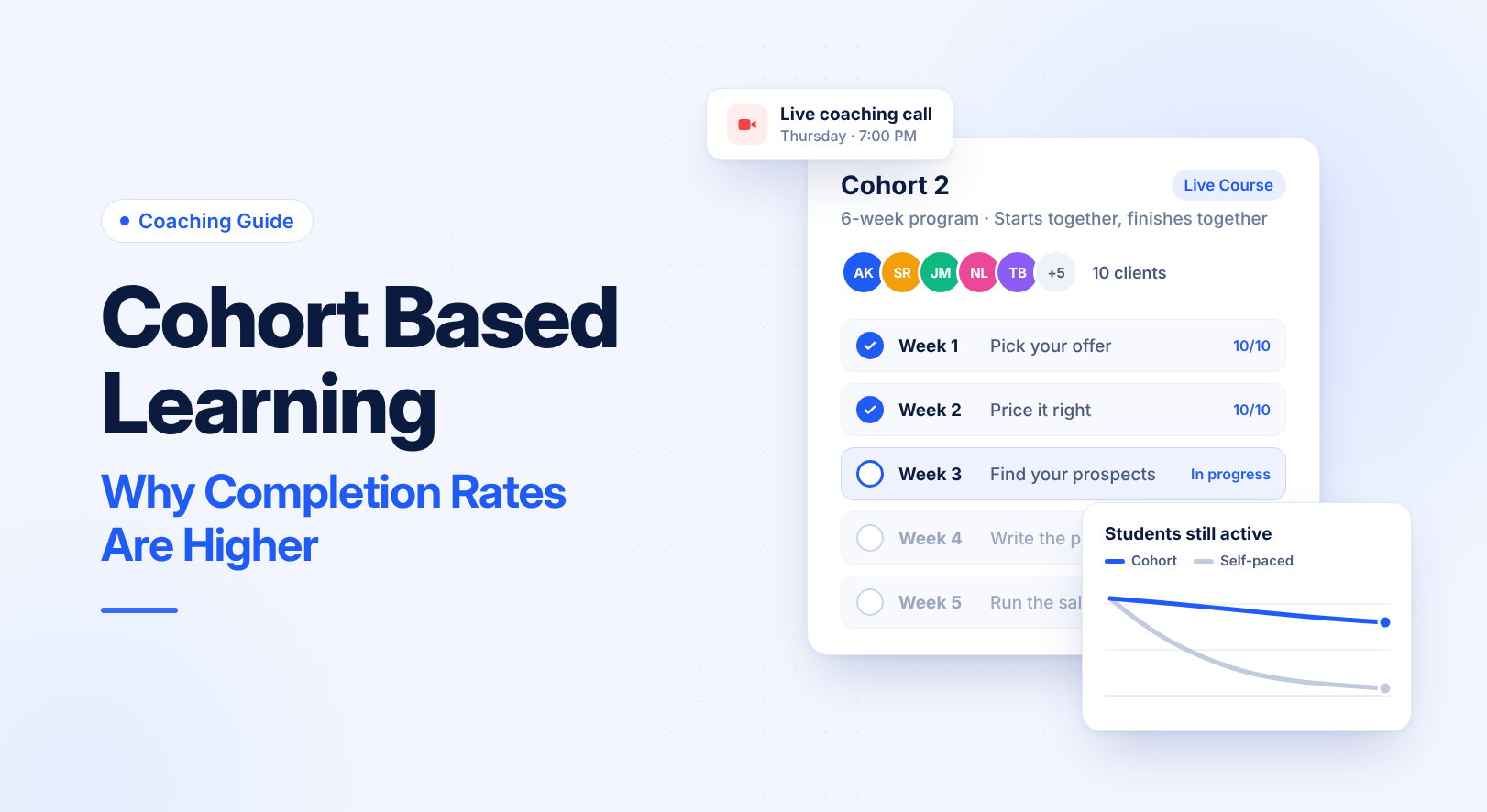
Cohort based learning takes a different approach. A group of students starts on the same date, follows the same schedule, completes assignments together, and meets for live sessions. Ruzuku’s platform data found that scheduled cohort courses had a 53.4% completion rate, compared with 41.9% for open-access courses.
But why do cohorts keep students moving when self-paced courses often do not? And how much higher are completion rates in real programs, rather than the 90%+ figures you often see online?
This guide shows you what cohort-based coaching is and how a program runs week by week. You will see the five reasons completion goes up and how much it really goes up. You will also see what the format costs you. Then you can decide if a cohort fits your coaching business.
TL;DR
- Cohort-based coaching puts a group of clients through one program on one schedule, with live coaching and a fixed start and end date.
- It differs from ongoing group coaching. A cohort has a set curriculum and a finish line.
- Completion goes up for five reasons: a shared start date, being seen by peers, live checkpoints, a visible end, and a bigger commitment at purchase.
- The famous 90%+ completion figures are mostly self-reported by cohort programs. Independent platform data still shows cohorts ahead of open self-paced courses.
- Cohorts cost you calendar freedom, steady cash flow, and live energy. They fit skills that need practice and feedback.
- Small cohorts, a weekly rhythm, and a strong first week matter more than polished video.
What Is Cohort-Based Coaching?
Cohort-based coaching is a coaching program where a group of clients starts together and finishes together. Everyone works through the same steps on the same dates. You teach the core method once. Then you coach each person live as they apply it.
A typical program runs four to eight weeks. Clients get a short lesson or worksheet each week. They do the work between calls. On the live call, you review their work, answer questions, and fix what is stuck.
The word “coaching” matters here. A cohort course can run on lessons and discussion alone. Cohort coaching adds your judgment on each learner’s real situation. That feedback is the part clients pay a premium for.
Many creators mix this up with group coaching. Group coaching is often ongoing, with clients joining any month and topics changing call to call. A cohort has a fixed start date, a fixed end date, and a set sequence. That structure is what moves completion.
Here is how the main delivery formats compare for your business:
| Format | Start date | Live time with you | Peer contact | Your hours per client | Price per client |
| 1:1 coaching | Anytime | High | None | Highest | Highest |
| Cohort-based coaching | Fixed, shared | Weekly group calls | High | Low | Mid to high |
| Ongoing group coaching | Rolling | Regular group calls | Medium | Low | Mid |
| Self-paced course | Anytime | None or little | Low | Near zero | Lowest |
A cohort sits in the middle. You earn more per hour than 1:1 work because one call serves the whole group. Your clients still get live access to you, which a self-paced course cannot give them. If you are still choosing between selling your time and selling content, our guide on coaching vs course creation walks through that decision.
Why Cohort Based Learning Gets Higher Completion Rates
Students rarely quit because your lessons are weak. They quit because nobody notices when they stop. Abe Crystal, founder of the course platform Ruzuku, puts it plainly: “They drop out because they are alone.”
His platform data backs this up. Across 26,632 courses and 1.3 million enrollments, courses with lesson-level discussion had 50.9% completion. Courses without it had 37.3%. Scheduled cohort courses reached 53.4%, against 41.9% for open-access courses.
Those numbers show a link, and Ruzuku says so. They do not prove cohorts cause the whole gap. Still, five clear mechanisms explain why a group on a schedule finishes more often.
1. A Shared Start Date Removes “I’ll Start Later”
A self-paced course is always available. So there is always a reason to start next week. A cohort turns the start into an event with a date. Missing it means falling behind people you know.
To use this, close enrollment a few days before the start. Open with a live kickoff call on day one. Put the start date on your sales page and in every reminder.
The common mistake is a “cohort” people can join any day. That is a self-paced course with a group chat. It loses the pull of a shared start.
2. People Notice When You Are Missing
In a group, absence is visible. When five peers post their work and you have not, you feel the gap. HBS Online describes this in its cohort courses: “No one wants to be the one who falls behind.”
Visibility only works when people know each other. Split larger cohorts into pods of four to six. Ask each pod to share progress before the weekly call. Call people by name on calls.
A cohort of 80 strangers loses this effect. Nobody feels missed in a crowd. Keep the group small enough that a missing face stands out.
3. Live Calls Work as Checkpoints
Each live call is a small deadline. Clients do the assignment because they know you will look at it. Six calls give you six chances to catch someone who slipped.
Deadlines alone are not enough. In 2002, Dan Ariely and Klaus Wertenbroch found that evenly spaced outside deadlines improved performance. A 2026 replication in Psychological Science did not reproduce that result. The lesson for you: a date on a calendar does little by itself. A date tied to people who expect your work does much more.
So build calls around submitted work. Run hot seats on two or three assignments each week. When the call depends on the homework, the homework gets done.
4. A Visible Finish Line Makes the Effort Feel Bounded
Six weeks feels doable. An open course with 40 lessons feels endless. Clients commit more easily to a program with an end date they can see.
Name the final week and what happens in it. A demo day, a final review, or a group showcase gives people something to aim for. Show progress against the end each week.
Avoid stretching the program because some clients fell behind. Extensions blur the finish line for everyone. Offer a spot in the next cohort instead.
5. A Bigger Commitment at Purchase
Price changes behavior. On edX, only 3.13% of all MIT and Harvard course participants finished in 2017-18. Among learners who paid for the verified track, 46% finished, as Inside Higher Ed reported from the MIT study. Same courses, different commitment.
Cohort coaching usually costs more than a self-paced course. That higher price filters for clients who plan to do the work. A short application form adds a second filter.
Discounts pull the other way. A deep discount fills seats with people who were never sure. Those seats are the first to go quiet.
What a 6-Week Cohort Looks Like, Week by Week
A cohort works best when every week has the same rhythm. Clients learn on Monday, work midweek, and bring that work to a live call. Say you coach freelance designers. Your program helps them land their first monthly retainer client in six weeks.
| Week | Lesson | Assignment | Live call |
| 0 | Welcome and setup | Post your goal and current client list | 30-minute kickoff |
| 1 | Pick one retainer offer | Write a one-page offer | Review each offer |
| 2 | Price the retainer | Set three price tiers | Pricing hot seats |
| 3 | Find 20 prospects | Build a prospect list | Fix weak lists |
| 4 | Write the pitch | Send 10 pitches | Review replies |
| 5 | Run the sales call | Book two calls | Live role-play |
| 6 | Close and onboard | Send one proposal | Wins and next steps |
Week 0 does more work than it looks. Clients meet each other, share a goal, and learn the schedule. A client who posts on day one already has a reason to return. A client who stays silent the first week is the one most likely to drop.
Each assignment feeds the next call. You review the offers clients wrote, so they come prepared. That link between the work and the call keeps people moving. If the call only repeats the lesson, clients learn they can skip the work.
The last week ends with a result anyone can see. A proposal sent or a client signed gives the cohort a real finish. It also gives you testimonials with specific outcomes. Those stories sell your next cohort.
How Much Higher Are Completion Rates, Really?
You will see “cohorts get 90% completion” on many sites. That number comes from a few standout programs that report their own results. Independent data shows a smaller gap. The gap is still real.
| Program or dataset | Format | Completion | Reported by |
| MIT and Harvard courses on edX, all participants, 2017-18 | Free, self-paced | 3.13% | MIT researchers in Science |
| Same courses, paid verified learners, 2017-18 | Paid, self-paced | 46% | Same study |
| Open-access courses on Ruzuku | Self-paced | 41.9% | Ruzuku platform data, Aug 2026 |
| Scheduled cohort courses on Ruzuku | Cohort | 53.4% | Same dataset |
| HBS Online | Cohort with weekly deadlines | 85% | HBS Online |
| altMBA | Intensive cohort, about 10 students per coach | 96% to 97% | altMBA, via Disco |
Three things push the headline numbers up. First, the highest figures are self-reported by the programs themselves. Second, those programs select their students. altMBA asks for heavy daily work, so the people who enroll are already committed.
Third, “completion” means different things in different reports. Some count everyone who registered. Others count only people who started. The MOOC figure counts every sign-up, including people who never opened a lesson. That alone makes it look worse.
So what should you expect? On the same platform, Ruzuku’s scheduled cohorts finished about 11 points higher than open-access courses. That is a fair baseline for adding a schedule alone. Programs that add live coaching, small groups, and a real price reach well above it.
The practical move is to measure your own baseline first. Check how many buyers of your current course finish it. Run one cohort and compare. Your own numbers will tell you more than any industry average.
What Running Cohorts Costs You

Cohorts raise completion, but you pay for it in time and flexibility. Most guides skip this part. Know these costs before you plan your first launch.
Your revenue arrives in launches. A self-paced course can sell any day. A cohort sells in a window before each start date. Between cohorts, sales drop. Many coaches fix this by keeping a self-paced version on sale between cohorts. Others run cohorts on a fixed calendar, such as every quarter.
Your calendar is locked for weeks. Six weekly calls mean six weeks you cannot travel or skip. A sick day affects the whole group. Plan cohorts around your busy seasons. Record calls so a missed date does not break the program.
Time zones shrink your audience. A 9 am call in London is 4 am in New York. If your buyers are spread across the world, one call time will exclude some of them. You can offer two call times, though that doubles your live hours. Or you can market to one region per cohort.
Live teaching takes more energy. Recording a course is hard work done once. Running a cohort means showing up with energy every week, for every group. Some coaches burn out after a few rounds. Keep cohorts short and leave a break between them.
Group size has a ceiling. Coaching quality drops when a call has too many people. Past a certain size, you need a second coach or more calls. That raises your cost per client. Price with this ceiling in mind from the start.
When a Cohort Is the Right Format (and When It Isn’t)
A cohort fits when your clients need to practice, get feedback, and try again. It is a poor fit when they mainly need information they can look up. Use these signs to decide.
A cohort is a good fit when:
- Your clients follow the same path. If your 1:1 clients keep asking the same questions in the same order, you already have a curriculum. A cohort lets one call serve all of them.
- The skill needs feedback. Pitching, writing, design, and leadership improve when someone reviews the work. Peers add a second round of feedback for free.
- The outcome takes weeks of action. Landing a client or building a habit needs steady effort. A schedule keeps that effort going.
- You can charge a real price. Live coaching is worth more than video. A higher price also brings in more committed clients.
- Your audience is small but engaged. You do not need thousands of buyers. Ten committed clients can fill a strong cohort.
A cohort is a poor fit when:
- Your content is reference material. Software tutorials or recipe libraries get used when needed. A schedule adds nothing there.
- Your buyers are in many time zones. If no call time works for most of them, live checkpoints fall apart.
- Your price point is low. At a low price, live calls eat your margin fast.
- You cannot commit fixed hours. If your schedule changes week to week, clients will feel it.
Most coaches do not jump straight to cohorts. They start 1:1, notice a repeated process, and then test a group program. Our guide on how to grow your online coaching business shows when to add group delivery and how it changes your revenue per hour.
How to Design a Cohort People Actually Finish
Completion is mostly decided by structure. Group size, program length, and the first week matter more. Get these five decisions right before you record anything.
Keep Groups Small
Small groups make absence visible and give everyone time on the call. altMBA runs learning groups of 10 students with a dedicated coach. Coaching platform Boldly suggests four to six people for group coaching.
For a first cohort, aim for 6 to 12 clients. That is enough for real peer feedback. It is small enough for you
to review everyone’s work. If demand grows, add a second group with its own call time.
Keep It Short
Most cohort programs run four to eight weeks. Maven courses, for example, usually run two to six weeks. Shorter programs keep energy high and the finish line close.
If your method takes three months, split it into two or three shorter cohorts. Each one gets its own start and finish. Clients who finish part one already trust your method. That makes part two an easier sale.
Use the Same Weekly Rhythm
Pick one pattern and repeat it every week. Lesson on Monday, assignment by Wednesday, live call on Thursday works well. Clients stop thinking about the schedule and start doing the work.
Release lessons week by week instead of all at once. Opening everything on day one lets fast clients race ahead and slow clients feel behind. Our post on drip content explains how pacing lessons keeps learners engaged.
Win the First Week
The first week predicts the rest. In Ruzuku’s data, students who finished a lesson in week one completed 78.3% of the time. Students who did not completed 17.2% of the time.
So make week one easy to start. Ask for an introduction post and one small task. Hold a short kickoff call. By day seven, message every client who has not posted yet. A personal note works better than an automated email.
Measure Completion the Right Way
Decide what “complete” means before the cohort starts. A good definition is a finished final assignment, such as a proposal sent. Watching all videos is a weaker signal.
Then track it the same way every cohort. Count completions against clients who started. Note where people went quiet. That week is where your next cohort needs a fix.
Running Cohort-Based Coaching on Klasio
Klasio lets you run a cohort as a Live Course with its own dates, weekly curriculum, and student list. You can run several cohorts of the same course without rebuilding anything. Here is how each part maps to the design steps above.
Each cohort gets its own start and end date. When you create a cohort, you give it a name, a start date, and an end date. Klasio splits the curriculum into weeks with date ranges, such as Week 1 from Aug 5 to Aug 9. You add lessons, assignments, and quizzes to each week. Clients see what is due and when, which supports the weekly rhythm.
You control enrollment and visibility per cohort. Each cohort has its own enrollment switch and visibility setting. You can close enrollment for Cohort 1 once it starts and open it for Cohort 2. That keeps a shared start date intact. Late buyers go to the next cohort instead of joining midway.
You can duplicate a cohort for the next round. The New Cohort option lets you start from scratch or copy an existing cohort. A copy brings over everything except uploaded files. Your second cohort takes minutes to set up, so running cohorts every quarter stays practical.
Video
Live calls run through Zoom or Google Meet. You connect your preferred provider and add live sessions to the course. Clients join from the same place they find their lessons. Notices let you post reminders and updates to the cohort.
Community keeps peers talking between calls. Klasio’s Community feature, added in September 2026, gives you discussion channels inside your academy. You can make a community paid or private and link it to a course. Members earn points and levels for posting, and a leaderboard shows activity. Pods can share progress there before each call.
Payments run through Stripe. You can charge a one-time price for a cohort or set up recurring billing. Your sales page lives on the same site through the Page Builder.
One honest limit: Klasio has no native booking calendar. If you also sell 1:1 sessions alongside your cohort, you will need a tool like Calendly for clients to pick a time slot. For group calls on a fixed schedule, this does not affect you.
Should You Run Your Coaching as a Cohort?
Cohort based learning works because it gives clients a start date, peers who notice them, live checkpoints, and a finish line. The completion gains are real. They are smaller than the 90% headlines suggest, and they come with a cost to your calendar.
Choose a cohort if your clients follow a similar path, need feedback on their work, and can meet at a shared time. It suits coaches who already see the same questions from 1:1 clients and want to serve more people per hour.
Stay with a self-paced course if your content is reference material, your price is low, or your buyers are spread across time zones. Add a discussion space to lift completion without live calls.
Stay with 1:1 coaching if each client’s problem is deep and personal, or confidentiality matters. A group setting will not give those clients what they need.
If you are still shaping the business around your coaching, start with our guide on how to build a successful online coaching business. When you are ready to run your first cohort, you can set it up on Klasio with dated weeks, its own enrollment window, and a community for your clients. Start for free.
Frequently Asked Questions
How do I price a cohort-based coaching program?
You price a cohort-based coaching program by starting from the outcome, then checking it against your two other formats. The price should sit above your self-paced course and below your 1:1 package for the same result. Clients get live access to you, but they share it with the group. Next, check the math. Multiply the price by your planned group size and divide by your total live hours, including review time. If that hourly figure is below what you earn 1:1, raise the price or cut the number of calls. Test your first cohort at a launch price and raise it once you have results to show.
Can I turn my existing self-paced course into a cohort?
You can turn your existing self-paced course into a cohort by adding a schedule, a live layer, and a group around the lessons you already have. Map your modules to weeks and release them one week at a time. Add one assignment per week that clients bring to a live call. Then set a start date and close enrollment before it. Many creators keep the self-paced version on sale too. The cohort becomes the premium option with live coaching, and the course stays the lower-priced entry point.
How often should I run a new cohort?
You should run a new cohort as often as you can fill it and still rest between rounds. For most solo coaches, that means every two to four months. Running back to back leaves no time to fix what the last group struggled with. Waiting too long lets interest from your waitlist go cold. A fixed calendar, such as one cohort each quarter, helps your audience plan ahead. It also lets you promote the next start date to everyone who missed the current one.
Can students join a cohort after it starts?
Students can join a cohort after it starts, but it usually hurts both them and the group. A late joiner misses the kickoff, the first assignments, and the early bonding inside their pod. They often stay quiet in week one. In Ruzuku’s data, week-one silence is the strongest early sign a student will not finish. A cleaner policy is a short grace period, such as the first three days. After that, offer a seat in the next cohort. That protects your shared start date and gives the late buyer a fair start.
What refund policy works for a cohort-based program?
A refund policy that works for a cohort-based program is one with a clear cutoff tied to the schedule. A common setup allows full refunds until the first live call or the end of week one. After that point, clients have taken a seat other people could have filled. Some coaches offer a transfer to the next cohort instead of a refund later on. Write the policy on your sales page and in your welcome email. Check local consumer rules too, since refund requirements differ by country.
What should happen after a cohort ends?
After a cohort ends, you should give clients a clear next step so the relationship continues. An alumni community lets past clients keep sharing wins and questions. A follow-up call 30 days later checks if results held. You can also offer a next-level cohort or a 1:1 package for people who want more help. Ask for testimonials in the final week while results are fresh. Those stories become the strongest proof for your next launch.




Leave a Reply