
Your coaching calendar is full. On paper, that should feel like success. But your income has stopped growing. You cannot add another client without giving up evenings or weekends. Raising prices feels risky, and if you take a week off, your revenue takes the week off with you.
So you try to market harder. More content, more emails, more discovery calls. The effort brings in more leads, but it only sends more people toward a calendar that is already full.
Your marketing is not the problem. Your business model is.
A coaching business becomes easier to grow when every sale does not create another hour of delivery. That does not mean abandoning private coaching. It means using what you have learned from your clients to build offers that serve more people at different price points.
This guide covers seven revenue streams you can add to an online coaching business, what each realistically looks like in numbers, what it takes to launch, and the order to build them in. It is for coaches who already have a few paying clients, know they can create results, and want to grow revenue without trying to clone themselves.
TL;DR
- Start by improving your existing 1:1 coaching offer. Package it around a fixed outcome, sell three- to six-month commitments, and raise prices when client results support the increase.
- Add group coaching once your private clients begin asking the same questions and following the same process. It lets one live hour serve several clients.
- Turn your proven coaching method into a small signature course. Presell it before recording the full curriculum so real buyers validate the idea.
- Use a membership to create recurring revenue, but do not mistake recurring billing for passive income. Retention requires fresh value, engagement, and a reason to stay.
- Sell templates, workbooks, and toolkits taken from materials you already use with clients. These low-priced products can turn subscribers into buyers and lead them toward larger offers.
- Run a paid workshop when you want the fastest offer to launch. Use it to generate direct revenue and introduce people to your course or group program.
- Create bundles and three pricing tiers only after you have several proven offers. Each new revenue stream should be fed by the one before it, and one new stream per quarter is enough.
Why One Revenue Stream Puts a Ceiling on Your Coaching Business
Private coaching is one of the simplest knowledge businesses to start. You find someone with a problem, help them solve it, and get paid for your time and expertise.
The problem appears when you try to grow.
The numbers behind the profession make the ceiling visible. According to the 2025 ICF Global Coaching Study, conducted by PwC, the average coach charges $234 per hour, delivers about 11.6 coaching hours per week, and earns roughly $49,283 per year. The same study found that 59% of coaches expect their revenue growth to come from adding more clients and more sessions, not from raising fees.
In other words, most coaches plan to grow by giving up more hours. That plan works until the calendar runs out.
Imagine you charge $150 per session and deliver 25 sessions a week. Using a four-week month, your revenue ceiling is about $15,000 per month.
That sounds strong until you look at what it requires.
You are spending 100 hours a month on calls alone. That does not include preparation, client notes, follow-ups, rescheduling, sales calls, content, or administration. You are also assuming every slot stays full and every client pays on time.
To earn more, you have only three immediate options:
- Raise your price.
- Add more sessions.
- Hire other coaches.
All three can work, but each has a limit. Prices cannot rise forever, your calendar cannot stretch forever, and hiring turns you into a manager before you may be ready to become one.
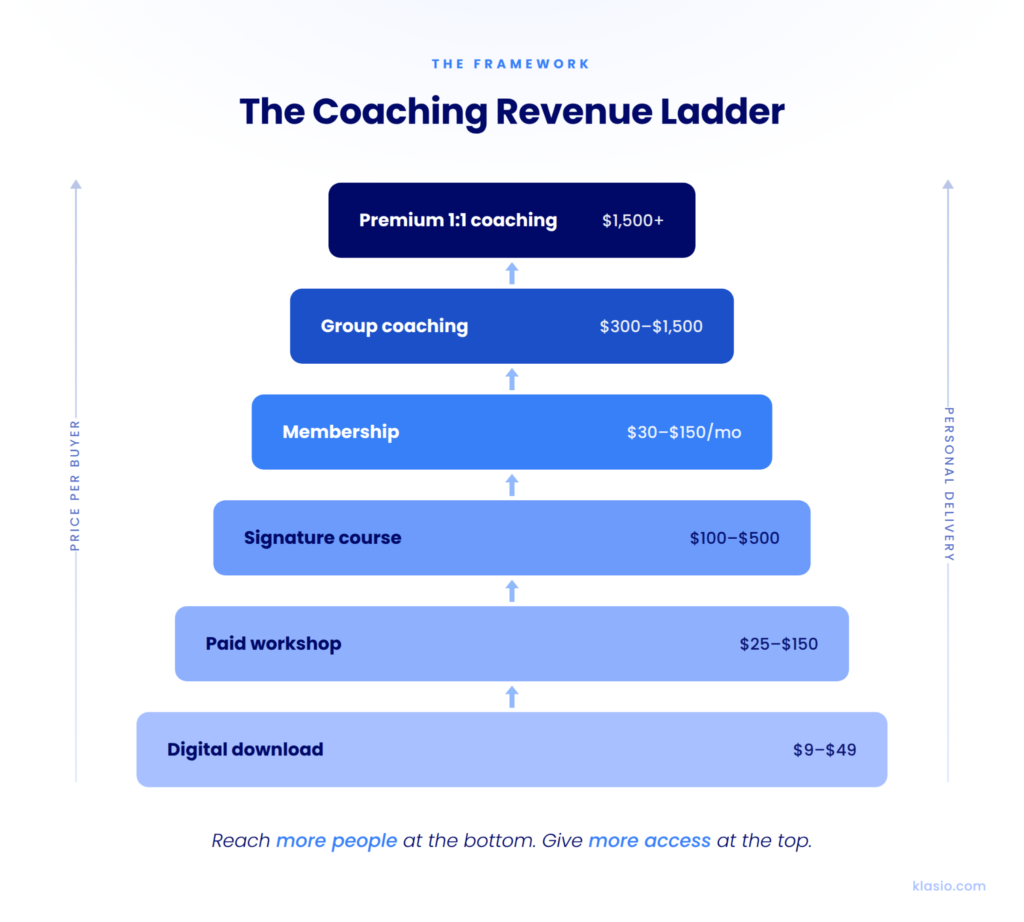
The more sustainable option is to build a Coaching Revenue Ladder.
The ladder gives people several ways to learn from you. A new buyer might begin with a $19 workbook, use it to get a quick result, buy your $249 course, join a $900 group program, and eventually upgrade to private coaching.
| Rung | Typical offer | Example price | Delivery effort per new buyer |
|---|---|---|---|
| 1 | Digital download | $9–$49 | Very low |
| 2 | Paid workshop | $25–$150 | Low after the event is created |
| 3 | Signature course | $100–$500 | Low after production |
| 4 | Membership | $30–$150/month | Ongoing shared delivery |
| 5 | Group coaching | $300–$1,500 | Shared live delivery |
| 6 | Premium 1:1 coaching | $1,500+ per package | High personal delivery |
The important part is not having six price points. It is having a natural path between them.
Your download introduces your method. Then, your workshop helps the buyer apply one part of it. Next, your course teaches the complete framework. And, your group program adds support and accountability. Finally, your private offer gives a smaller number of clients personalized help.
That is how the streams feed each other instead of competing with each other.
Here is what a lean, mostly do-it-yourself launch can look like:
| Revenue stream | Example offer price | Lean launch budget | Practical launch time |
|---|---|---|---|
| Premium 1:1 coaching | $1,500+ per package | $0–$200 | 1–2 weeks |
| Group coaching | $300–$1,500 per seat | $100–$500 | 4–8 weeks |
| Signature course | $100–$500 | $200–$2,000 | 6–12 weeks |
| Membership | $30–$150/month | $100–$500 | 4–8 weeks |
| Digital download | $9–$49 | $0–$200 | 1–3 weeks |
| Paid workshop | $25–$150 | $0–$300 | 2–4 weeks |
| Bundle or tiers | Varies by products included | $0–$200 | 1–2 weeks |
These budgets assume you create most of the content and use an existing audience. They cover basic software, design, and setup, not paid advertising or the value of your own time. Professional video production, custom websites, outside copywriting, and paid traffic can increase the cost considerably.
Most substantial new offers take 30 to 90 days to validate, build, and launch properly. Do not try to add all seven this year. The goal is to remove pressure from your calendar, not create seven new jobs for yourself
Before You Add a New Revenue Stream
A new offer will not repair a coaching business that has not yet proven it can create results.
Before you record a course, open a membership, or build a library of templates, make sure the following pieces are in place:
- A proven coaching offer: You should have paying clients who have completed enough of your process to show that it works. If the current offer is not selling or producing results, fix that before adding another one.
- A defined niche and transformation: “Business coaching” is too broad. Something like “Help freelance designers reach their first $5,000 month” gives you a problem, audience, and result around which to build products.
- A small audience or email list: You do not need tens of thousands of followers. You do need a group of people you can talk to, learn from, and invite into the first version of the offer.
- A place to host and sell your offers: At minimum, you need a sales page, checkout, delivery system, and a way to communicate with buyers. A platform such as Klasio can keep your coaching, courses, cohorts, subscriptions, webinars, and downloads in the same academy.
- Two or three documented client outcomes: Save the starting point, process, result, and client quote. These stories give future buyers a reason to trust the new offer. If you are still building proof, start with this guide to building credibility as a course creator.
You should also speak to potential buyers before building. A presale is more useful than a room full of compliments because it shows whether people will pay for the result. Klasio’s guide on how to presell an online course walks through that validation process.
Once these pieces are ready, you can choose the next revenue stream based on the stage of your business.
Revenue Stream #1: Premium 1-to-1 Coaching
The first “new” revenue stream is not new at all.
Before you add products, improve the offer that already pays you. Many coaches try to escape 1:1 work when the real problem is that they are selling isolated sessions with unclear outcomes.
Private coaching should become your premium offer, not the default way everyone works with you.
Raise prices based on proof, not tenure
Being a coach for another year does not automatically make the offer more valuable. Producing clearer, faster, or more reliable results does.
A practical time to test a price increase is when you have:
- At least three documented client outcomes.
- A clear process you can explain before the client buys.
- More qualified inquiries than you can comfortably accept.
When those conditions are present, increase the price by 15% to 25% for new clients or at the next renewal. A $1,800 package might move to $2,100 or $2,250.
Do not send clients a vague message saying your “rates have changed.” Connect the price to a stronger offer. Explain the result, the support included, and the improvements you have made to the process.
Sell longer packages instead of individual sessions
Single sessions make revenue unpredictable. Every appointment creates another moment when the client can delay, cancel, or decide not to continue.
Packages create commitment around the transformation.
For example, a client booking one $150 session each week is worth $600 in a four-week month. If they continue for three months, their total value is $1,800, but only if they remember to rebook 12 times.
A 12-week package priced at $1,800 creates the same revenue with one buying decision. A six-month package at $3,600 creates $600 in predictable monthly revenue from that client. You can collect it upfront or use a payment plan.
The package also gives you enough time to work toward a meaningful result. That is easier to sell than “four calls per month.”
Productize the offer
A productized coaching offer has a fixed audience, scope, outcome, timeline, and price.
Instead of:
Book a coaching call with me.
Try:
Build and launch your first client acquisition system in 12 weeks through weekly private calls, personalized reviews, and an implementation plan.
The second offer tells the buyer what they are buying and when they can expect to reach the outcome. It also makes your delivery more repeatable because each client moves through the same core process.
Premium 1:1 coaching fits every stage of a coaching business. Early on, it helps you discover what clients need. Later, it becomes the high-touch offer at the top of your ladder.
With Klasio Coaching, you can create structured coaching packages and offer them beside the rest of your academy. If you are still deciding what to charge, read how to price an online course as a beginner and apply the same outcome-first thinking to your coaching package.
Revenue Stream #2: Group Coaching Programs
Group coaching changes the revenue math because one delivery hour serves several clients.
Suppose one private client pays $150 for an hour. Fifteen group members paying $200 per month generate $3,000 in monthly revenue. If the program includes one group call each week, four live hours produce $750 in revenue per delivery hour before support and administration.
That does not make group coaching automatically better. It makes it the one with more leverage.
This is the model behind some of the most successful creator education businesses. Ali Abdaal’s Part-Time YouTuber Academy launched as a live cohort program in November 2020 and served more than 1,000 students across its first three cohorts, with seats priced between $1,995 and $5,995. One curriculum, delivered live to a group moving through the same transformation together, produced revenue that no 1:1 calendar could match.
You do not need Ali’s audience to use the same structure. A first cohort of 10 people from your own waitlist follows the exact same economics at a smaller scale.
Choose one transformation for the group
Do not build a group for “people who want coaching.” Build it for people trying to achieve the same result.
Strong group outcomes sound like the following:
- Sign your first three freelance clients.
- Prepare for a first management role.
- Build and launch a paid newsletter.
- Complete your first half-marathon safely.
When everyone wants the same result, their questions help each other. When the goal is too broad, every call turns into several unrelated private sessions performed in public.
Build a six- to eight-week journey
A simple group program can include:
- One live coaching call each week.
- One lesson, exercise, or milestone for that week.
- A shared workspace or discussion area.
- An accountability check-in between calls.
- A clear start date and completion date.
Each week should move participants one step closer to the final transformation. Avoid filling the schedule with guest speakers, bonus calls, and extra resources before you know the core journey works.
Price the result and level of access
For many consumer and creator niches, a six- to eight-week group program can start between $300 and $1,500 per person. The right position within that range depends on the financial value of the outcome, your proof, the size of the group, and how much direct feedback each participant receives.
A career program that helps senior professionals negotiate higher compensation can justify a different price from a general productivity group.
Here is simple worked math:
| Seats | Price per seat | Cohort revenue |
|---|---|---|
| 10 | $500 | $5,000 |
| 15 | $750 | $11,250 |
| 20 | $1,000 | $20,000 |
These are revenue examples, not guarantees. You still have to fill the seats, deliver the program, pay any platform or marketing costs, and account for refunds.
Fill the first cohort from warm demand
Your first participants should come from people who already know your work:
- 1:1 clients who want continued support at a lower price.
- People on your private coaching waitlist.
- Past clients who want accountability.
- Course students who need help applying what they learned.
- Email subscribers who have attended your free training.
Group coaching works best after private coaching has proven the method. If you are still giving every client completely different advice, keep working 1:1 until the repeated process becomes visible.
For a deeper comparison, read 1:1 coaching vs group coaching. You can then use Klasio Live Cohort to organize the scheduled learning experience around your group.
Revenue Stream 3: A Signature Online Course
A signature course is your coaching method recorded and organized into a repeatable learning experience.
It is the first stream on this list that can sell without adding a live hour for every new buyer. But that scalability only matters if the course solves a problem people already want help with.
This is why the most successful course creators are usually known for one signature program, not a catalog of small products. Amy Porterfield built her business around a flagship course that packages her complete method, and her sales pages have generated millions in revenue by selling one clear transformation. One deep course you can improve every year beats five shallow ones competing for your attention.
Build from real client questions
Open your notes from the last 10 coaching clients. Look for questions you have answered repeatedly, exercises you assign often, and moments where clients tend to get stuck.
Those patterns are the raw material for your curriculum.
Do not sit in front of a blank document and ask, “What do I know about this topic?” That question produces an encyclopedia. Ask, “What does a client need to do, in order, to reach one result?” That produces a course.
Presell before you record
A presale asks buyers to commit before the full course has been produced. You explain the outcome, curriculum, delivery schedule, and early-buyer price clearly. Then you build for the people who paid.
This protects you from spending three months recording a course that no one buys.
It also gives you a useful first version: deliver the lessons live to a small group, answer their questions, and record what needs to become evergreen. The questions from that first group will show you where the course needs more explanation.
Follow the complete online course preselling process before you invest heavily in production.
Keep version one small
Your first course does not need 40 hours of video. It needs one useful outcome.
Aim for four to six modules. Each module should move the student through one necessary stage of the process. Add a worksheet, template, or action step only when it helps the student apply the lesson.
A smaller course is faster to finish, easier to update, and more likely to produce testimonials you can use in the next launch.
Price it high enough to support the next step
A focused self-paced course often sits between $100 and $500. The right price depends on the result, audience, proof, and support included.
Underpricing may hurt more than your revenue. A $29 course promising to help someone build a profitable consulting offer may feel less credible than a focused $249 program with proof and a clear process.
For example, 40 sales of a $249 course generate $9,960 in gross revenue. The same 40 sales at $49 generate $1,960. The lower price requires more than five times as many buyers to reach roughly the same revenue.
Price is only one part of the sale. Your page must explain the problem, outcome, proof, curriculum, objections, and next step. Don’t forget to check our guides on creating a course sales page and using storytelling to sell an online course when you write it.
You can host the curriculum, lessons, assessments, and student experience with Klasio Courses.
Revenue Stream 4: Memberships and Subscriptions
A membership creates a recurring-revenue floor under the rest of your business.
If 75 members pay $49 per month, the membership produces $3,675 in monthly recurring revenue before churn, fees, and expenses. That makes planning easier than beginning every month at zero.
But recurring billing does not create recurring value by itself.
Pat Flynn’s Smart Passive Income is the clearest public example of this transition done deliberately. By 2020, SPI was earning over $1 million per year from individual course launches. Then the team moved the entire business toward recurring membership: SPI Pro in 2020, an All-Access Pass in 2022, and finally one tiered community in 2024 that includes the full course library, monthly workshops, office hours, and a private forum for $99 per month or $990 per year.
The result was predictable monthly revenue instead of launch-to-launch spikes. But notice what the membership contains: live calls, fresh workshops, and active community management. SPI did not replace work with recurring billing. It replaced launch work with retention work.
Give members a reason to stay
A coaching membership can include:
- One or two monthly Q&A calls.
- A private discussion space.
- A growing library of templates and resources.
- Access to one or more courses.
- Monthly implementation challenges.
- Feedback sessions or office hours.
Choose a small number of benefits you can deliver consistently. Members are more likely to use one valuable monthly call and a focused resource library than 17 benefits they cannot navigate.
Match the price to access and ongoing value
Use these bands as starting points, not fixed rules:
- $30–$50 per month: Community, resource access, and a shared monthly call.
- $50–$100 per month: More frequent coaching, structured challenges, or a stronger course library.
- $100–$150 per month: Direct feedback, smaller groups, deeper access, or an outcome with clear financial value.
The price should make sense against the alternative. If a private hour with you costs $250, a $79 monthly group membership may feel accessible. If your only benefit is a collection of old recordings, even $29 can feel expensive.
Treat retention as the real work
Churn is the percentage of paying members who cancel during a period. If you begin the month with 100 members and lose five, your monthly subscriber churn is 5%.
There is no universal acceptable churn rate for a course membership. Your most useful benchmark is whether your own rate is improving. Still, modeling a 5% to 10% monthly loss shows why retention matters.
At 100 members, that means replacing five to 10 people every month just to stay the same size. If you treat the membership as passive and stop creating reasons to return, recurring revenue slowly becomes recurring replacement work.
Track logins, lesson progress, attendance, and participation. A member who stops showing up is giving you an early warning before they cancel. Klasio’s guide to subscription churn for course businesses explains how to diagnose those warning signs.
Start with people who already trust you
Course graduates and former 1:1 clients are natural first members. They know your method but may still want accountability, ongoing access, and help applying it.
That makes the membership a continuation, not another cold offer you have to explain from scratch.
You can use Klasio Subscriptions to offer recurring access to your learning products.
Revenue Stream 5: Digital Downloads
Digital downloads are the lowest-priced stream on the ladder, but they can be one of the most strategically useful.
They turn free subscribers into buyers.
Once someone has paid you $19 for a useful toolkit and received a real result, asking them to consider your $249 course is easier than making that offer to someone who has only liked a post.
Extract products from work you have already done
Do not begin by writing a 100-page ebook.
Look at the materials you already use in coaching:
- Intake questionnaires.
- Planning worksheets.
- Progress trackers.
- Audit checklists.
- Email or message scripts.
- Notion, Canva, or spreadsheet templates.
- Reflection prompts.
- Decision-making frameworks.
Choose one item that helps the buyer complete a small but important task without your direct help.
A career coach might sell an interview preparation workbook. A fitness coach might sell a four-week habit tracker. A marketing coach might sell a campaign planning template.
Keep the price easy to say yes to
Most small downloads fit between $9 and $49. The price depends on how much time the resource saves and how close it moves the buyer toward a valuable result.
For example, 150 sales of a $19 toolkit produce $2,850 in gross revenue. The number is useful, but direct revenue is not the only goal.
The product also tells you who is willing to pay, what topic they care about, and which offer to show them next.
Use the download as a tripwire
A tripwire is a low-priced offer shown soon after someone joins your email list, often after they request a free resource.
It can serve two jobs:
- Offset some of the cost of attracting new leads.
- Identify subscribers who are more likely to buy a larger offer.
The download should solve one small part of the problem your main program solves. A “Client Discovery Call Script” can lead naturally into a freelance sales course. A random meal planner cannot.
This is the same logic behind the tripwire described in Klasio’s guide to selling online courses with Pinterest: the first purchase creates a bridge between a free subscriber and your primary offer.
You can upload, sell, and deliver these resources with Klasio Digital Downloads.
Revenue Stream 6: Paid Workshops and Webinars
A paid workshop is the fastest new revenue stream to launch because you only have to solve one problem in one session.
You do not need to record a course, build six modules, or promise ongoing support. If you know your audience well, you could validate and run the first workshop this month.
Choose one topic and one outcome
A strong workshop usually lasts 60 to 90 minutes and ends with the participant completing something useful.
Compare these two titles:
“Social Media Marketing Workshop”
and
“Build Your 30-Day LinkedIn Content Plan in 90 Minutes”
The second is easier to buy because the outcome is visible.
Build the session around three parts:
- Explain the small framework.
- Help participants apply it.
- Give them a clear next step after the workshop.
Price for the problem and interaction
Paid workshops commonly fit between $25 and $150. A broad introductory session may sit near the bottom of the range. A specialist workshop with templates, feedback, or a valuable business outcome can sit higher.
Here is simple launch math:
| Attendees | Ticket price | Gross workshop revenue |
|---|---|---|
| 30 | $29 | $870 |
| 50 | $49 | $2,450 |
| 75 | $99 | $7,425 |
Again, these examples do not account for marketing costs, refunds, software, preparation, or taxes. Their purpose is to help you model the offer before you build it.
Give every workshop a next step
The workshop can generate direct revenue, but its second job is often more valuable.
Someone who attends a live session has heard you teach, experienced your method, and spent time applying it. That makes a relevant course or group program a natural next step.
Do not turn the final 20 minutes into a surprise sales pitch. Tell participants at the beginning that you will share an optional way to continue. At the end, explain who the next offer is for, what result it helps them reach, and how it builds on what they completed today.
Sell the replay
Record the workshop and sell the replay with the worksheet or template. The live event gives you urgency. The replay gives the asset a longer shelf life.
You can also include several workshop replays in a future bundle or membership library. That means one live event can support three streams: ticket sales now, replay sales later, and conversions into a higher-priced program.
With Klasio Webinars, you can run the session as part of the same academy that contains your other offers.
Revenue Stream 7: Bundles and Tiered Packages
Bundles do not require a new product. They create new revenue from products you have already built.
Once you have a course, workshop replay, download, and coaching offer, some buyers will want more than one. Packaging them together can raise your average order value and make the buying decision easier.
Bundle related products around one outcome
Do not bundle products just because you own them.
A good bundle combines items that help the same buyer reach the same result. For example:
- A client acquisition course.
- Three sales-call workshop replays.
- A proposal template pack.
- A 30-day outreach tracker.
If the products cost $249, $147, and $49 separately, their combined price is $445. A bundle priced 20% to 30% below the combined value would sit around $310 to $356.
The discount gives the buyer a reason to purchase the complete path while increasing the amount earned from that order.
Create a three-tier offer ladder
You can also package the same transformation at three levels:
| Tier | What it includes | Example price |
|---|---|---|
| Self-study | Course + templates | $249 |
| Guided | Course + templates + group coaching | $899 |
| Private | Everything above + limited 1:1 coaching | $2,500 |
This structure gives buyers a choice based on the support they need, not a yes-or-no decision on one product.
It also helps you stop selling private coaching to people who cannot afford it. The self-study and group options let them enter your world without asking you to discount the premium offer.
Use the premium tier as an anchor
When buyers see the $2,500 private option, the $899 guided tier gains context. It becomes the middle path: more support than self-study without the cost of private access.
That is the anchor-pricing effect. The premium option does not have to be your bestseller. Its presence helps the buyer understand the value and trade-offs of the other tiers.
Your course sales page should make the differences clear. Avoid hiding important limits such as the number of calls, length of access, or response time in small text.
You can combine courses, coaching, downloads, and other learning products with Klasio Product Bundles.
How to Sequence Your Revenue Streams Without Launching All Seven
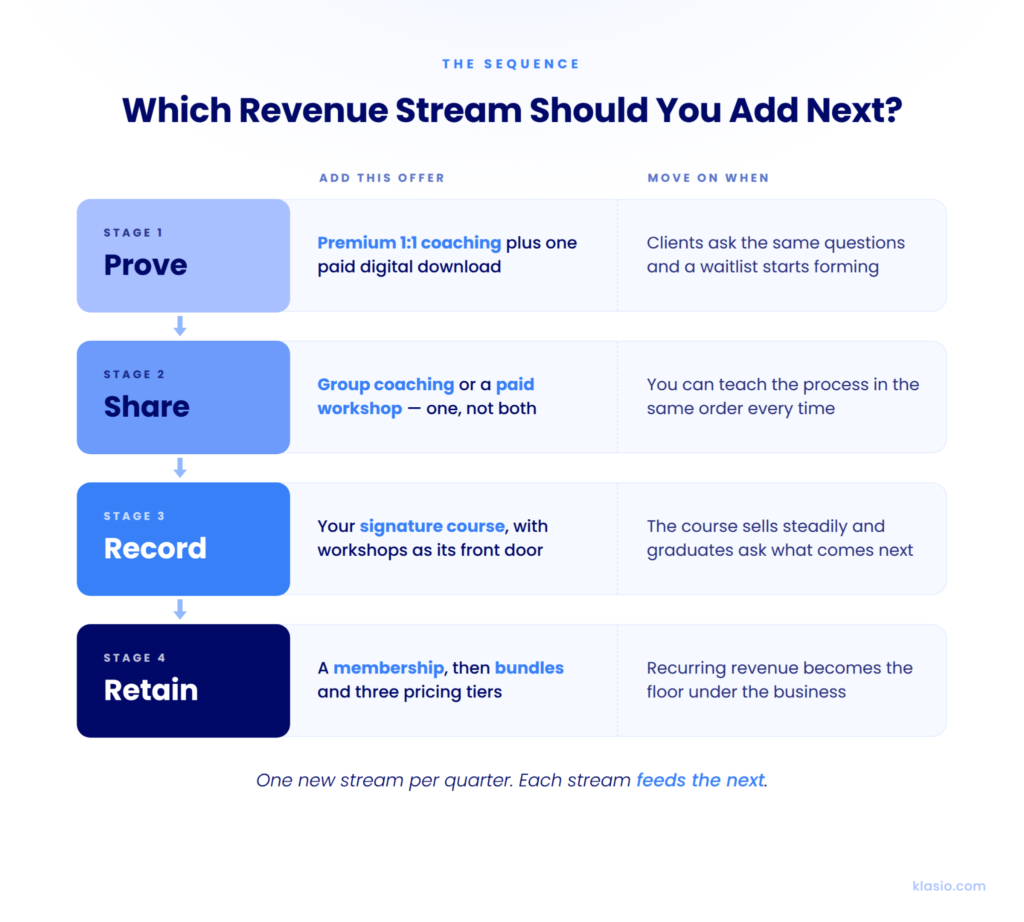
The seven streams are not a menu to order from at random. They work best as stages.
Each offer should use demand, proof, or assets created by the one before it. That is what makes the ladder easier to build over time.
| Stage | What your business looks like | Revenue streams to focus on | What you are proving |
|---|---|---|---|
| Stage 1: 0–10 clients | Your method is still developing | Premium 1:1 + one digital download | The problem, process, and result |
| Stage 2: Steady 1:1 demand | Clients repeat the same questions; a waitlist may be forming | Add group coaching or a paid workshop | That one method can serve several people |
| Stage 3: Proven curriculum | You can teach the process in a consistent order | Record the signature course; use workshops to feed it | That clients can progress without constant private access |
| Stage 4: Steady course sales | You have buyers, graduates, and several useful assets | Add a membership, then bundle offers into tiers | Retention, recurring value, and higher order value |
Stage 1: Prove the method
Work closely with private clients. Document their language, questions, sticking points, and outcomes. Turn one useful tool from the process into a small paid download.
Your goal is not scale yet. Your goal is evidence.
Stage 2: Test shared delivery
Once clients begin moving through a similar journey, test a group program or paid workshop.
Choose one, not both. A workshop is easier when the audience wants help with one immediate task. Group coaching is better when they need several weeks of implementation and accountability.
Stage 3: Turn delivery into curriculum
Your private sessions, first groups, and workshops have now shown you what people need to learn and in what order.
Record the smallest course that delivers the core method. Continue running workshops as a front door. A workshop solves one part of the problem and introduces the full course as the next step.
This is the same path the Part-Time YouTuber Academy followed: years of live cohorts first, and only then a recorded self-paced version built from everything those cohorts taught the team.
Stage 4: Build recurring revenue and tiers
When the course sells steadily, invite graduates into a membership for ongoing support. Then bundle your existing assets and create self-study, guided, and private tiers.
At this stage, you are not inventing seven unrelated offers. You are packaging one proven transformation for different levels of budget and support.
The rule of thumb is simple: add one new revenue stream per quarter, and make sure the stream before it creates demand for the next one.
Common Mistakes to Avoid While Diversifying Your Coaching Revenue
Adding revenue streams can make your business more stable. It can also spread your attention so thin that every offer becomes harder to sell.
Here are the mistakes to avoid:
- Launching a course before you have proof of results: A course built from assumptions usually becomes a collection of information. Coach real people first, identify the repeated process, and build from evidence.
- Adding streams to escape a weak core offer: If people do not want the current transformation, repackaging it as a course, membership, and workshop creates three weak offers instead of one.
- Underpricing scalable products: A course or download takes less time to deliver per buyer, but that does not make the result less valuable. Price according to the outcome, proof, and market, not the number of live hours.
- Running everything through disconnected tools: Separate checkouts, email lists, course platforms, calendars, and community spaces create more administration and a confusing customer journey. Simplify the system before the volume grows.
- Abandoning 1:1 coaching too early: Private work gives you research, cash flow, testimonials, and product ideas. Reduce it gradually as scalable offers become proven. Do not remove the strongest part of the business based on projected course sales.
- Treating a membership as passive income: Members keep paying only while they keep receiving value. Onboarding, engagement, content planning, and retention become part of the product.
- Launching three streams at once: Every new offer needs positioning, a sales page, marketing, delivery, and improvement. Split that energy across three launches and none receives enough attention.
Build the Ladder One Rung at a Time
Growing an online coaching business is not about collecting as many revenue streams as possible.
It is about building a system in which each offer has a job.
Your private coaching proves the result. Your group program turns repeated guidance into shared delivery. Your course teaches the method without requiring your calendar. Your membership creates ongoing support. Your downloads and workshops bring new buyers into the system. Your bundles help them choose the right level of access.
Pick the stream that matches your current stage and make it the focus for this quarter.
If you have fewer than 10 clients, keep improving the private offer. If the same questions appear in every call, test a group. If your curriculum is already proven, presell the course. If graduates keep asking what comes next, build the membership.
The goal is not to remove yourself from the business. It is to stop making every dollar depend on another open slot in your calendar.
Klasio lets you run all seven streams under one roof through courses, coaching, cohorts, subscriptions, downloads, webinars, and bundles. That keeps the buyer’s journey connected while you build the ladder one rung at a time.
FAQs about Growing Your Online Coaching Business
What is the most profitable revenue stream for online coaches?
The most profitable revenue stream depends on how you measure profit. Premium 1:1 coaching earns the most per client, while group coaching and courses earn more per delivery hour because one session or curriculum serves many buyers. For most coaches, a ladder that combines all three is more resilient than relying on one.
How many revenue streams should a coaching business have?
A coaching business should have only as many revenue streams as it can sell and deliver well. Two are enough at the start: a proven 1:1 offer and a small digital product. As demand steadies, add one new stream per quarter. Three to five connected offers cover different price points without the burden of seven unrelated products.
Can I sell an online course and coaching at the same time?
Yes, you can sell an online course and coaching at the same time by making the course the core learning experience and coaching the support layer. Sell the course alone to self-directed students, pair it with group coaching for those who want accountability, and offer private coaching as the premium tier.
How much can an online coaching business make?
An online coaching business can make anywhere from a few thousand dollars per month to a much larger figure, depending on niche, pricing, audience size, conversion rate, and offer mix. The useful way to gauge your own potential is to model each stream: eight private clients at $600 per month is $4,800, and 50 course sales at $199 adds $9,950 in a launch. These are worked examples, not typical or guaranteed earnings.
What should I add first: a course or group coaching?
You should add group coaching first when your 1:1 clients follow a similar process but still need live guidance and accountability, since the group lets you test the shared curriculum. Add the course first only when the process is already well documented, and buyers can reach the result with less support. For most coaches, 1:1 leads to a group program, which then becomes the recording ground for the course.




Leave a Reply