
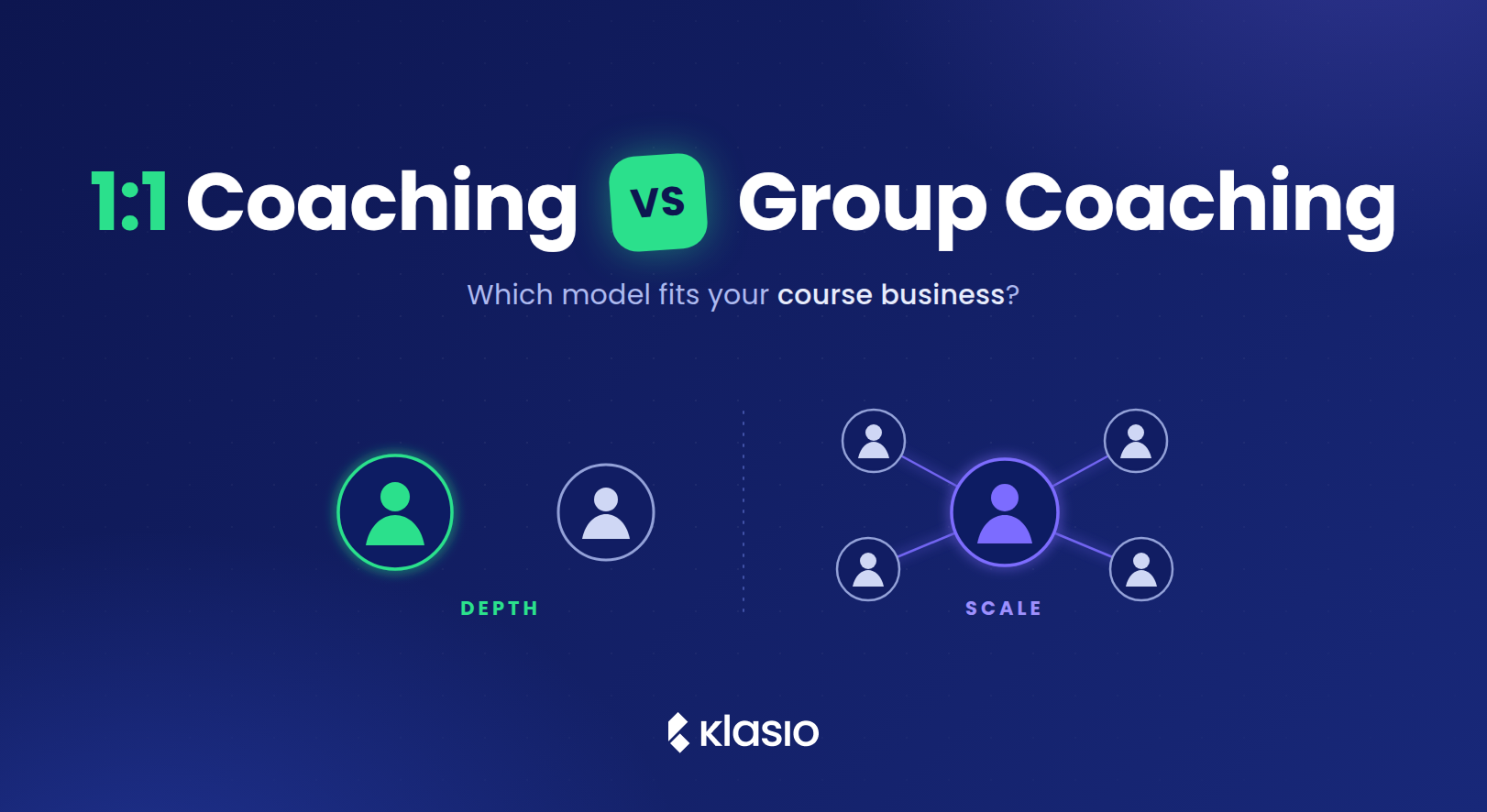
If you already sell online courses, coaching is probably the next offer your students expect from you.
Some learners want more than lessons, worksheets, and recorded videos. They want feedback, direction, accountability, and a chance to ask questions based on their own situation. That is where coaching fits naturally into a course business.
But the bigger question is, should you offer 1:1 coaching or group coaching?
Short answer: Choose 1:1 coaching when your students need private, personalized guidance and you are selling a high-ticket or sensitive transformation. Choose group coaching when many students share the same goal and you want to earn more per hour while supporting more people at once. Most course creators eventually run both – group coaching as the scalable offer and 1:1 coaching as the premium upgrade for students who need deeper support.
In this guide, we’ll compare both models so you can choose based on your content, capacity, audience, and revenue goals.

TL;DR
- Choose 1:1 coaching if your offer is high-ticket, deeply personal, confidential, or still being shaped through direct student feedback.
- Choose group coaching if you already have a repeatable process, want to serve more students at once, and can create value through shared learning.
- 1:1 coaching usually earns more per client, while group coaching can earn more per hour.
- The better model depends on your available time, your pricing, and how much personal support your students need.
- Many course creators eventually use both: group coaching as the scalable offer and 1:1 coaching as the premium upgrade.
- Your existing course library makes both models easier to sell because your students already trust your teaching.
Quick Comparison: 1:1 Coaching vs Group Coaching
| Factor | 1:1 Coaching | Group Coaching |
| Revenue per client | Higher, because each student gets personal access | Lower per student, but can add up with more participants |
| Revenue per hour | Lower if every client needs separate calls | Higher when one session serves multiple students |
| Scalability | Limited by your available time and energy | Scales better as your group size grows |
| Personalization | Deep and fully tailored to each student | Shared structure with some room for individual support |
| Main results driver | Direct coach attention, feedback, and guidance | Peer accountability, shared questions, and coach direction |
| Best for | Sensitive topics, high-ticket offers, personal transformation, custom strategy | Repeatable frameworks, common goals, community-based learning |
| Skill required | Deep listening, diagnosis, and personalized guidance | Facilitation, curriculum design, and group management |
| Setup effort | Easier to start with simple booking and calls | Takes more planning, scheduling, and structure |
| Student experience | Private, focused, and highly personal | Social, collaborative, and accountability-driven |
| Best starting point | Good when you are still learning what students need | Good when your method is already clear and repeatable |
1:1 Coaching Earns More Per Client, Group Coaching Earns More Per Hour
The biggest difference between 1:1 coaching and group coaching usually shows up in the revenue model.
With 1:1 coaching, each client pays more because they are getting direct access to you. You are reviewing their situation, answering their specific questions, and helping them move forward based on their own goals. For course creators selling high-ticket transformation, this can be a strong offer. A student who already trusts your course may be willing to pay more for personal guidance.
But there is a limit. Every new 1:1 client adds more calls, more follow-ups, and more individual context for you to manage. So while your revenue per client is higher, your time commitment grows with every sale.
Group coaching works differently. Each student usually pays less than they would for private coaching, but you are supporting multiple people in the same session. That means one hour of coaching can serve 10, 20, or even more students depending on your format.
This is why group coaching often performs better when you look at revenue per hour. Instead of asking, “Which offer costs more?” ask, “How much can I earn from each hour I spend delivering this?”
For course creators, that question matters. You probably started selling courses because you wanted to stop repeating the same teaching again and again. If your coaching model brings you back into a strict time-for-money cycle, the higher price may not be as attractive as it looks.
Winner: Group coaching for revenue per hour, 1:1 coaching for revenue per client.
Group Coaching Scales, 1:1 Coaching Hits a Ceiling
1:1 coaching is naturally limited by your calendar.
Even if you charge well, there are only so many private calls you can take in a week before your schedule becomes crowded. Add course updates, marketing, content creation, community support, and admin work, and your available coaching hours become even smaller.
That does not make 1:1 coaching a bad model. It simply means the model has a ceiling. Your income grows when you add more clients or raise your price, but both options have limits. Too many clients can reduce the quality of your support. Too high a price can narrow the number of students who can afford it.
Group coaching gives you more room to grow because it separates your income from individual call volume. You can teach the same framework to a group of students who share similar goals, challenges, or stages. Instead of repeating the same guidance in ten private calls, you can address it once in a group session and let everyone benefit.
This is especially useful when your course already has a clear structure. For example, if you teach freelancing, fitness, career growth, marketing, exam preparation, or business building, many students will face similar questions at similar points. A group format allows you to answer those shared questions without stretching your schedule too far.
The key is not to make the group too broad. Group coaching scales well when people join for a common outcome, not just because they bought the same course.
Winner: Group coaching.
1:1 Coaching Delivers Deeper Personalization Than Group Coaching
Where 1:1 coaching stands out is personalization.
In a private coaching setting, you can slow down, ask better questions, and understand the student’s full situation. You are not only teaching the next step. You are helping them decide which step makes sense for them.
That matters a lot in offers where the path is not the same for everyone. For example, a creator teaching leadership, career transitions, relationships, personal finance, business strategy, or high-stakes decision-making may find that students need more than a framework. They need context-specific feedback.
1:1 coaching also works better when privacy matters. Some students will not feel comfortable discussing personal blockers, business numbers, emotional challenges, or sensitive goals in front of a group. In those cases, private coaching can create a safer environment for honest conversations.
This is also useful when your method is still evolving. If you are building a new coaching offer around your course, 1:1 sessions can help you understand what students really struggle with. You can notice patterns, refine your process, and later turn those insights into a group program.
The downside is that deep personalization takes time. You need to remember each client’s background, progress, goals, and blockers. That makes the experience valuable, but it also makes the model harder to scale.
So if your students need tailored direction, private support, or a high level of confidentiality, 1:1 coaching is likely the better fit.
Winner: 1:1 coaching.
Group Coaching Adds Peer Accountability 1:1 Coaching Can’t
One thing group coaching offers that 1:1 coaching cannot fully recreate is peer accountability.
In a private coaching model, the relationship is mostly between the coach and the student. That can be helpful, but it can also make the student too dependent on the coach for direction and motivation.
In group coaching, students get to see other people working toward a similar goal. They hear questions they had not thought to ask. They learn from other people’s progress, mistakes, and examples. Sometimes, a student understands a concept better when they see how another student applies it in real life.
This is valuable for course creators because courses can often feel lonely. A student may watch the lessons, take notes, and understand the content, but still struggle to take action consistently. A group setting adds rhythm. There are live sessions, shared milestones, check-ins, and a sense that other people are moving forward too.
Group coaching can also reduce the pressure on you as the only source of value. You still guide the program, but the group itself becomes part of the learning experience. Students can encourage each other, exchange ideas, and stay more engaged between sessions.
That said, peer accountability only works when the group is managed well. If the group is too large, too quiet, or too unfocused, students may feel like they are simply attending another webinar. The format needs structure, participation, and clear expectations.
When done well, group coaching gives students both your guidance and the momentum of a shared environment.
Winner: Group coaching.
1:1 Coaching Is Easier to Launch; Group Coaching Takes More to Build
If you are adding coaching to your course business for the first time, 1:1 coaching is usually easier to launch.
You do not need a full curriculum, a cohort schedule, a community space, or a large number of buyers. You can start with a simple offer-book a private coaching call, get personalized feedback, or work with you for a fixed number of weeks-and a simple sales page that explains what students get.
This makes 1:1 coaching useful for testing demand. You can offer it to your existing students, learn what they need help with, and see what they are willing to pay for. You can also use those early calls to understand which problems come up repeatedly.
Group coaching needs more planning. You need to decide how many people can join, how long the program will run, what each session will cover, how students will interact, and what kind of support they will receive between calls. You also need enough demand to fill the group. A group coaching program with only two or three people may still work, but it may not deliver the community experience students expected.
There is also a facilitation skill involved. In 1:1 coaching, you guide one person. In group coaching, you manage different personalities, different progress levels, and different questions in the same space. You need to keep the conversation useful without letting one person take over the session.
So if you want to move quickly, validate your offer, and start with less setup, 1:1 coaching is the easier first step. Once your process becomes clearer, you can turn it into a group format.
Winner: 1:1 coaching to start.
Which Coaching Model Fits Your Niche?
The right coaching model depends heavily on what you teach and how your students get results.
1:1 coaching works better when the outcome depends on personal context. If your students need private feedback, custom strategy, or support around sensitive decisions, individual coaching will usually feel more valuable. This can include leadership coaching, career pivots, relationship-related education, business consulting, executive development, or any niche where the student’s situation changes the advice you give.
It is also a strong fit when your framework is still forming. Private coaching helps you see the details behind your students’ struggles. Over time, those repeated patterns can become modules, templates, worksheets, or even a future group coaching program.
Group coaching works better when students share a common goal and can follow a repeatable process. This can include business, freelancing, creator education, health and wellness, finance, productivity, mindset, marketing, design, language learning, and many course-based niches where students benefit from seeing others go through the same journey.
For example, if you teach people how to launch a freelance service, many students will need help with positioning, pricing, outreach, proposals, and client calls. Those topics work well in a group because everyone learns from each other’s questions.
The simplest way to decide is this: if every student needs a different path, start with 1:1 coaching. If most students need the same path with light personalization, group coaching may be the better model.
Best fit: 1:1 coaching for sensitive or highly personalized outcomes; group coaching for repeatable systems and shared goals.
The Revenue Math: A Worked Example for Course Creators
Before we compare the numbers, one thing should be clear: this table is not a fixed industry dataset. You will not usually find a clean report that says, “Here is the exact revenue difference between 1:1 coaching and group coaching for course creators.”
Instead, the smarter approach is to build the model from realistic inputs.
For example, coaching and consulting courses already tend to sit at a higher price point than the average online course. Ruzuku’s 2026 course data shows a median price of $531 for coaching and consulting courses, compared with $110 across all niches on the platform. That tells us students are already used to paying more when the offer includes deeper guidance, support, or access to the instructor.
Coaching package benchmarks also support this. Paperbell’s 2026 pricing guide puts a typical 3-month 1:1 coaching package at around $1,500 to $10,000+, while group coaching programs often sit around $1,000 to $3,000 per person for a similar period.
It also helps to anchor the delivery side, not just the price. The ICF Global Coaching Study reports that the average coach carries about 12 active clients at a time and spends close to 12 hours a week in live sessions. That lines up almost exactly with the 1:1 scenario below – 12 clients at one weekly call each – which is a good sign these numbers reflect a realistic workload rather than a best-case guess.
So let’s use conservative creator-friendly numbers and compare the monthly math.
| Model | Price per client | Clients | Hours per month | Monthly revenue | Effective hourly |
| 1:1 Coaching | $600/month | 12 | 48 | $7,200 | $150/hour |
| Group Coaching | $300/month | 40 | 32 | $12,000 | $375/hour |
| Premium Group Coaching | $500/month | 24 | 24 | $12,000 | $500/hour |
The 1:1 model still looks strong. Twelve clients paying $600 per month gives you $7,200 in monthly revenue. For many course creators, that is a healthy coaching offer, especially if it sits on top of existing course sales.
But notice the time cost. If each client gets one hour of live support per week, that becomes 48 hours per month before admin, follow-ups, notes, or rescheduling.
Group coaching changes the equation. With 40 students paying $300 per month, you can earn $12,000 while spending fewer live coaching hours. You are not earning more because each student pays more. You are earning more because one session supports multiple students at the same time.
The premium group model is even more interesting. A smaller group of 24 students paying $500 per month can create the same $12,000 monthly revenue with fewer delivery hours. This works well when the group is more curated, the outcome is more valuable, and students get more direct interaction during each session.
That said, group coaching only wins if you can fill the seats. A 1:1 offer can start with one buyer. A group program needs enough people with the same goal, at the same time, willing to join the same structure.
This is where course creators have an advantage. If you already have students, email subscribers, or course buyers, you are not starting from zero. Your course becomes the trust-builder. Coaching becomes the next step for the students who want more support.
The Hybrid Model: How Most Course Creators Actually Win
For many course creators, the best answer is not choosing between 1:1 coaching and group coaching forever.
The better structure is usually:
Course → Group coaching → 1:1 premium support
Your course sits at the base. It teaches the core framework, builds trust, and gives students a lower-friction way to learn from you. Not everyone is ready to pay for coaching right away, and not everyone needs personal support. A course gives them a place to start.
Group coaching becomes the next layer. Students who want accountability, live sessions, peer discussion, and guided progress can join a group program. This gives them more structure without requiring you to turn every student into a private client.
The 1:1 coaching offer then becomes the premium upgrade. It is for the smaller group of students who want deeper feedback, more privacy, or help applying your framework to their specific situation.
This model works because it matches different levels of buyer intent. Some people only want the course. Some want the course plus live accountability. A few want direct access to you.
It also matches how sustainable creator businesses are usually built. Kajabi has previously reported average creator earnings of around $37,000 per year, and its 2025 Creator Commerce report points to creators building stronger businesses by blending products such as courses, communities, newsletters, and coaching instead of relying on one revenue stream alone.
The student outcome argument is just as important. Ruzuku’s data shows courses with active community features reach 65.5% completion, compared with 42.6% for courses without community features. The same report also notes that creators who offer community features earn roughly twice as much as those who do not.
That does not mean every course needs a large community. But it does show why adding live support, peer accountability, and structured interaction can make your offer more valuable.
This is not just intuition. In a Dominican University study on goal achievement, participants who sent weekly progress updates to a peer succeeded at their goals far more often than those who kept their goals to themselves-a gap of roughly 70% versus 35%.
A hybrid model lets you serve students at different levels without doubling your workload. Recurring coaching also gives students an ongoing reason to stay subscribed, which helps reduce subscription churn across your whole academy.”
Your course delivers the core teaching. Your group coaching creates momentum. Your 1:1 coaching gives high-touch support to the students who need it most.
How Klasio Helps You Run Coaching Alongside Your Courses
Once you understand the model, the next challenge is operational.
You do not want your course in one tool, your coaching offer in another, payments somewhere else, bookings in a separate calendar, and student communication scattered across multiple platforms. That kind of setup may work in the beginning, but it becomes harder to manage as your offers grow.
This is where Klasio makes the transition easier.
With Klasio Coaching, you can add coaching as part of your academy instead of treating it like a disconnected service. You can create structured coaching offers, add multiple sessions, manage bookings, and offer coaching beside your courses. Klasio also lets you use scheduling tools such as Calendly, Cal.com, Google Calendar, or your preferred booking tool, so you do not have to rebuild your entire workflow from scratch.
That matters whether you choose 1:1 coaching, group coaching, or both.
If you want to start simple, you can offer 1:1 coaching as a premium add-on for students who need personal guidance. If you want to scale, you can package group coaching around a course, cohort, or specific outcome. And if you want to increase order value, you can combine coaching with your courses, subscriptions, or product bundles.
For example, you could sell:
- A self-paced course for students who want to learn independently.
- A course plus group coaching for students who want accountability.
- A premium package with the course, group sessions, and limited 1:1 access.
This gives students more ways to buy based on their needs, budget, and desired level of support.
The real benefit is that coaching does not have to sit outside your course business. It can become part of the same learning journey. A student can discover your course, make progress through your lessons, and then upgrade into coaching when they need more help applying what they learned.
So, whether you start with 1:1 coaching or build a group coaching program, the goal is the same: give students the right level of support without making your business harder to run.
Let’s Start Selling for Free
FAQ: 1:1 Coaching vs Group Coaching
What’s the difference between 1:1 coaching and group coaching?
The difference between 1:1 coaching and group coaching is that 1:1 coaching gives one student private, personalized support, while group coaching supports multiple students around the same course, framework, or outcome. For course creators, 1:1 works best for tailored guidance, while group coaching works best when many students need help with similar steps.
Is group coaching more profitable than 1:1 coaching?
Group coaching can be more profitable than 1:1 coaching for course creators because multiple students are already learning the same material and can be supported together. It usually earns more per hour. But for high-ticket coaches who want to earn more from each individual client, 1:1 coaching can still make more sense.
Should a course creator start with 1:1 or group coaching?
A course creator should usually start with 1:1 coaching if the coaching framework is still new or untested. Private calls help you understand where students struggle. But if your course already has many students asking similar questions, group coaching may be a better starting point because the demand is already visible.
Can I offer both 1:1 and group coaching in the same business?
You can offer both 1:1 and group coaching in the same business by turning them into different support levels. For example, sell the course as the base offer, group coaching as the guided option, and 1:1 coaching as the premium upgrade for students who need deeper personal help.
How many people should be in a group coaching program?
A group coaching program should usually start with 6 to 12 people if you want discussion, participation, and personal attention. For a more structured course-based program, 15 to 30 people can also work. Beyond that, the program may need breakout groups, assistants, or a more webinar-style format.
Which coaching model is better for beginners?
1:1 coaching is usually better for beginners who are still learning how to coach, price, and package their support. It is easier to launch and improve. Group coaching is better for beginners only when they already have a course audience with shared problems and enough demand to fill a small cohort.




Leave a Reply