
If you’re looking at Podia alternatives, you probably already know why.
Maybe your account got locked over the weekend with no warning.
Maybe “Penny” — Podia’s AI support bot — has been looping you through canned responses for days while your free trial counts down.
Maybe you’re tired of paying for features that don’t quite work the way the marketing promised, or watching your sales reports stay broken after a refund.
We went through the recurring complaints from real Podia customers across Trustpilot and G2 to figure out which alternatives actually solve them. Below are the Podia alternatives that hold up where Podia doesn’t — ranked by what real users actually said about them.
TL;DR
- Klasio is the best Podia alternative if you want a free plan that includes assignments and certificates, and a lifetime pricing option that protects you from subscription drift.
- LearnWorlds is the best Podia alternative if your students expect a polished learning experience with interactive video, SCORM support, and a branded mobile app that Podia does not offer at any tier.
- FreshLearn is the best Podia alternative if you sell internationally and a documented track record of fast human support.
- Esmerise is the best Podia alternative if you operate in Europe and need multilingual platform support in Italian, English, Spanish, and French, plus a white-label mobile app included on mid-tier plans.
- Ruzuku is the best Podia alternative if you teach in cohorts and want responsive human support from a small team rather than an AI bot.
What’s Wrong with Podia? An Analysis of Recent Negative Reviews
If you’re evaluating Podia as your course and membership platform, the recent reviews from paying users tell a very different story than the marketing does.
1. Accounts Get Locked With No Warning and No Fast Way Back In
The most serious complaint in the recent reviews is creators losing access to their live business overnight, with no advance email and no self-service path back to normal.
One creator who had been on Podia for almost a year, and who had paid annually in advance, discovered on a Sunday from angry customers that the platform had blocked their website. No notification was sent.
The account had been flagged for manual review, which disables the normal verification flow, and no one responded over the weekend. Customers who had paid for products could not access them during that window.
A separate 2026 review describes a brand-new account being locked immediately after signup. The reviewer received only automated AI replies, the free-trial countdown kept running while the platform was unusable, and no human ever picked up the thread.
The common thread is that Podia appears willing to take an account offline before talking to the creator, and the path back online runs through a queue that doesn’t operate on weekends or with much urgency.
2. Support Has Largely Been Replaced by an AI Bot
Across the 2024–2026 negative reviews, the same support pattern repeats: an AI agent (referred to in reviews as “Penny”) handles the first response, escalation to a human is slow, and paying for a higher tier doesn’t appear to change that meaningfully.
Multiple Europe-based reviewers describe the practical impact: the chat widget returns a “we’re outside working hours” message even during normal weekday business hours in their region, and a problem that hits on a Saturday cannot be addressed until Monday evening their time.
One creator on Podia’s premium support plan reported that the plan does not include weekend or holiday coverage — exactly the windows when live launches and course sales tend to happen.
When humans do reply, reviewers describe canned responses that don’t engage with the specifics. One creator on the most expensive plan reported a Stripe integration problem affecting customers in India and was told the issue was on their end; they describe a VP-level employee declining to have engineering reproduce the bug because no one else had reported it.
A two-year customer raising a billing question described support as slow and unhelpful in late 2025.
3. When Fraud or Chargebacks Happen, You’re On Your Own
A G2 review from a roughly year-long Podia user describes a $3,000 fraud dispute filed by a customer through Stripe. To defend the chargeback, the creator needed server-side evidence that a real customer had completed the purchase. Podia declined to provide it, sending only an HTML copy of the receipt email, which doesn’t establish much in a dispute.
This connects to a separate 2026 Trustpilot complaint that Podia’s sales and revenue reports stop being trustworthy once refunds and chargebacks enter the picture, because the figures aren’t updated to reflect them.
Podia also does not collect mailing addresses or run additional verification before purchase, which the G2 reviewer points out leaves room for fraudulent buyers in the first place.
The takeaway for creators selling higher-ticket products: when a dispute does happen, the platform is not set up to help you win it.
4. Core Features Behave Differently Than the Marketing Suggests
A January 2026 review from a working creator lists a series of feature gaps that aren’t obvious until you’re operating on the platform at scale:
Affiliate links are supported, but only if you route traffic through Podia’s own sales pages rather than your own. And the reviewer describes those pages as poorly converting.
There is no native signal for when a student has completed a course, which is needed for certificate generation; support reportedly sends a list manually on request. Additional team-member seats can be paid for, but the seats are restricted — the reviewer reports that paid additional users still couldn’t edit settings or view customer conversations.
A G2 reviewer who used Podia for a couple of years and ultimately migrated describes the platform as not scalable and limited in ways that became more costly the larger their business grew. Another reviewer summarized the support culture more bluntly as knowing only the words “no” and “sorry.”
5. Pricing and Promises Don’t Stay Stable
Several reviewers describe being charged for things they were told they wouldn’t be, or seeing the product change in ways that conflict with what they originally signed up for.
A two-year customer reports being charged a per-transaction fee while on the Shaker plan, which is marketed without one.
The G2 migrant reviewer is more pointed and more general: they describe false advertising and Podia changing things on the fly that contradicted the original terms of the plan they bought into.
A creator on the highest plan in late 2024 was paying $89/month plus another $9 for email, and still ran into the issues above.
6. International Creators Face a Separate Set of Problems
If you’re based outside the US, the support and infrastructure picture is materially worse than the marketing suggests.
European creators describe support hours that are functionally a US-business-day window, which makes weekend or evening incidents unresolvable until well into the following week.
A creator selling into India reported a Stripe integration bug that Podia declined to reproduce or fix. The same creator’s Buy Now pages reportedly stopped loading for customers in Canada, with no resolution and canned replies in response.
None of this is disclosed clearly at signup, and there is no documented escalation path for non-US creators when the standard support flow stalls.
Who Should Look for a Podia Alternative?
You should seriously consider Podia alternatives if you:
- Run a business that operates outside US weekday hours, since support coverage does not, and live-launch incidents on a weekend will not be resolved in time to recover the sales
- Sell higher-ticket products where a chargeback or fraud dispute is plausible, since the platform does not provide the server-side records you’d need to win one
- Need a working affiliate program with affiliates driving traffic to your own pages rather than Podia’s
- Issue certificates or otherwise need reliable completion data
- Are based outside the US, particularly in markets like India or Canada where reviewers describe payment-processing bugs that Podia has declined to reproduce
- Expect reporting to stay accurate after refunds and chargebacks
- Want pricing and feature stability over the life of your subscription, since multiple reviewers describe terms and behavior changing on the fly
- Plan to scale beyond a small catalog, since the most experienced negative reviewers consistently describe the platform as feature-limited and not built for growth
Best Podia Alternatives at a Glance
| Tool | Best For | Starting Price |
| Klasio | Course creators who want predictable pricing, a free plan with no credit card, and a student mobile app included on every paid plan | Free + Starts from $49/month |
| LearnWorlds | Established course creators who need interactive video, SCORM, and a professional learning experience | Starts from $29/month |
| ThriveCart Learn | Launch-driven creators who want a one-time payment model and full ownership of their checkout | One-time from $495 |
| FreshLearn | International creators who need Razorpay support and a 0% transaction fee model | Free + Starts from $37/month |
| Esmerise | European or multilingual creators who want a white-label mobile app included on the Pro plan | Starts from ~$83/month |
| Ruzuku | Cohort-based creators who want zero transaction fees and human support from a small team | Starts from $99/month |
Now, let’s get to know more about the better alternatives to Podia in detail.
Klasio — Best for Beginner Course Creators

Podia’s two recurring complaints in the recent reviews are an AI bot named Penny that handles first-line support and a feature set that has not kept up with what creators actually need. Klasio’s structure addresses both.
Klasio’s free plan lets you teach up to 50 students before you spend anything. No credit card is required, and there is no auto-enrollment into a paid tier when the trial ends.
Monthly paid plans start at $49/month with 0% commission on your sales. For creators who want to step out of the subscription model entirely, Klasio offers lifetime plans starting at $399, with a small commission on sales in exchange for no recurring fees.
The student mobile app is included on every paid plan. Podia does not offer a native mobile app, and this is a recurring criticism in the 2025 and 2026 reviews. Every paid plan also includes course certificates with completion tracking built in.
On payments, Klasio connects directly to Stripe, PayPal, and Razorpay. The Stripe integration bug in India that one Podia review described becomes far less likely on a platform that supports Razorpay as a first-class integration.
On support, Klasio’s reviews show a consistent pattern: the team responds quickly, and the founder has personally engaged with user requests. This is the opposite of what Podia reviewers spent months describing.
Where it falls short: Klasio is a newer platform, and some features that established platforms have had for years are still in development. If you need deep third-party automation today, evaluate whether the current integration list covers your stack before committing.
Looking for a simpler Podia alternative?
Use code “MOVE30” to get 30% off Klasio Business LTD plan.

LearnWorlds — Best for Established Course Creators

LearnWorlds is built for creators who want to deliver a structured learning experience. Interactive video is the clearest differentiator. You can embed clickable questions, branching interactions, and in-video prompts directly inside your videos, which Podia does not support at all.
For creators selling high-ticket programs, that level of engagement is hard to replicate on a basic LMS.
LearnWorld’s plans start at $29/month, though that tier carries a $5 flat fee per enrollment. The Pro Trainer plan at $99/month removes that fee entirely and adds subscriptions, memberships, affiliate management, live sessions, certificates, and SCORM support. SCORM at this price point is worth flagging for anyone building certification or compliance content.
The website builder gives you real control over how your school looks, not only the course pages.
Where it falls short: LearnWorlds is built for course delivery, and the marketing toolset reflects that. If your business runs on a content marketing engine or you need deep automation across your funnel, you will still need to supplement with external tools.
Read More: Best LearnWorlds Alternatives
FreshLearn — Best for International Course Creators
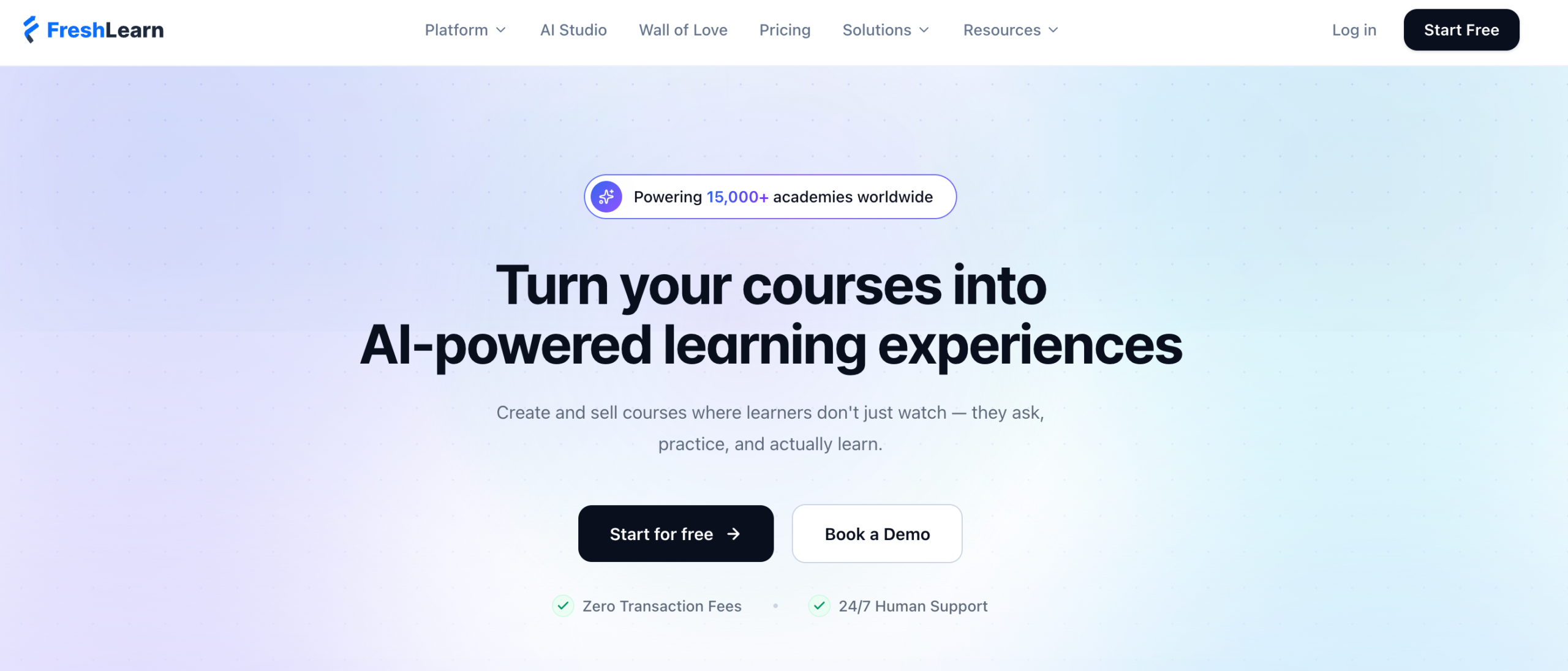
FreshLearn runs its support team across multiple time zones rather than a single US business-hours window. For creators based in Europe, India, or Southeast Asia, that means weekday issues get picked up in their local working hours instead of waiting overnight.
The free plan covers courses, coaching, digital downloads, and a web app, with a 10% platform transaction fee. The Pro plan at $37/month annually drops the transaction fee to 0% and adds custom domains, drip content, upsells, and member access controls.
The next tier up adds a native Android and iOS mobile app, live classes, certificates, assessments, and gamification. Payment gateways include Stripe, PayPal, and more.
A 14-day refund policy applies to yearly plans, with one caveat worth flagging: once a free migration has been started, refunds are off the table.
Where it falls short: FreshLearn’s email automation is functional but shallower than a dedicated tool like ActiveCampaign or Kit. Direct integrations beyond the main payment gateways are limited. Most third-party connections route through Zapier.
Esmerise — Best for Multilingual Course Creators
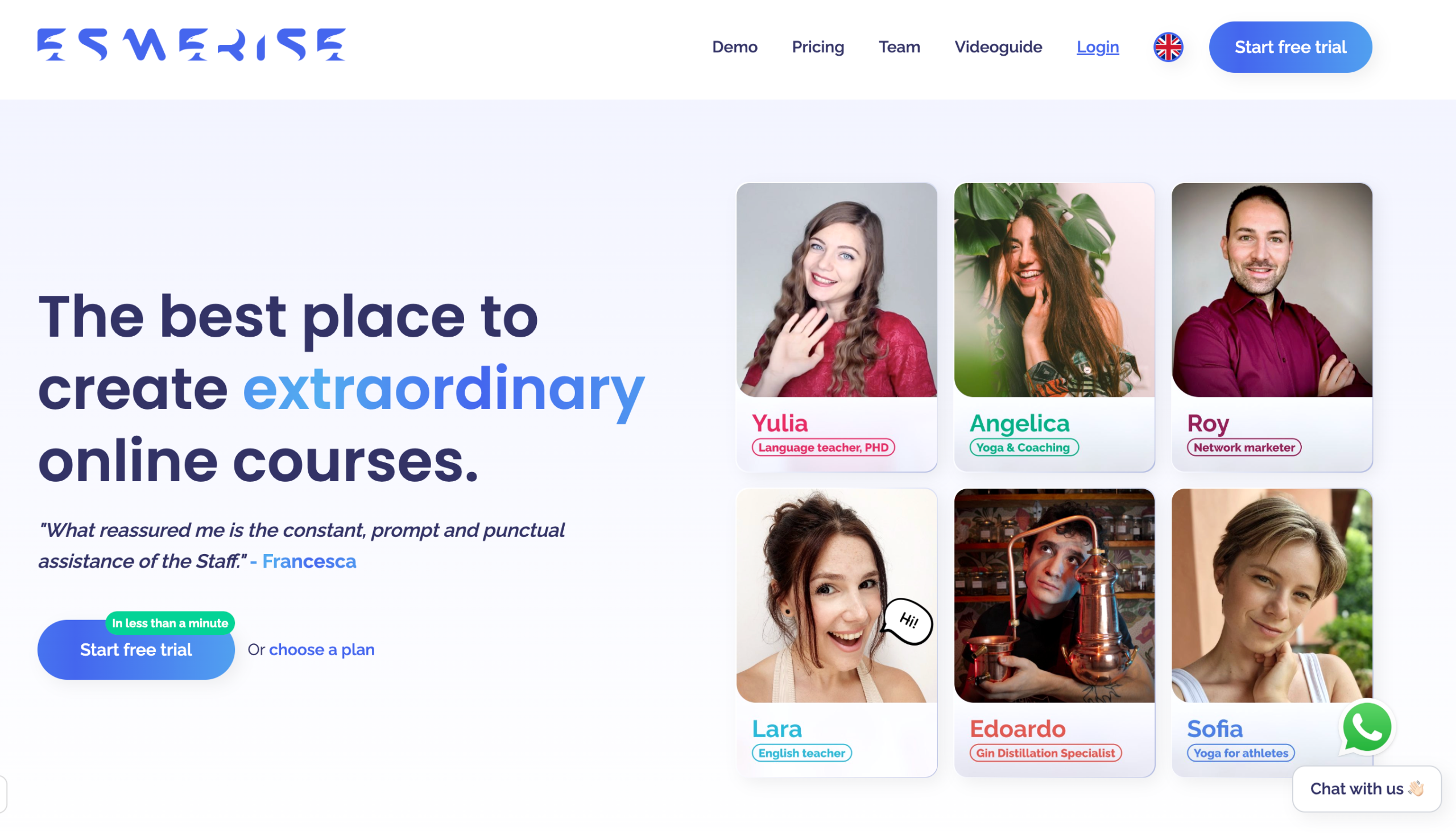
Esmerise is based in Italy and offers a platform interface and human support in Italian, English, Spanish, and French.
Esmerise’s Pro plan, priced at around $83/month when billed annually, includes a white-label PWA mobile app branded with your icon and name. Podia does not offer a native mobile app at any tier.
Esmerise also offers a content preservation policy where your courses and student data are retained for roughly a month after cancellation, which means a reactivation restores your academy intact.
Courses, community, and gamification are integrated into the same interface. Group chats, forums, comments, and notifications are built into the learning environment rather than offered as separate add-ons.
Esmerise also supports SCORM and xAPI for creators who need standards-compliant content delivery.
Where it falls short: The mobile app is a PWA rather than a native iOS or Android build. This means push notifications are limited to in-app messages and email instead of the OS-level alerts students get on platforms like Klasio. White-label app branding is also gated to the Pro plan and above. Students on the Base plan see the Esmerise icon instead of yours.
Ruzuku — Best for Cohort-Based Course Creators
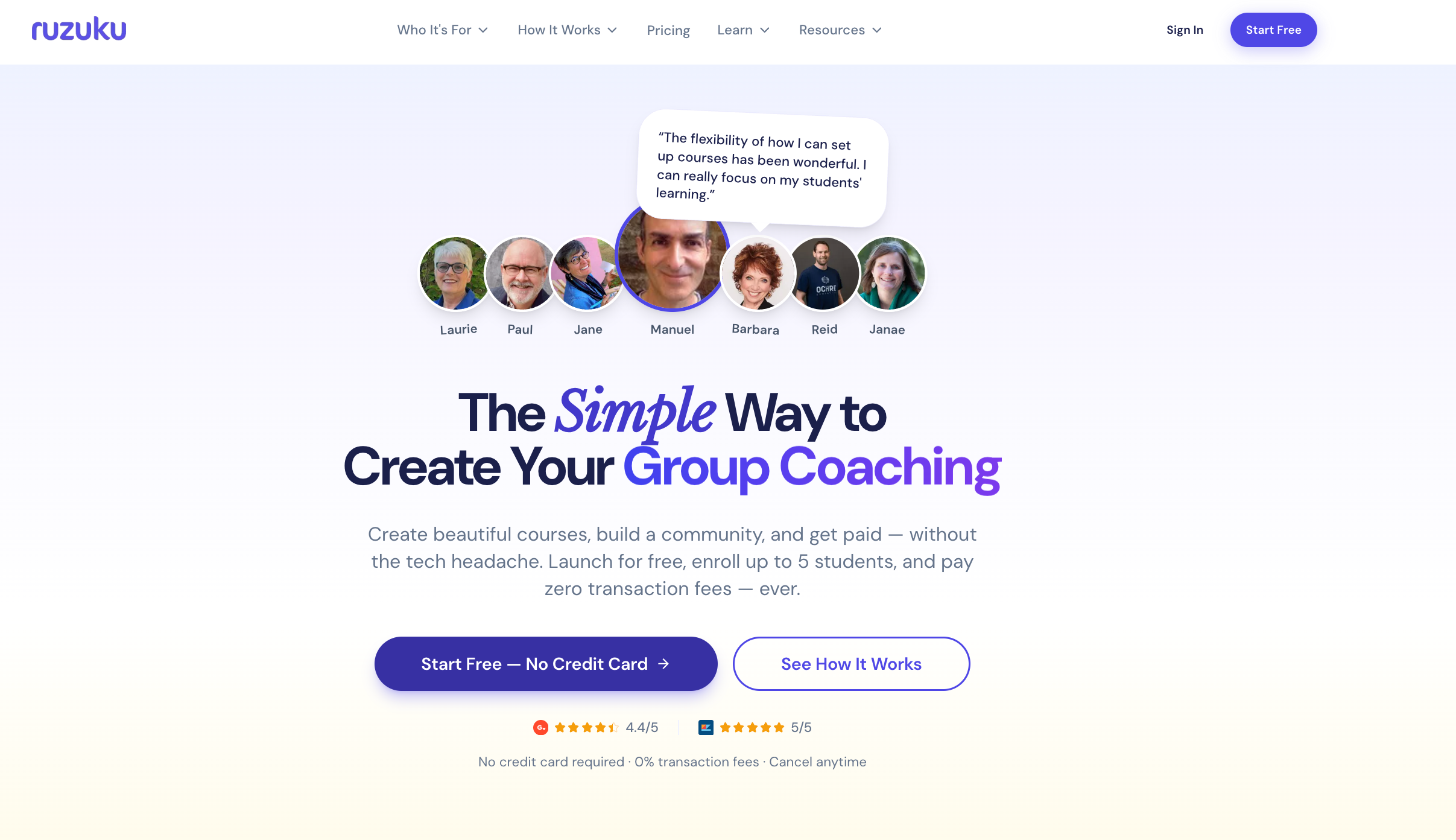
Ruzuku has been on the market since 2012 and has built its positioning around teaching-focused simplicity and direct human help.
Ruzuku’s plans start at $99/month and include zero transaction fees, unlimited courses, unlimited students, and live teaching tools. The platform is built around running cohorts and live classes, with built-in webinar functionality that does not require a third-party integration.
For creators frustrated with Podia’s missing completion tracking, Ruzuku includes built-in quizzes, surveys, and progress tracking on every plan. Email automation handles course-related communication, such as drip content and lesson reminders.
Ruzuku integrates with Stripe and PayPal directly for payment processing, which means you keep your existing payment relationships rather than routing through a proprietary layer.
Where it falls short: Ruzuku is the highest entry price on this list, which makes it a harder fit for creators just starting out. The design and template options are also more basic than what newer platforms offer, and the marketing toolset is limited compared to options like FreshLearn or Klasio. If sales page design and conversion optimization are central to your business, you will likely need to pair Ruzuku with an external tool.
Final Verdict: Which Podia Alternative Is the Best for You?
The pains we pulled from the Podia reviews fall into a small number of consistent patterns.
- AI bot support that does not escalate.
- Accounts locked without warning and no weekend recovery path.
- A missing mobile app.
- Missing completion tracking.
- Weak chargeback defense.
- A payment infrastructure that breaks for non-US creators.
Most alternatives on this list solve one or two of these. Klasio is the only one that solves most of them inside a single plan.
The free plan requires no credit card and gives you a working course on the platform, with 50 students, quizzes, assignments, and certificates included before you spend anything. There is no auto-enrollment into a paid tier when the trial ends.
Klasio’s monthly plans start at $49 with 0% commission, and every paid plan includes the student mobile app, certificates, gamification, leaderboards, and live session integrations through Zoom and Google Meet.
On support, Klasio’s reviews show the inverse of what Podia users described. Founder consultation is offered on the comparison page itself, and testimonials reference fast responses from the team. The CEO is named in several of those testimonials.
For creators migrating from Podia, Klasio offers a free migration consultation. If you want to evaluate the platform before committing, the free plan gives you enough to run a real pilot before you pay anything.

Frequently Asked Questions
Does Podia have AI?
No, Podia does not include any built‑in AI capabilities. However, they do offer a Zapier integration for AI-powered automation.
Is Podia good for SEO?
Yes, Podia includes basic SEO tools, such as custom page titles, meta descriptions, clean URLs, and alt text. However, it doesn’t offer a built‑in blog or advanced SEO features.
Is Podia an LMS?
Yes, Podia is an LMS that functions by providing course creation, lesson modules, quizzes, and student progress tracking. It also has features for selling digital products and memberships.
Does Podia have analytics?
Podia offers built‑in analytics for tracking course sales, student progress, and email campaign performance, along with a set of pre‑built audience segmentation filters.
Is Podia mobile-friendly?
Yes, Podia is mobile-friendly. Podia’s sites and storefronts are fully mobile‑responsive, so your pages, courses, and checkout will adapt smoothly to smartphones and tablets. However, Podia does not provide a dedicated mobile app for instructors or students.




Leave a Reply