
The way we create and sell online courses is changing fast. Earlier, it used to be all about posting videos, but now it’s about using new tools like AI, building communities, and more.
As an online course creator in 2026, you’re doing more than just teaching. You’re also running a business, bringing people together, and designing how your students learn.
Your students are also not satisfied with only videos anymore. They want courses that feel personal, allow them to interact, fit their schedules, and help them achieve real results.
To give you a bigger picture of the e-learning industry, let’s look at some of the recent trends in online courses. So, you can create courses that your students will find valuable.
TL;DR
- The e-learning market was estimated at $399.3B in 2022 and is projected to grow 14% per year through 2032, reaching about $1T.
- Course platforms are evolving into “all-in-one,” commerce-driven solutions with integrated payments, tax handling, and upselling features becoming standard.
- AI is now a default feature in course creation, with platforms like Teachable and LearnWorlds integrating AI tools for generating content, quizzes, and sales pages.
- Online communities are increasingly being monetized as standalone products rather than free add-ons, with data suggesting creators who sell community access earn significantly more.
- Marketing for online courses is shifting towards “social search” and direct-to-consumer channels, while regulations around online endorsements and fake reviews are tightening.
Market Size and Growth Trends
Demand for e-learning continues to grow.
The e-learning market was estimated at $399.3B in 2022 and is projected to grow 14% per year through 2032, reaching about $1T.
For you as an online course creator, these points contribute to continued demand for online skill development, professional education, and flexible learning options.
The LMS market is also growing. It was valued at $32B in 2023 and is expected to grow more than 19% annually through 2032, reaching $163.7B.
This matters because many online course platforms now offer LMS-style features. Such as progress tracking, assignments, certificates, integrations, and more.
The creator economy is expanding quickly, with direct-to-fan monetization driving platform strategy.
Grand View Research estimates the creator economy at $205.25B in 2024 and projects it will reach $1.35T by 2033, growing at 23.3% annually.
This includes more than online courses. But one of the main drivers—creators selling directly to their audience—closely reflects how course and membership businesses operate.
As more creators focus on owning their audience and monetizing directly, the tools and platforms supporting courses and memberships are growing alongside that shift.
Live, instructor-led formats still matter and continue to generate real revenue.
Industry research shows that instructor-led virtual courses held the largest share of e-learning revenue in 2024. This is largely because they combine live interaction with the flexibility of being online.
This means that cohort-based and live formats can continue to grow alongside self-paced courses, rather than being replaced by them.
Creator earnings reported by platforms indicate significant global sales activity.
Teachable reported that creators on their platforms have generated $10B in global earnings (as of December 18, 2024).
Kajabi reported in April 2025 that creators on its platform have earned over $9B in total, stating that all of that revenue goes directly to creators. The company also shared that more than 100,000 creators have collectively reached that figure.
Platform and Feature Trends
AI-native course creation and “content-to-product” acceleration
Online course platforms are building AI directly into the authoring process. Instead of being separate tools, AI features are now embedded into:
- Course outline generation
- Quiz and assessment creation
- Subtitles and translations
- Sales pages and email drafts
- Learner-facing AI assistants
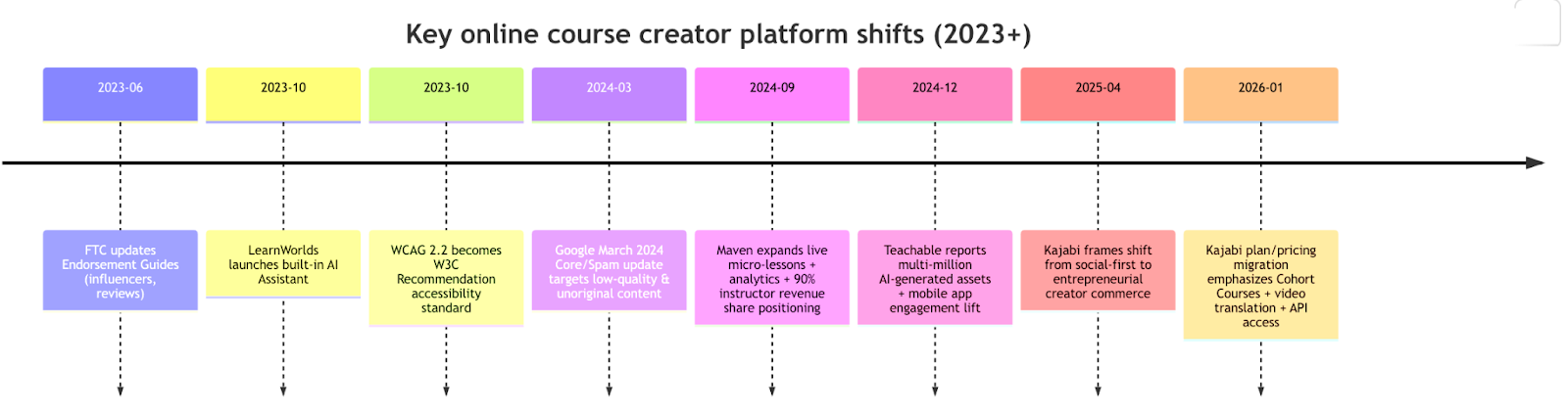
Teachable reported that in 2024, creators generated more than 3.8 million pieces of AI content using its built-in tools, including curriculum builders, quiz generators, subtitles, and sales page drafts.
Community becomes a sellable product and retention layer
Communities are increasingly being sold directly as paid memberships or bundled with courses. Instead of being an add-on, they are becoming standalone products designed to improve retention, accountability, and long-term revenue.
Kajabi reported in April 2025 that creators who include community offerings say they earn about 2x more than those who do not.
Modern course platforms bundle content hosting with built-in payments, tax compliance, and conversion features
Course platforms are expanding beyond content hosting. Many now include:
- Built-in payment processing
- Sales tax, VAT, and compliance handling
- Upsells and order bumps
- Cart recovery and automated retries
- Buy Now, Pay Later (BNPL) options
- Revenue and financial reporting
Instead of connecting multiple third-party tools, you can manage more of your business in one place.
Thinkific states that Thinkific Payments can increase average transaction size by up to 31%.
Monetization Models and Creator Economics Trends
Creators are building multi-product portfolio businesses instead of relying on a single flagship course
More course creator platforms are moving beyond selling a single course. Instead, they offer a suite of products, often structured as a ladder:
- A flagship course
- A paid community or membership
- Group or 1:1 coaching
- Digital downloads or templates
- Live workshops or events
These offers are often bundled or tiered to serve different price points and commitment levels.
Membership and subscription models are becoming common among course creators
More creators are using subscriptions and memberships to stabilize cash flow and create an ongoing learning experience rather than selling only one-time courses.
Instead of a single purchase, students join a recurring plan that gives them continued access to content, community, or new material over time.
Cohorts + live learning persist as a premium format
Instructor-led virtual courses held the largest revenue share in 2024 in an e-learning services market summary.
Maven expanded “Lightning Lessons” (short live lessons) and reports “200K+ student signups” for that format.
Marketing and Audience-building Trends
More creators are prioritizing direct relationships with their audience
More course creators are shifting away from relying heavily on social platform payouts and brand deals. Instead, they’re building owned channels such as:
- Email lists
- Private communities
- Direct checkout pages
- Membership sites
The goal is to reduce exposure to algorithm changes, payout shifts, and fluctuating brand budgets.
Kajabi’s 2025 Creator Commerce report states that creators saw declines in platform payouts (-33%), affiliate revenue (-36%), and brand deals (-52%). The same report says 55% of creators identify audience ownership as the most important factor for long-term success.
The IAB creator economy report found that 44% of advertisers planned to increase investment in creator content in 2024, with an average planned increase of 25%. It also noted that nearly half of advertisers consistently allocate budget to creator content marketing.
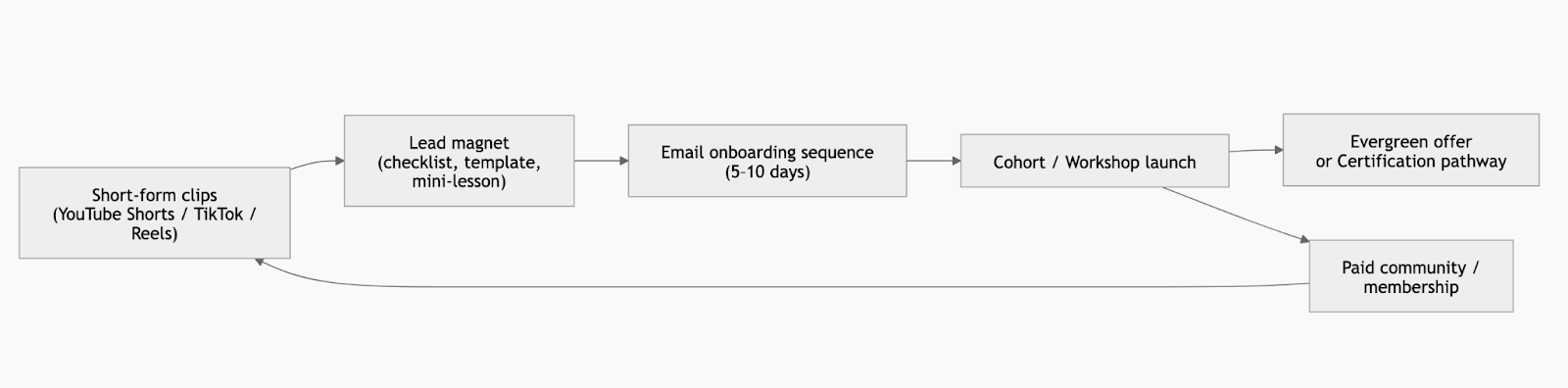
Short-form video becomes “searchable top-of-funnel,” not just awareness
Discovery is increasingly happening through short-form and experience-based content. Search engines and social platforms are blending traditional search with short videos, social posts, and creator perspectives.
As a result, many creators are producing short educational clips that connect directly to their course outcomes.
In June 2023, Google said it would expand search results to include more perspectives, including content from social platforms and short videos such as 30-second clips.
TikTok allows ads to appear in search results. However, it’s not like Google, where you choose specific keywords to bid on. Instead, TikTok’s system automatically decides when your ad should show in search based on relevance.
Previously, advertisers could turn this search placement on or off. As of July 21, 2025, that control was removed — but ads can still appear in search automatically.
Search engines are prioritizing original content and penalizing large amounts of low-quality, mass-produced content
Google’s March 2024 core/spam update states it expects to reduce “low-quality, unoriginal content” in search results by 45% through improved core ranking systems and spam policies.
The easiest forms of AI-generated SEO content are less effective. Authenticity, case studies, and original data (surveys, learner outcomes, unique frameworks) have higher durable value.
Content Format Trends
Microlearning as a structured teaching model
Microlearning is increasingly defined as short, focused lessons designed around a specific action or objective. These lessons are delivered in seconds or minutes and often include interactive elements or personalization.
A 2024 systematic review analyzing 40 studies defines microlearning as short, targeted content and reports that it has a positive impact on learning outcomes across cognitive (knowledge), behavioral (application), and affective (attitudes or motivation) domains.
For creators, this suggests that short-form content works best when it is intentionally designed around a clear outcome, not just shortened versions of longer lessons.
Interactive video and embedded questions improve engagement efficiency
Quizzes, embedded questions, and other active learning elements are increasingly built directly into video-based courses. Interaction is becoming part of the lesson itself, not just an add-on at the end.
An Open University study found that embedding questions during videos helped participants answer more efficiently and affected how much they enjoyed the experience.
Teachable highlights interactive quizzes in its mobile app and reports that app users are three times more likely to complete lessons.
Certificates and Micro-Credentials Are Growing, but Quality Matters
More platforms now make it easy to issue certificates. But recognition in the market depends less on the certificate itself and more on clear learning outcomes and consistent quality.
A certificate only has value if learners and sometimes employers trust what it represents.
Thinkific documents automated certificates tied to 100% course completion and references learning paths and bundle-based certificates.
Coursera’s 2024 Micro-Credentials Impact Report, based on a survey of more than 1,000 higher education leaders across 850+ institutions, describes micro-credentials as increasingly integrated into university curricula.
The OECD (2023) notes that micro-credentials are becoming more prominent in education and training policy discussions.
Technology Trends and Integrations
AI “teaching assistants” and AI-driven support workflows
Beyond content generation, AI is being used for learner Q&A and support at scale.
AI support can reduce time spent answering repetitive questions and can improve response time (a key satisfaction driver). However, a significant risk factor would be hallucinated answers or inconsistent policy guidance, which can harm trust.

Analytics moves from “nice-to-have” to ongoing product optimization
Platforms are investing in engagement analytics, conversion attribution, and learner activity tracking to support data-driven iteration.
Maven launched course analytics (beta) for landing page conversion, syllabus engagement, and “last student activity,” explicitly responding to instructor requests.
Compliance, tax, and payments infrastructure is becoming the hidden differentiator
Global selling introduces operational complexity (tax/VAT, fraud, payout timing). Platforms are increasingly competing on these “boring” features.
Before choosing a platform, map your target geographies. If you sell heavily into the EU/UK, prioritize clear VAT handling and audit trails. Build a refund/chargeback playbook and integrate fraud monitoring early.
Security and Compliance Trends
AI-generated course content raises copyright and provenance issues
As AI generates text/video/audio, creators must manage IP ownership, training data concerns, and disclosure norms.
The U.S. Copyright Office issued “Copyright Registration Guidance: Works Containing Material Generated by AI”, outlining how generative AI raises questions about protectability and what applicants should disclose.
Over-reliance on AI outputs can weaken IP defensibility and can introduce unintentional plagiarism or factual errors, threatening trust and brand safety.
Accessibility becomes a competitive and legal risk area for course businesses
Accessibility requirements for websites, course platforms, and mobile learning experiences continue to change.
On October 5, 2023, the W3C published WCAG 2.2 as an official recommendation. This update added nine new success criteria beyond WCAG 2.1.
This means that course creators and platform operators need to ensure their websites and learning environments meet updated accessibility standards, especially as expectations around usability and inclusive design continue to rise.
What the Future Looks Like for Online Course Creators?
The future of online courses will be shaped by those who can adjust to these online course creator trends. To be more effective and precise, use new course creator platforms wisely and focus on helping their students grow.
By keeping up with these trends, you can set yourself up to be a leader in this space.




Leave a Reply