
Building a great course is only half the job. The other half is getting it in front of the right people. That’s where many course creators struggle. Their course is live, but enrollments never come.
The good news is that you don’t need a huge audience or a massive advertising budget to grow. You need the right promotion strategy. The right channels help more people discover your course, build trust in your expertise, and give them a reason to enroll.
This guide shows you how to promote your online course using proven channels like SEO, email marketing, social media, webinars, partnerships, referrals, and paid ads. You’ll also learn when to use each strategy, what mistakes to avoid, and how to turn them into a practical promotion plan that consistently brings in new students.
TL;DR
- Create a sales page that clearly explains your course before you start promoting it.
- Publish SEO content and blog posts if you want a steady stream of long-term traffic.
- Build an email list early so you can stay connected with potential students.
- Focus on one social media platform instead of trying to grow on every channel.
- Let people experience your teaching through free lessons or webinars before asking them to buy.
- Run paid ads only after your course is already getting enrollments through organic marketing.
- Encourage happy students to leave reviews and refer others because they can become your best marketing channel.
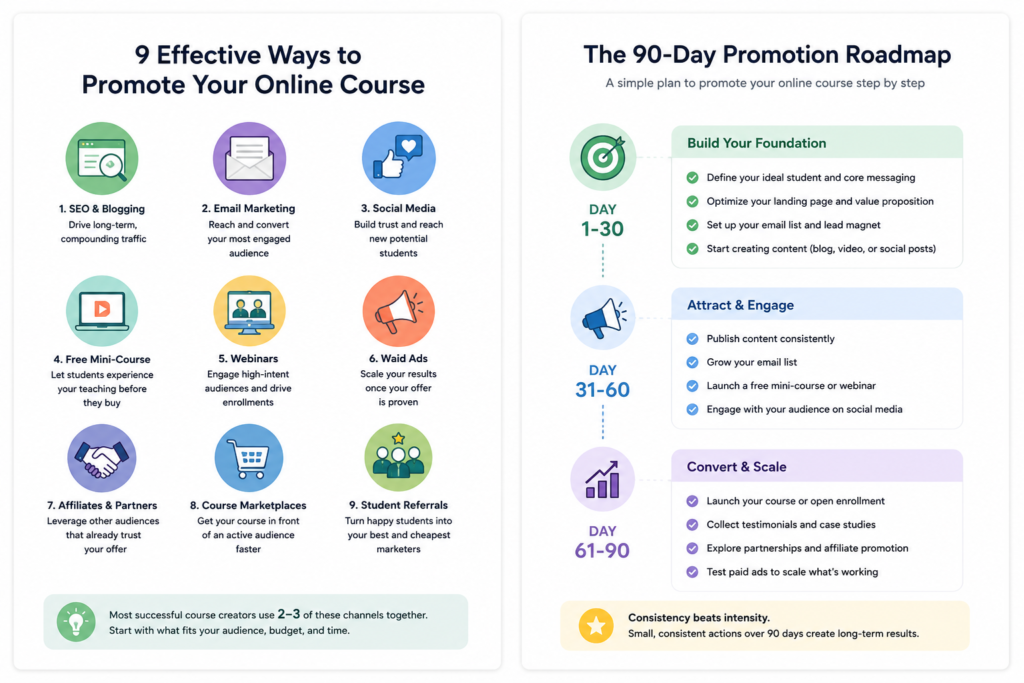
Ways to Promote Your Online Course: Channels at a Glance
We built this guide using insights from course creators, industry research, and our experience building an LMS platform. Instead of listing every marketing tactic, we focused on the promotion channels that consistently help course creators attract more students and grow their course business. Use the comparison table below to find the strategies that best match your goals, budget, and stage of growth.
| Channel | Best For | Typical Cost | Time to First Results |
|---|---|---|---|
| SEO and blogging | Long-term, compounding traffic | Free (your time) | 3 to 6 months |
| Email list | Highest-converting audience you own | Free to low cost | 2 to 6 weeks |
| One social platform | Building trust and reach fast | Free (your time) | 2 to 4 weeks |
| Free mini-course | Letting students sample your teaching | Free (your time) | 2 to 4 weeks |
| Webinars | High-intent, direct conversion | Free to low cost | 1 to 3 weeks per session |
| Paid ads | Scaling what already converts | $200 to $500 to test | Days, but costly without proof |
| Affiliates and partners | Reaching audiences you don’t have | Commission-based | 1 to 3 months to set up |
| Course marketplaces | Fast exposure, less control | Commission-based | Days |
| Student referrals | Cheapest, highest-trust growth | Free to low cost | Ongoing, compounds over time |
Strategy 1: Define Your Ideal Student Before You Pick a Channel
Course creators who struggle to pick a promotion channel usually have a different problem hiding underneath it. They haven’t defined who they’re actually promoting to, so no channel feels like the obvious choice.
Trying to reach “anyone interested in photography” or “people who want to learn coding” spreads your message thin. It lands with no one in particular.
Why it works: a specific student, with a specific frustration, responds to language aimed straight at their situation. A vague audience responds to nothing, because nothing in a generic message tells them it was written for them.
Get three things clear before you promote anything: who buys this course, what problem it solves for them, and what changes for them after they finish.
- Name your ideal student. Give them an age range, a job or life situation, and a specific frustration. A course for “busy working parents who want to cook faster on weeknights” points toward a different promotion strategy than one for “home cooks” in general.
- Name the problem in their words. Write the exact sentence a student would use to describe their struggle before finding your course. That sentence becomes your headlines, your ad copy, and your blog titles.
- Name the transformation. Describe where they start and what your course leaves them able to do, in one sentence you could say out loud to a stranger.
Common mistake to avoid: widening your audience description to avoid excluding anyone. A course description built to fit everyone ends up connecting with no one.
Once this is clear, the channel choice gets easier. A course for corporate HR managers points toward LinkedIn and email outreach. A course for home bakers points toward Instagram and Pinterest.
The audience tells you where to show up. Start there, and let the channel follow.
Strategy 2: Build the Home Base Every Promotion Effort Points Back To
Every channel you use to promote your online course eventually sends someone to one place: the page where they decide to enroll or leave. If that page doesn’t do its job, every dollar and hour spent on the channels ahead of it gets wasted.
Why it works: every other strategy in this guide only pays off if the destination converts. Fixing this page first means traffic from every channel that follows has somewhere worthwhile to land.
Think of your sales page as the one salesperson working around the clock while you sleep, travel, or work on the next module. Ads, social posts, and blog links only earn their keep if the destination actually converts the traffic they send.
A page that converts usually includes a few consistent elements, regardless of what the course teaches.
- A headline built around the transformation the student gets. “Learn Photoshop” describes a feature. “Edit product photos your customers stop scrolling past” describes an outcome.
- A clear description of who the course is for, and who it isn’t for. This filters out the wrong buyers before they get frustrated and ask for a refund later.
- Specific, outcome-focused testimonials. A testimonial that names a real result carries more weight than five that just call the course helpful.
- An honest breakdown of what’s included, module by module, so buyers know exactly what they’re paying for before they pay.
- One clear next step, repeated at sensible intervals down the page, so a ready buyer never has to scroll back up to find the enrol button.
Where this matters most: if you’re about to run any paid promotion, fix this page first. Paid traffic sent to a weak page is the fastest way to spend a marketing budget with nothing to show for it.
If you’re still working out how to structure this page, this guide on how to create a course sales page walks through it section by section.
Klasio’s Page Builder lets you put this page together with drag-and-drop sections. You’re not waiting on a developer before you can start sending traffic anywhere.
Strategy 3: Use SEO and Blogging to Attract Students Who Are Already Searching
A social media post has a lifespan measured in hours. A blog post that answers a real question a potential student is typing into Google can keep bringing in visitors for years without any extra work from you.
SEO, short for search engine optimization, is the practice of writing content in a way that search engines can match to what people are already searching for.
Why it works: you’re not creating demand from nothing. You’re showing up in front of demand that already exists, which means the traffic keeps arriving long after you’ve stopped actively promoting that post.
Start by listing the exact questions your ideal student types into Google before they know your course exists. Someone learning watercolor painting might search “why does my watercolor paint look muddy” long before they search for a course by name. That question is your blog topic.
- Write to answer the question itself, rather than to match a keyword. Answer it thoroughly in your own words. Mention your course only where it fits naturally, and skip it everywhere else.
- Use header tags to structure the post. Search engines and readers both scan headers first to decide whether a page answers their question.
- Link between related posts on your own site. This keeps readers on your site longer and helps search engines understand which topics you’re an authority on.
Search behavior is shifting in a way most course creators haven’t adjusted for yet. People increasingly ask ChatGPT or Perplexity a question instead of typing it into Google. Those AI tools tend to pull from the same clear, helpful content that ranks well in traditional search too.
Common mistake to avoid: publishing three posts, seeing no sales, and giving up. SEO compounds. A blog that’s been running for a year with twenty solid posts will usually outperform one with three posts from last month.
Klasio’s blog tools let you publish directly from your course dashboard. The built-in AI assistant can help you draft a first pass of a post, so you’re editing instead of staring at a blank page.
Strategy 4: Build Your Email List Before You Need It
A social platform can change its algorithm overnight and cut your reach in half. Your email list stays yours no matter what any platform decides to do next.
Why it works: everyone on your list already raised their hand and asked to hear from you. Benchmarking data compiled by Omnisend puts the average return across industries at roughly $36 to $42 for every dollar spent on email, ahead of paid search or social ads.
To get someone’s email address, you need to offer something worth that exchange. A lead magnet is a small piece of free, genuinely useful content that solves one specific problem for your ideal student.
- A short checklist or template related to the first step of the transformation your course teaches.
- A 10 to 15 minute mini video lesson that solves one narrow problem completely, rather than teasing the full course.
- A quiz or self-assessment that shows the student exactly where their skill gaps are, with your course positioned as the fix.
Once someone joins your list, don’t drop them straight into promotional emails. Send a short welcome sequence first. Deliver the lead magnet, share a few more useful tips over the following days, then introduce your course as the next step.
Common mistake to avoid: only emailing your list when you have something to sell. Subscribers who only hear from you during launches learn to ignore or unsubscribe from those emails.
Klasio includes email automation on every plan. That covers the free plan too. You can set up a welcome sequence without adding a separate tool.
If you want a full walkthrough of building this list from scratch, this guide on building an email list as a course creator covers the process step by step.
Strategy 5: Pick One Social Platform and Go All In
Course creators who try to post on five platforms at once usually end up posting inconsistently on all five. That reads to followers as an account that doesn’t have much to say.
Your ideal student’s habits should decide the platform. Personal preference doesn’t matter here. A course for corporate professionals fits LinkedIn. A course on cooking, fitness, or crafts fits Instagram or Pinterest.
Why it works: showing up consistently in one place builds recognition and trust over time. A thin presence spread across many platforms never builds enough of either.
Once you’ve picked a platform, an 80/20 split keeps followers engaged without feeling like they’re being sold to constantly. Roughly 80 percent of what you post should be genuinely useful on its own, tips, behind-the-scenes looks, and answers to common questions, with no ask attached. The remaining 20 percent can promote the course directly.
Common mistake to avoid: treating every post as a sales pitch. Followers can tell the difference between an account that shares knowledge and occasionally sells, and one that’s constantly selling.
Consistency matters more than frequency here. Three genuinely useful posts a week for six months will build more trust than a daily posting streak that burns out after three weeks.
Strategy 6: Give Away a Free Sample to Build Trust Fast
Nobody wants to be the first person to buy a course from someone they’ve never seen teach. A free sample removes that risk by letting a potential student experience your teaching style before they spend anything.
Why it works: it lets your teaching speak for itself instead of asking a stranger to take your word for it. Trust built this way moves faster than trust built through sales copy alone.
The simplest version of this is a free mini-course. Take one useful module from your paid course, or build a short standalone lesson that solves one specific problem completely. At the end, point students who want more toward the full course.
A YouTube channel works the same way at scale. Publish tutorials related to your course topic and answer real questions people search for. Include a link to your course in every video description.
Where this matters most: if you have zero past students and zero testimonials, a free sample is the fastest way to start building trust.
Common mistake to avoid: making the free sample too shallow to demonstrate value, or too complete that it removes any reason to pay for the rest. Aim for one real result delivered fully, with a clear next step toward more.
Strategy 7: Host a Webinar That Sells Without a Hard Pitch
A webinar compresses everything else in this guide into one hour. You teach something real, answer questions live, and make an offer while you have someone’s full attention.
Why it works: no other format combines teaching, live interaction, and a direct offer while you have someone’s undivided attention. That combination shortens the trust-building process dramatically.
The structure that tends to work follows a simple shape. Open by establishing why you’re qualified to teach this topic and what attendees will walk away with. Spend the bulk of the session teaching something genuinely useful. Then bridge into the course as the next step for anyone who wants to go deeper.
- Announce it one to two weeks ahead through your email list and whichever social platform you’ve built an audience on.
- Send a reminder the day before and the morning of, since a meaningful share of registrants forget without one.
- Record it and send the replay to anyone who registered but couldn’t attend live. Some of your best leads show up after the fact.
Common mistake to avoid: turning the teaching portion into a thinly disguised sales pitch. Attendees can tell within minutes, and it undermines the trust the format is built to create.
For a full walkthrough of planning and running one of these sessions, this step-by-step guide to hosting webinars that convert covers the structure in more detail.
Klasio connects with Zoom and Google Meet, so you can run the live session through a tool you already know. Registration and follow-up stay on your course dashboard.
Strategy 8: Add Social Proof Before You Ask for the Sale
A stranger deciding whether to buy your course is really asking one question: has this actually worked for people like me?
Why it works: social proof answers that exact question before the buyer has to ask it out loud. It reduces the perceived risk of being the one who finds out the hard way.
Testimonials that name a specific result carry far more weight than generic praise. “This course was great” tells a prospective buyer nothing. “I had zero coding experience, and I shipped my first small app in six weeks” tells them exactly what became possible.
- Ask former students directly, with a short list of prompts: what did you struggle with before, what specifically changed, what would you tell someone on the fence.
- Request a short video wherever possible. A 30-second clip of a real student talking about their result outperforms a wall of written quotes, because it’s harder to fake and easier to trust.
- Feature reviews on a third-party site as well as your own. Reviews on an independent platform read as more credible, since visitors know you can’t edit or hide them.
Common mistake to avoid: waiting until you have dozens of glowing reviews before featuring any of them. Even two or three specific, honest testimonials do more for conversion than a sales page with none at all.
If you don’t have testimonials yet, offer your course at a reduced rate or for free to five to ten beta students in exchange for honest feedback.
Strategy 9: Test Paid Ads Once Your Message Already Converts
Paid advertising has one job: to speed up something that’s already working.
Why it works, and when it doesn’t: ads amplify a message and page that already convert organically. They don’t create demand for a course that hasn’t proven it can sell without paid help, so spending before that proof exists usually burns budget instead of building it.
Before running a single ad, confirm two things through free channels first. Your message actually resonates. Your sales page actually converts the traffic it already gets.
- Google Search ads reach people actively typing in a solution to their problem, so purchase intent tends to run higher here than on social platforms.
- Meta ads (Facebook and Instagram) work well for interest-based targeting, especially for courses with a broad, identifiable audience like fitness, cooking, or personal finance.
- Retargeting ads show up to people who already visited your sales page but didn’t buy, usually the cheapest, highest-converting ad type to start with.
Common mistake to avoid: sending paid traffic directly to your sales page on the very first campaign. Route new visitors through a lead capture page first and collect an email address before asking for the sale.
A realistic starting budget is $200 to $300, spent in small daily increments while you test which audience and message combination actually converts.
Strategy 10: Get Other People to Promote Your Course for You
Every strategy covered so far relies on your own audience and your own time.
Why it works: someone else’s audience and someone else’s trust do part of the promotion work for you. It’s performance-based, so you only pay when it actually generates a sale, which makes it lower risk than paid ads.
An affiliate program lets past students, bloggers, or niche influencers promote your course for a commission on each sale, typically 20 to 40 percent.
- Look for creators who serve your audience without competing directly. A nutrition course creator and a fitness coach share an audience without fighting over the same sale.
- Equip affiliates properly. Give them ready-made social captions, email copy, and a clear tracking link, since most won’t write their own promotional material from scratch.
- Pitch yourself for podcasts in your niche. Listeners already trust the host, and that trust transfers to you as a guest.
Common mistake to avoid: launching an affiliate program with no tracking system in place. Without reliable link tracking, you can’t tell which partner actually drove a sale.
Klasio doesn’t currently include a built-in affiliate management system, so running this channel means pairing your course with a separate affiliate tracking tool.
Strategy 11: Use Discounts and Guarantees to Remove the Last Objection
By the time someone reaches your sales page, they’re usually not asking whether the course is good. They’re asking whether it’s worth the money to them personally, right now.
Why it works: urgency pushes a “maybe later” decision into a “yes, now” one, and a guarantee removes the risk of the purchase entirely. Together they answer the exact hesitation standing between a visitor and a buyer.
- Early bird pricing rewards people who commit during your launch window, before the course has any track record of reviews.
- Seasonal promotions tied to a real moment, like a new year or back-to-school period, give a natural reason for the discount to exist.
- A money-back guarantee, typically 14 to 30 days, removes the risk of the purchase entirely.
Common mistake to avoid: discounting so often that your stated price stops meaning anything. If your course is “always 30% off,” buyers will wait for the next markdown instead of paying full price.
Klasio’s coupon tool lets you create a unique code for each channel you’re promoting on, so you can track exactly which promotion drove enrollments.
If you haven’t settled on your base price yet, this guide to pricing an online course is worth reading before you plan discounts around it. For seasonal ideas specifically, this list of Black Friday promotion ideas for course creators has more angles to work from.
Strategy 12: Decide Whether a Course Marketplace Belongs in Your Strategy
Platforms like Udemy solve the distribution problem instantly by putting your course in front of an audience that already exists, measured in the tens of millions. That convenience comes with a real trade-off.
Why it works, and where it doesn’t: a marketplace hands you access to an audience already primed to buy, without months of your own marketing work. The trade-off is control. You give up pricing power, the student relationship, and a meaningful cut of every sale.
Marketplaces typically take a significant commission on each sale, sometimes the majority of the price. They also control pricing, discounts, and how your course is presented.
You don’t own the student relationship the way you do on your own site either. The marketplace holds the email address and the ongoing connection. You don’t.
Where this matters most: a marketplace can work well as one channel among several, particularly for reaching students who’d never have found your own site. It works less well as your only channel.
A middle path some creators use is publishing one course, often a shorter or older one, to a marketplace purely for exposure.
They keep their flagship course on their own platform. That way they keep full pricing control and the student’s contact information.
For a closer look at how the major marketplaces compare on commission, audience size, and control, this guide to the best marketplaces for selling courses online breaks down the trade-offs in more detail.
Strategy 13: Turn Your Students Into Your Next Marketing Channel
The promotion channels covered so far all aim at people who’ve never bought from you. Your existing students are a channel too, and they’re usually the cheapest and most trusted one you have, if you actually ask them to help.
Why it works: these students already trust you enough to pay once. A recommendation from someone who’s already taken the course carries more weight than any ad, since they have nothing to gain by exaggerating the result.
A referral program gives current students a reason to mention your course to someone they know. A discount on their next purchase, or a small bonus for a successful referral, turns a passive fan into an active promoter.
- Ask for referrals right after a win. The moment a student finishes a module or hits a milestone is when they feel most positive about the course.
- Cross-promote your other courses inside the one they’re currently taking, through a short mention or a resource at the end of a module.
- Bundle related courses together at a combined price for students who’ve already shown interest in your teaching style.
Common mistake to avoid: treating existing students as a finished transaction instead of an ongoing relationship. A student who feels forgotten after paying is far less likely to refer anyone.
If you’re planning to bundle courses or build an all-access plan out of your growing catalog, Klasio can help.
You can combine courses, digital downloads, and live sessions into a single subscription plan.
Returning students get an easy way to keep buying from you, without a separate checkout for every new course.
A Realistic First 90 Days of Course Promotion
Trying to run every channel in this guide at once is the fastest way to burn out before any of them has time to work. A phased approach spreads the effort out and lets each channel build on what came before it.
- Weeks 1 to 4: clarify your audience and message, finish your sales page, and start posting consistently on the one social platform your students actually use.
- Weeks 5 to 8: publish your first blog posts targeting real student questions, and set up a lead magnet to start building your email list.
- Weeks 9 to 12: run your first webinar, collect and feature your first testimonials, and test a small paid ad budget once your message has proven it converts organically.
This sequence isn’t a rule to follow exactly. Adjust the order based on where your audience already spends their time and how much of each week you can realistically give to promotion.
Once your channels are bringing in traffic and your sales page is converting, the deeper work of pricing psychology and closing the sale is worth a closer look.
This guide to selling an online course picks up where this one leaves off.
How Klasio Supports the Work of Promoting Your Online Course
Most of the tactics in this guide need somewhere to live: a page to send traffic to, a way to track what’s working, a place to publish content, a system to reward the people helping you promote.
Klasio brings several of these pieces together in one dashboard, instead of scattering them across separate tools.
The drag-and-drop Page Builder lets you build and edit your sales page, landing pages, and subscription plan pages. You don’t wait on a developer every time you want to test a new headline or offer.
The built-in blog gives your SEO content a home on the same domain as your course. The AI assistant helps you draft a first version of a post, so you’re editing rather than starting from a blank page.
For running promotions, the coupon tool lets you create a unique, trackable code for every channel. That way you can see which one is actually converting.
Email automation is included on every plan, even the free one. It covers welcome sequences and lead nurturing without a separate email tool.
For anyone running webinars, Klasio connects directly with Zoom and Google Meet for the live session itself. Registration and follow-up stay on your own dashboard.
Klasio doesn’t currently include a built-in affiliate management system. If partner promotion is a channel you want to run, that piece still needs a separate tool alongside it.
Start your free trial on Klasio to see how the rest of the pieces fit together for your own course.
Frequently Asked Questions on How to Promote Your Online Course
How much does it cost to promote an online course on a limited budget?
Promoting an online course on a limited budget can cost little to nothing if you focus on SEO, blogging, email marketing, and social media. If you decide to run paid ads later, start with a small test budget after you’ve validated your offer.
How much does it cost to promote an online course on a limited budget?
Promoting an online course on a limited budget can cost little to nothing if you focus on SEO, blogging, email marketing, and social media. If you decide to run paid ads later, start with a small test budget after you’ve validated your offer.
How long does it take to start getting enrollments from marketing?
Getting enrollments from marketing can take anywhere from a few weeks to several months, depending on the channel. Email and social media produce faster results, while SEO and blogging usually take three to six months.
Should you start promoting a course before it’s finished?
Starting to promote your course before it’s finished is a smart strategy. It helps validate demand, build an audience before launch, and collect feedback that improves the final course.
What is the fastest way to get your first 10 students?
Getting your first 10 students usually starts with your existing network. Offer early bird pricing or free access in exchange for honest feedback and testimonials to build trust and social proof.
How do you know if a promotion channel is actually working?
Knowing whether a promotion channel is working comes down to tracking enrollments. Use unique links or coupon codes for each channel so you can identify which ones generate the most sales.
Is it better to focus on organic or paid promotion first?
Focusing on organic promotion first is usually the better approach. Once your content and sales page consistently generate enrollments, you can use paid ads to scale your results.
Do you need a large following to sell an online course?
Selling an online course doesn’t require a large following. A small audience that trusts your expertise often converts better than a large audience with low engagement.




Leave a Reply