
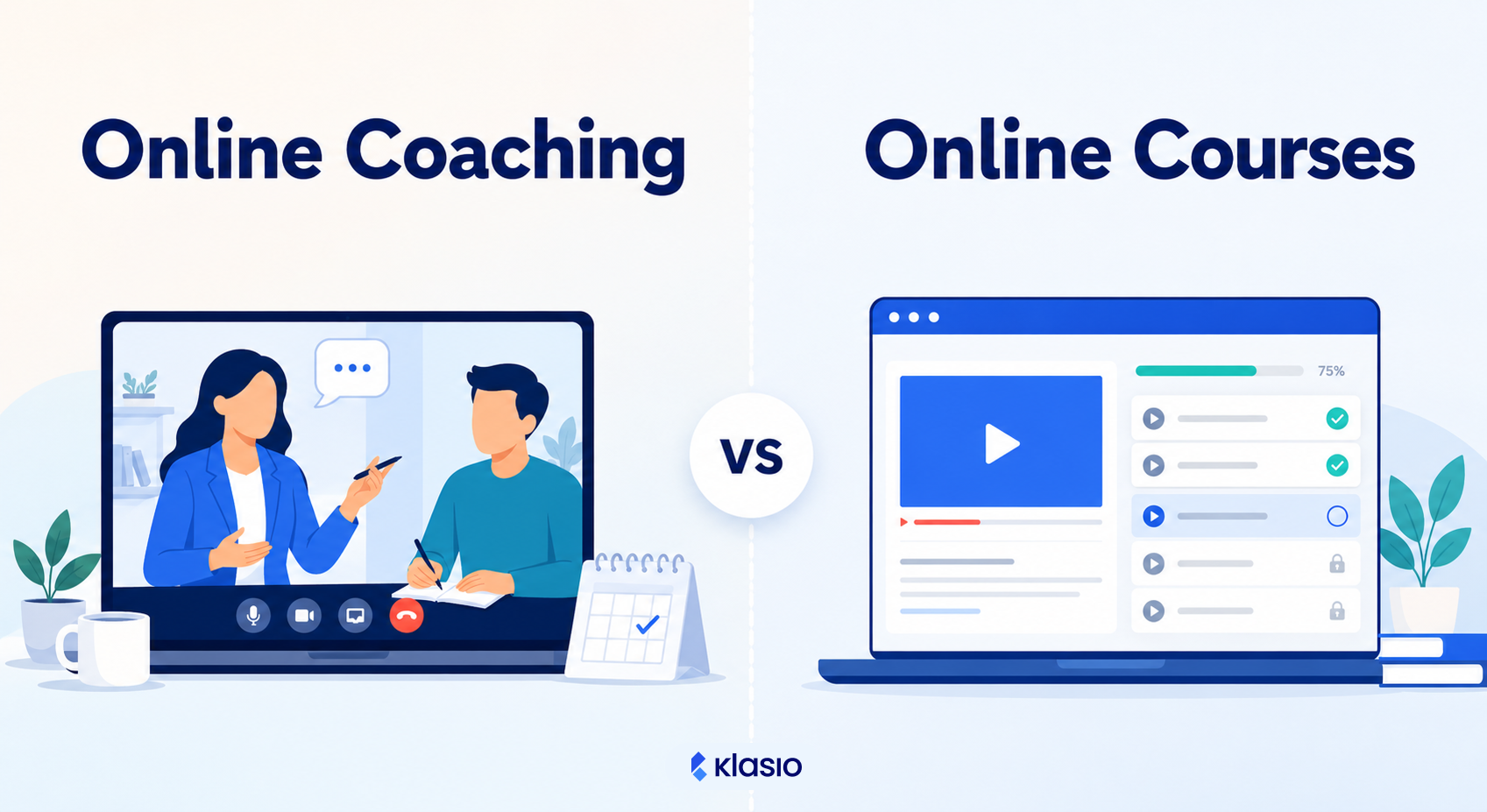
You have expertise people will pay for. But should you sell that expertise as a course or as coaching?
That choice changes how you make money, how much time you spend with clients, and how quickly you can grow. A course turns your knowledge into a repeatable system. Coaching sells your judgment, feedback, and ability to solve a specific person’s problem.
The right choice depends on how your expertise works. If most people need the same process, a course can scale it. If every client needs a different answer, coaching is the better fit.
This guide will help you decide on coaching vs course model fits your expertise, audience, cash needs, and working style before you invest time building the wrong offer.
TL;DR
- Start with how you actually help people. If most people can follow your method on their own, build a course. If you need to understand their situation before giving the right answer, offer coaching.
- Look at what buyers really need. A simple skill can often be taught through recorded lessons. A high-stakes decision or a problem with many variables usually needs your judgment and feedback.
- Think about your cash flow. A course takes time to build before you make your first sale. Coaching can start bringing in money much faster, but every new client also takes more of your time.
- Check your audience before building a course. A great course still needs people to see it and buy it. If you have a small audience but solve an expensive problem, coaching can make more sense.
- Run the numbers before you choose. A $60,000 year could mean 202 sales of a $297 course or 20 clients at $3,000. The question is not which number looks better. It is which business you can realistically run.
- Do not ignore completion. Katy Jordan’s study of 221 open online courses found a median completion rate of 12.6%. If your offer promises a real transformation, getting people to finish can matter as much as the content itself.
- You do not have to choose forever. Many creators start with coaching, learn what clients actually need, then turn the repeatable parts into a course. Others build a course first and add coaching as a higher-value offer.
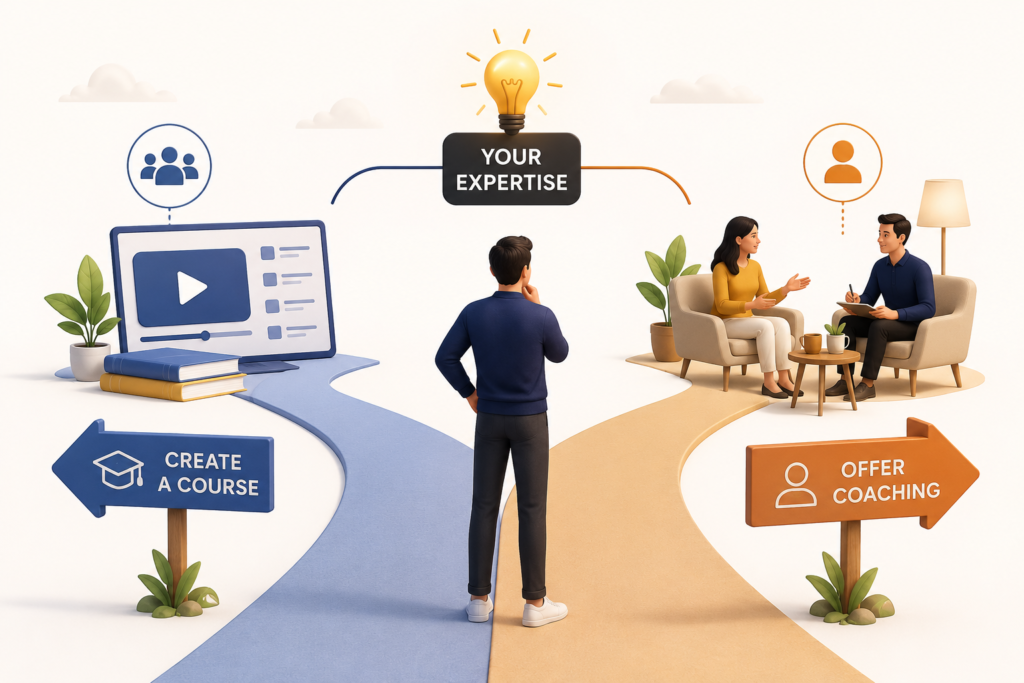
Course or Coaching? Start With These 3 Questions
A photographer teaching manual exposure is teaching a process. The settings work the same way for everyone holding the camera. A photographer helping someone find a style that will sell in their local market is applying judgment. The answer changes with the person.
Three checks make this concrete. Run all three before you commit to either model.
Check 1. Do Most People Start From the Same Place?
Course students need to arrive with roughly the same starting point. Lesson three has to make sense for everyone who finished lesson two. When your audience starts from wildly different places, a single recorded sequence fits almost none of them.
Think about who has asked you for help lately. If their first questions were nearly identical, you have course material. If you had to ask them four questions before you could answer anything useful, that is coaching work.
The Risk- Creators often build a course for a broad topic, then watch refund requests come from people who needed a different starting point. The content was fine. The format assumed a shared baseline that did not exist.
Check 2. Does the Order of Steps Stay Fixed?
A course locks your method into a sequence. That works when step four always follows step three. It breaks when the right next step depends on what happened in the client’s business last week.
Bookkeeping software setup has a fixed order. Turning around a stalled sales team does not. One coach might start with pipeline hygiene, another with the comp plan, depending on what they find.
How to apply it. Write your method on one page as numbered steps. If you keep adding “unless” and “it depends” branches, that is judgment showing up. Sell the judgment directly instead of trying to record every branch.
Check 3. How Much Does Getting It Wrong Cost the Person?
Stakes change what people are willing to buy. Low-stakes topics sell fine as courses because a student can try, fail, and retry at no real cost. High-stakes topics push people toward a human who will catch the mistake before it happens.
Someone learning to edit video will happily buy a $200 course. Someone deciding whether to sell their company wants a person on the call. The information might be identical. The risk of applying it alone is not.
Business impact. High-stakes topics support higher prices in either model, but they convert far better with a live component attached. Selling a $2,000 self-paced course on a high-stakes decision is one of the hardest sales in this market.
Coaching vs Course Creation at a Glance
The table below covers the differences that change your daily work and your income ceiling. Two columns decide most choices, which are build cost and delivery cost.
| Factors | Course Creation | Coaching |
|---|---|---|
| What the buyer pays for | A method they apply alone | Your judgment on their situation |
| Build cost before first sale | High, weeks of recording and editing | Low, a method and a booking link |
| Delivery cost per sale | Close to zero | Your hours, every time |
| Typical price range | $50 to $2,000 | $500 to $10,000 per package |
| What drives sales | Traffic and email list size | Conversations and referrals |
| Income ceiling | Set by audience size | Set by your calendar |
| Most common failure | Built it, nobody bought it | Full calendar, flat income |
| Time to first revenue | Two to three months | Two to three weeks |
Read the build cost row against your savings. Read the delivery cost row against your calendar. A course asks you to spend before you earn. Coaching asks you to earn before you scale.
That timing difference matters more than price for anyone who needs income soon. Coaching produces revenue while a course is still being edited.
When is an Online Course Better than Coaching?
Course creation fits when your method is stable, your audience is already forming, and you can afford the gap between building and earning. Five signals point this way.
- Your method holds a fixed order for most people
- You already have traffic, an email list, or a following
- The topic is a skill rather than a situation
- You want income that does not track your hours
- You can absorb two or three months of building before revenue
Your Method Holds a Fixed Order
Skills with a right and wrong way to do them record well. Spreadsheet modeling, Lightroom editing, and Facebook ad setup all have correct sequences. A student can pause, rewind, and practice without needing you present.
This is where courses beat coaching on quality, not just on cost. A recorded lesson is your best explanation, refined over several takes. A live call is your explanation on a Tuesday when you are tired.
When not to use it. If your method changes every quarter because the underlying tool changes, recording becomes a treadmill. Budget for re-recording or pick a topic with a longer shelf life.
You Already Have an Audience
Course revenue is a function of traffic times conversion times price. With no traffic, the equation returns zero no matter how good the course is. This is the single most common reason a well-made course fails.
An existing email list changes the math completely. Selling 100 seats to a list of 3,000 is normal. Selling 100 seats from a standing start usually takes a year of content work first.
What to do instead. If you have no audience yet, coaching earns while you build one. Then the course launches into a list that already trusts you. Our guide on how to promote your online course covers which channels are worth the time.
The Topic Is a Skill, Not a Situation
Skills are teachable at scale. Situations are not. “How to write a cold email” is a skill. “Whether to fire your first hire” is a situation, and no recorded module will cover the version of it your student is living.
Look at the questions people actually ask you. Skill questions start with “how do I.” Situation questions start with “should I.” Count which type you get more of.
Expected impact. Skill-based courses hold their price better over time because the outcome is verifiable. A student either can do the thing at the end or cannot. That clarity makes the sales page easier to write.
You Want Income That Does Not Track Your Hours
A course keeps selling on weeks you do nothing. That is the real prize, and it is genuine. It is also slower to arrive than most creators expect.
The honest version is that marketing time replaces delivery time. You stop spending hours on calls and start spending them on content, email, and ads. The hours do not disappear. They move.
Common mistake. Treating a course as finished at launch. Sales decay without ongoing promotion. Creators who plan for that build recurring revenue into the structure rather than relying on launch spikes.
You Can Wait Two or Three Months for Revenue
Outlining, recording, editing, building a sales page, and setting up email takes most first-time creators eight to twelve weeks part time. Nothing comes in during that window.
That gap is a business decision, not a technical one. If your rent depends on income this quarter, the course build is the wrong first move regardless of how well your topic fits.
When is Coaching Better than an Online Course?
Coaching fits when your value shows up in diagnosis, when your audience is small, or when you still need to learn what people actually struggle with. Five signals point this way.
- Your advice changes based on the person in front of you
- Your audience is small but the problem is expensive
- You need income within weeks
- You are still learning what your market wants
- The outcome depends on accountability, not information
Your Advice Changes Per Person
Some expertise only becomes useful after a diagnosis. A physiotherapist cannot prescribe until they see how you move. A tax advisor cannot answer until they see your structure. Recording generic guidance for either would be close to useless.
This is the clearest case for coaching and the hardest to fake. If you find yourself asking a lot of questions before you can help, that questioning is the product.
How to price it. Price the diagnosis, not the call length. Clients who buy a diagnosis rarely negotiate on time. Clients who buy hours always do.
Your Audience Is Small but the Problem Is Expensive
Coaching works at audience sizes where a course cannot. Twenty right people can support a coaching practice. Twenty people will not support a $200 course.
Run it as a number. Ten clients at $6,000 a year is $60,000. Getting to $60,000 on a $200 course takes 300 sales, which takes far more reach than most creators have in year one.
When not to use it. If your problem is cheap to solve and your audience is large, coaching leaves money on the table. Nobody pays $3,000 for help naming an Instagram account.
You Need Income Within Weeks
Coaching can go from decision to first payment in under a month. You need a defined offer, a price, and a way to book. No production, no editing, no launch sequence.
That speed makes coaching the standard first move for anyone testing whether people will pay at all. A paid client is the only real proof of demand.
You Are Still Learning What Your Market Wants
Coaching gives you the transcript of your market. You hear the exact words people use for their problem. You see where they get stuck and which objections keep coming up.
That raw material becomes the course later. Creators who coach first write better sales pages, because they are quoting clients rather than guessing.
Business impact. Ten coaching clients will teach you more about your course outline than three months of keyword research. The pattern that repeats across all ten is your curriculum.
The Outcome Depends on Accountability
Some results need someone watching. Weight loss, sales activity, and writing habits all fall here. The information is freely available. The follow-through is what people pay for.
If your students already know what to do and simply do not do it, more content will not fix it. A weekly check-in will. Our guide on how to build a successful online coaching business walks through structuring that kind of program.

Is Coaching More Profitable Than Selling Online Courses?
You have a $60,000 income goal. Now ask yourself how you want to reach it. Do you want hundreds of people buying a $297 course, or a smaller number of clients paying you $3,000? Both can get you there, but they create very different businesses.
If you choose the $297 course, you need 202 sales a year, or about 17 sales every month. At a 2% sales page conversion rate, you would need roughly 850 visitors to your sales page each month. That means your main challenge becomes getting enough people to see your offer.
Now imagine you choose coaching instead. At $3,000 for a twelve-week package, you need only 20 clients a year to reach the same $60,000. That is about five clients per quarter. At a 25% close rate, you would need around 80 discovery calls a year.
But before you choose coaching because the number looks easier, look at what happens after the sale. Those 20 clients would mean around 240 weekly sessions across the year, plus preparation and notes. That is roughly eight hours of delivery every week before marketing.
So, look at your own situation. Can you consistently bring 850 people to a sales page each month, or would you rather have seven sales conversations and spend eight hours a week coaching? The answer points toward the model that fits your business.
You also need to think about what happens when you want to grow. With coaching, doubling your income usually means taking on more clients or charging more. Once your calendar starts filling up, you can add revenue streams that do not require more hours.
Do Online Courses Get Better Results Than Coaching?
Self-paced courses have a delivery problem that rarely shows up in the buying decision. Katy Jordan’s study of 221 open online courses, published in the International Review of Research in Open and Distributed Learning, found completion rates ranging from 0.7% to 52.1% with a median of 12.6%.
Those figures come from free open courses, so paid courses from independent creators run meaningfully higher. The pattern still holds. Most people who buy a self-paced course do not finish it.
This matters for your model choice because unfinished courses do not produce results. No result means no testimonial, no referral, and no repeat purchase. Your second product launches into an audience that never got the first one to work.
Weigh it against your topic. If your promise is knowledge, low completion is annoying. If your promise is a transformation, low completion means the promise fails for most buyers, and refunds follow.
There are two ways to answer this without abandoning courses. You can build accountability into the course itself through deadlines, cohorts, and live check-ins. Our breakdown of how to make online courses more interactive covers the mechanics.
Or you can add a coaching layer on top and price it accordingly. That is where the hybrid model earns its keep, which is worth looking at directly.
Can You Sell Coaching and Online Courses Together?
Running both is normal at a certain size. Running both from day one is how creators end up doing neither well. Three sequences work, each with a different trade-off.
Coaching First, Course Second
Start with clients, then record the method once it stops changing. This is the lowest-risk order because you validate demand before you spend on production.
The cost is time. You are delivering calls and building a course at the same time, which usually stretches the build to four or five months. Plan for that instead of being surprised by it.
Best for. Anyone starting without an audience. It also produces better courses, because you already know which explanation lands and which one confuses people.
Course First, Coaching as the Upgrade
Sell the course, then offer coaching to the students who want more help. Your buyers have already paid you once, so the sale is easier than any cold pitch.
The trade-off is that this only works with traffic. No traffic means no course sales, which means no pool to upgrade from. It is the right order for creators who already have reach.
Watch for. Pricing the coaching too close to the course. If the course is $297 and the coaching is $497, students will feel the course was incomplete on purpose.
One Program With Both Built In
Sell a single cohort program that includes recorded lessons and live sessions. Students work through the content on their own and bring questions to a weekly call.
This solves the completion problem and the calendar problem at once. You serve ten or twenty people in the same hour, and the deadlines keep them moving. Pricing sits between a course and one-to-one coaching.
Trade-off to accept. Cohorts run on a schedule, so revenue arrives in cycles rather than continuously. Students who join late get less value, which limits how evergreen the offer can be.
How Do You Choose Between Coaching and an Online Course?
Work through these five questions in order. The first one you answer clearly usually settles it.
- Can a stranger follow your method without you? Yes points to a course. No points to coaching.
- How many people can you reach this month? Under a few hundred points to coaching.
- When do you need revenue? Inside eight weeks points to coaching.
- Does the result depend on follow-through? Yes points to coaching or a cohort.
- Can you fund two or three months of building? No points to coaching first.
Whatever the answers, the model has to actually run somewhere. Klasio handles courses, coaching programs, live cohorts, and one-time or recurring payments through Stripe in one place, which matters most if you expect to add the second model later. One thing to flag is that Klasio has no native booking calendar, so a heavy one-to-one practice will still need a tool like Calendly alongside it.
If platform choice is where you are stuck, our comparison of the best coaching platforms for course creators lays out where each option fits and where it does not.
Running Coaching and Online Courses From One Platform
Once you offer courses, coaching, or both, keeping everything in one place becomes a business advantage. Course content, students, payments, subscriptions, and live programs can quickly spread across several tools, adding setup work and daily management.
Klasio brings these parts together in one platform. You can sell online courses, run coaching programs and live cohorts, and accept one-time or recurring payments. You can also add a course later without moving your coaching business to another system.
If you plan to sell courses, coaching, or both, see how Klasio can fit your model. You can explore the platform and see whether it gives you the tools you need without adding another layer of complexity to your business.
Frequently Asked Questions
How long does it take to create an online course compared to a coaching program?
To create an online course compared to a coaching program, you usually need eight to twelve weeks for the course and one to two weeks for coaching. A course requires planning, recording, editing, publishing, and promotion, while coaching mainly needs an outcome, session structure, price, and booking process.
How do I stop my course from cannibalizing my coaching sales?
You stop your course from cannibalizing your coaching sales by making each offer solve a different part of the problem. Let the course teach the repeatable method, while coaching helps buyers apply that method to their situation through feedback, judgment, and accountability.
Can I turn my past coaching clients into course students?
You can turn your past coaching clients into course students, but they may be more valuable as sources of testimonials and referrals. They already received your direct help, so use their results to show future students what your method can help them achieve.
What happens to my income if I take a month off from coaching?
Your income usually drops if you take a month off from coaching because one-to-one coaching depends on your time. Upfront payments and recurring plans can soften the drop, but a course or another product can give you a second source of income that does not depend on every client call.
Should I price my course based on my hourly coaching rate?
You should not price your course based on your hourly coaching rate because coaching buyers pay for your time, judgment, feedback, and attention. Course buyers pay for access to a method and the outcome it can help them achieve. Price the course around its value and your market.
What do I do if I start coaching and find out I do not enjoy it?
If you start coaching and find out you do not enjoy it, finish your current commitments and use what you learned to build a better offer. Your client conversations already show you their questions, objections, and problems. Turn the repeatable parts into a course or test a group program.




Leave a Reply