
You finished your training. The lessons are recorded, the slides look good, and the sales page is live. So why aren’t the orders coming in?
If that sounds familiar, you’re in good company. Most course creators hit this wall. In most cases, the trouble starts after the content is done.
Here’s the thing. Teaching and selling are two different skills. To sell, you need an offer people get, a price that fits, a checkout that works for your buyer, and a steady way to reach new people.
This guide shows you how to sell online training step by step. You’ll learn how to package and price your training, where to sell it, and how to land your first buyers without a big audience. Keep it open as a checklist for your next launch.
TL;DR
- Pick your buyer first. Individuals and companies buy differently. Each needs its own price, page, and way to pay.
- Validate with money. Five to ten paying buyers tell you more than a hundred “sounds great!” comments.
- Sell one clear result. Build your core offer around a specific outcome. Add cohorts or coaching later.
- Do the math before you set a price. See how many buyers each price needs, then pick.
- Own your audience. On Udemy, you keep 37% of organic marketplace sales. On your own site, you keep the price minus fees.
- Fix your checkout. Local payment methods and guest checkout stop ready buyers from leaving.
- Turn students into sellers. Their results become your testimonials, and their links bring new buyers.
- Watch five numbers. They show you exactly where sales break.
What Selling Online Training Actually Involves
Let’s start with what online training means. It’s any paid teaching you deliver online. Think self-paced courses, live cohorts, workshops, webinars, and coaching. You can sell it to individual learners, to companies training their staff, or to both.
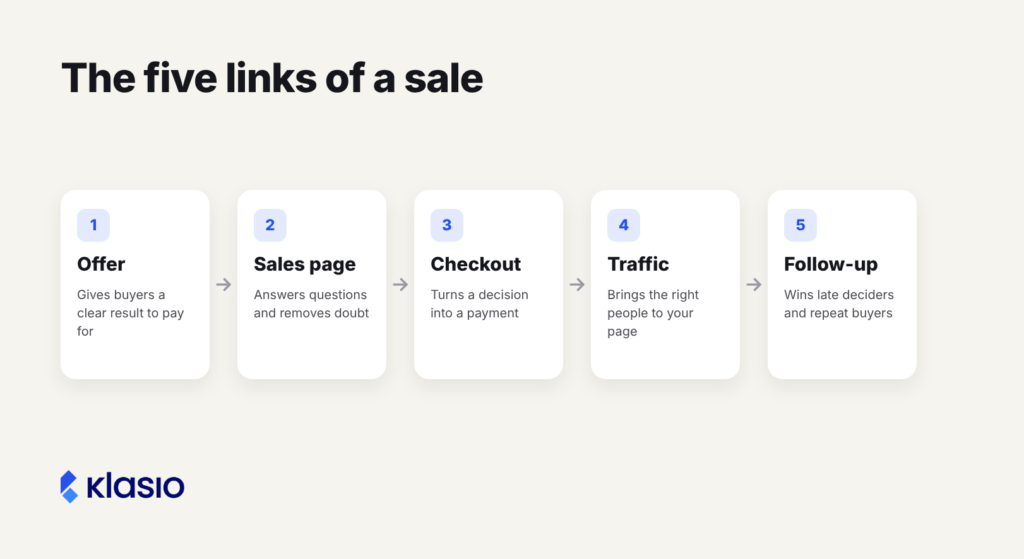
Now picture every sale as a chain with five links. You need an offer, a sales page, a checkout, traffic, and follow-up. If a buyer drops at any link, they never reach your course.
Most creators pour nearly all their energy into the first link. That makes sense, since the content feels like the real work. But the other four links decide whether anyone sees your training and pays for it.
| Link | What it does | Where this guide covers it |
| Offer | Gives buyers a clear result to pay for | Buyer choice, validation, packaging, pricing |
| Sales page | Answers questions and removes doubt | Sales page section |
| Checkout | Turns a decision into a payment | Checkout section |
| Traffic | Brings the right people to your page | First buyers, launch, and traffic sections |
| Follow-up | Wins late deciders and repeat buyers | Student sales and tracking sections |
So when sales slow down, check the chain first. Which link is losing people? A new headline won’t help much if buyers are leaving at checkout.
Decide Who You’re Selling To: Individuals or Teams
Before you write a single word of your sales page, ask yourself one question. Who’s paying? Your answer shapes your price, your page, and how people pay you.
Individual buyers pay with their own money and decide alone. They want to know if your training will help them land a job, earn more, or fix a problem soon. They often buy within days, and they’ll compare you with other courses.
Team buyers are a different story. A manager wants proof that staff will perform better. Finance wants an invoice and a seat count. HR may want to see who finished. The deal takes longer to close, but the order is much bigger.
| Individual buyers | Team buyers | |
| Who decides | The learner | A manager, finance, sometimes HR |
| Decision speed | Usually days | Often weeks |
| Pricing model | Per person | Per seat, per group, or flat license |
| Payment method | Card, PayPal, local wallets | Invoice, bank transfer, card for small teams |
| What your page must prove | A personal result | A business result and simple admin |
Let’s make this real. Say you teach Excel for financial reporting. A freelance accountant buys your $149 course to win better clients. That’s an individual sale.
Now a 12-person finance team wants the same skills. You could sell them 12 seats with a kickoff call and a progress report for their manager. The lessons stay the same. Only the offer, price, and paperwork change.
So where should you start? If you don’t know anyone inside companies yet, start with individuals. You’ll close sales faster and learn what buyers need. Move into team sales once your testimonials mention real work results.
Validate Demand Before You Build
Have friends told you your course idea sounds great? That feels good, but it doesn’t tell you much. Likes and compliments cost nothing. The only real test is whether someone pays.
So start by talking to people. Have 10 to 15 short conversations with people in your target group. Ask about their problem instead of pitching your course. What have they tried? What has it cost them?
Write down the exact words they use. You’ll reuse those words on your sales page later. They’ll sound right to your buyers because they came from them.
Next, pre-sell. Tell people the result, the format, the start date, and the price. Offer a lower founding price to the first group. Promise a full refund if you don’t reach your minimum.
You don’t need a polished sales page for this. A short document, a payment link, and a personal message will do the job.
How many buyers is enough? For a first course, 5 to 10 paying buyers is a solid signal. If you get fewer, change the promise or the audience before you record anything.
There’s a bonus, too. Your founding students tell you which lessons they need first. You build in that order and skip modules nobody would use.
One warning. If you have zero contacts in your niche, a pre-sale will fail for reasons unrelated to your idea. Build a small email list with free content first. Then pre-sell to that list.
Package Your Expertise Into an Offer People Buy
Here’s something that changes how you sell. People pay for a change in their life or work. Your lessons are only how they get there. So your offer needs three things: a clear promise, the right format, and a next step.
Write a Specific Outcome Promise
Compare these two promises. “Learn Excel.” Or “Build a monthly financial report in Excel in 3 weeks.” Which one would you buy?
The second one tells you who it’s for, what you’ll do, and by when. Specific promises are easier to sell. They’re also easier to deliver, because your course has a clear finish line.
Want a quick test? Read your promise to someone in your audience. If they can picture life after the course, you’ve got it. If they ask what they’ll actually be able to do, tighten it.
Pick the Right Format
Your format should match how the skill is learned. Some skills need practice and feedback. Others only need clear steps you can follow at home.
| Format | Best for | Price level | Your time |
| Self-paced course | Clear step-by-step skills | Low to mid | Low after launch |
| Live cohort | Skills that need practice and feedback | Mid to high | High during each run |
| Group coaching | Problems that vary from person to person | Mid to high | Fixed weekly hours |
| 1:1 coaching | High-stakes, custom situations | Highest | Highest |
| Hybrid | Self-paced lessons plus live Q&A | Mid to high | Moderate |
Live formats take more of your time. In return, more students finish. Here’s why cohort-based learning gets higher completion rates. Students who finish get results, and results are what you sell next time.
Build an Offer Ladder
An offer ladder lets buyers start small and move up. A typical ladder has four steps: free content, a low-priced entry product, your core training, and a premium option with live access.
Back to our Excel trainer. Their ladder could be a free reporting template, a $29 pivot table mini-course, a $199 core course, and a $599 cohort with weekly reviews. Someone who grabs the template today might join the cohort six months later.
Don’t build all four steps at once, though. Start with free content and your core offer. Add the premium step when students start asking for more help. Weighing your live options? Compare 1:1 coaching vs group coaching first.
How to Price Online Training
Pricing is where a lot of creators freeze. Too low, and serious buyers doubt your quality. Too high without proof, and nobody takes the risk. So where do you start? With the value of the result.
Ask yourself what the result is worth to your buyer. If your training helps someone win a $5,000 raise, a $300 price is an easy yes. A hobby skill has a lower ceiling. Then check what similar training costs, and use that as your range.
Do the Revenue Math First
Pick a revenue goal and divide it by your price. Now you can see how many buyers each price needs. The visitor column assumes a 1% conversion rate.
Why 1%? Money coach Denise Duffield-Thomas puts it plainly: “a normal sales page conversion is 1%” (source). Your rate may differ, but it’s a sensible place to start.
| Price | Buyers needed for $10,000 | Sales page visitors needed at 1% |
| $49 | 205 | 20,500 |
| $199 | 51 | 5,100 |
| $499 | 21 | 2,100 |
| $999 | 11 | 1,100 |
See the problem with low prices? If 500 people visit your page each month, a $49 course takes years to reach $10,000. A $499 cohort could get there within a year, even at half that conversion rate.
Price Team Sales Differently
Companies expect pricing that fits how they buy. You’ve got three common options:
- Per seat: a price per learner, with a lower rate above a set number of seats.
- Flat license: one yearly price for up to a set number of learners.
- Add-ons: live kickoff sessions, Q&A calls, or progress reports for managers.
Whatever you choose, build your extra time into the price. Invoices, onboarding calls, and reports all take hours. You should get paid for them.
Make the Price Easier to Pay
Some buyers want your training but can’t pay all at once. A payment plan splits the price into 3 or 4 smaller payments. That one change can turn a “maybe later” into a “yes.”
Do you update your training often or deliver it monthly? A subscription might fit better. If so, compare annual vs monthly subscription billing before you set your intervals.
Selling across countries? A price that feels fair in the US might block buyers in South Asia or Africa. Country-specific coupon codes let you adjust without touching your main price.
One last thing. Don’t underprice to feel safe. A low price needs more traffic than most new creators have. Start at a fair price, then raise it as your testimonials grow.
Where to Sell: Marketplace, Your Own Platform, or Both
Where you sell decides two things. How much of each sale you keep, and who owns the relationship with your students. You have two main options, and plenty of creators use both.
Marketplaces like Udemy and Skillshare already have millions of learners. Your course can show up in their search without you running a single ad. That’s the upside.
The downside is your share. On Udemy, you keep 97% when someone buys through your own coupon or referral link. When they find you through Udemy’s marketplace or ads, you keep 37% (Udemy).
Your own platform flips that around. You keep the price minus payment fees and your plan cost. You get every student’s email. You set your own prices, discounts, and bundles. The catch? You bring every buyer yourself.
| Marketplace | Your own platform | |
| Who brings buyers | Partly the marketplace | You |
| Your share of each sale | 37% on Udemy organic sales, 97% on your own links | Full price minus payment fees and plan cost |
| Student contact details | Kept by the marketplace | Yours |
| Pricing control | Partial | Full |
| Branding | The marketplace’s | Yours |
| Coaching, bundles, subscriptions | Limited to what the marketplace offers | Your choice |
So which one fits you? A marketplace makes sense if you have no audience yet, want to test topics, or want an extra discovery channel.
Your own platform makes sense once you can bring buyers yourself. Even a small email list changes the math, because each buyer you bring is worth far more on your own site.
Many creators do both. They put a short, focused course on a marketplace and keep their core training, cohorts, and coaching on their own site. Just keep in mind that marketplace students stay the marketplace’s customers.
Build a Sales Page That Answers Buyer Questions
When someone lands on your sales page, they’re quietly asking questions. Who is this for? What will I be able to do? Why should I learn from you? What if it doesn’t work for me?
Your job is to answer each one, in the order they ask. A page like that sells better than a list of modules ever will. Here’s the order that works:
- Headline: the result and who it’s for.
- The problem: in your buyer’s own words from your validation calls.
- The change: what their work or life looks like after the training.
- Curriculum: each module written as a result instead of a topic title.
- About you: one short paragraph of proof that you can teach this.
- Social proof: student results, reviews, and stories.
- Price and inclusions: everything they get, plus any payment plan.
- Guarantee: your refund terms in plain words.
- FAQ: answers to the objections you hear most.
- Call to action: one clear button, repeated after each major section.
Handle Objections Before Buyers Raise Them
Most people hesitate for one of four reasons. They think they don’t have time. They tried something similar and it didn’t work. They aren’t sure it fits their level. Or they worry about the cost.
Answer each one right on the page. Show weekly hours and lesson length for the time worry. Explain what your method does differently for anyone burned before.
For level, add a short “this is for you if” and “this isn’t for you if” list. For cost, compare your price with what the problem costs them if it stays unsolved.
Get Social Proof Before You Have Testimonials
No student reviews yet? You probably have more proof than you think. Use results from your pre-sale students. Share outcomes from past 1:1 clients, with their permission. Show your own before-and-after results.
And go specific. “Sara now finishes her month-end report in 4 hours instead of 3 days” sells far more than “Great course!” When you ask for reviews, ask for the starting point, the result, and how long it took.
Add a Section for Team Buyers
Selling to companies too? Give them their own section or page. Show the business result, your seat options, and how managers can track progress.
Mention that you can send an invoice. Then add a “book a call” button, since team buyers usually want to talk before they commit.
Remove Friction at Checkout
Think about who reaches your checkout. These people have already decided to buy. Your page did its job. Losing them now hurts the most, yet most creators barely look at this step.
So how many people leave? Baymard Institute averaged 50 studies and found a 70.22% cart abandonment rate (Baymard). Many of those shoppers were only browsing. Many others left for reasons you can fix.
In Baymard’s survey, 19% didn’t trust the site with their card. 18% left because they had to create an account. 9% couldn’t find enough payment methods. These are general ecommerce numbers, but your checkout faces the same problems.
Offer the Payment Methods Your Buyers Use
Cards are common in the US and Europe. Elsewhere, people pay differently. In Bangladesh, many buyers use mobile wallets like bKash and Nagad. In Nigeria and Kenya, bank transfer and mobile money are common.
If your checkout only takes cards, you’re quietly turning those buyers away. Check your analytics to see where your visitors live. Then connect payment gateways that support their local methods.
Cut Every Step You Can
Let buyers check out with just an email address. Ask only for the fields you truly need. Show the full price, tax included, before the payment step. Surprise costs at the last second make people leave.
Show Trust Next to the Pay Button
Put your guarantee right beside the button. Show payment logos people already know. Add a support email in case something goes wrong. Small details like these settle the last doubt before someone pays.
Raise Order Value Carefully
An order bump is a small extra that buyers add with one click, such as a template pack or a recorded workshop. Keep it to one offer so your checkout stays simple. Bundles work too when two products clearly belong together.
Make It Easy for Teams to Pay
Company buyers often can’t pay by card. Offer an invoice option for team orders. Let them add a purchase order number or tax ID if they need one. If a finance team can’t pay the way it needs to, it’ll buy elsewhere.
Get Your First 10 Buyers Without a Big Audience
You don’t need thousands of followers to make your first sales. You need conversations. Ads and SEO take months to work. Talking to people works this week.
Does selling feel pushy to you? You’re not alone. Pat Flynn held back for a long time for the same reason. His turning point was realizing that “you can sell and serve at the same time” (Smart Passive Income).
If your training solves a real problem, telling people about it is part of helping them. With that in mind, here are five steps to your first 10 buyers:
- List 50 people. Think past clients, colleagues, and contacts who have the problem or know someone who does. Message each one personally and ask about their problem.
- Show up where your buyers talk. Join their groups and forums. Answer questions for two or three weeks before you mention your training. Check each group’s promotion rules first.
- Run a free live workshop. Teach one small piece of your topic well for 45 minutes. At the end, invite people to your paid training with a founding price and a deadline.
- Borrow an audience. Go on a podcast, swap newsletter mentions, or co-host a webinar with someone who serves the same buyers.
- Follow up. Many first sales happen in the second or third conversation. A short personal message works better than a sales email.
Expect most people to say no. That’s normal, and it says little about your training. You only need a handful of yeses to get your first results, testimonials, and feedback.
Keep track of where each buyer came from, too. After 10 sales, you’ll see which step worked best. Then do more of it in your launch.
Choose a Launch Model: Live Launch or Evergreen
Should you open enrollment for a few days or keep it open all the time? Both work. The right choice depends on where you are right now.
A live launch opens enrollment for a short window, then closes it. An evergreen setup stays open and sells through automated emails. Many creators use both at different stages.
| Live launch | Evergreen | |
| How it works | Enrollment opens for 5 to 7 days, then closes | Enrollment stays open, sales run through automated emails |
| Best for | First launches, cohorts, new offers | Proven offers with steady traffic |
| Main strength | A real deadline pushes people to decide | Sales come in every week |
| Main weakness | Sales arrive in bursts, then stop | Needs a tested sales page and email sequence |
| Your time | Intense for 2 to 3 weeks | Heavy setup, then light upkeep |
If this is your first launch, go live. Course creator Paige Brunton recommends this for beginners. A group joining at the same time creates energy an automated funnel can’t match (Paige Brunton).
You’ll also learn which messages land and which questions come up most. That knowledge becomes your evergreen funnel later.
A Simple 7-Day Launch Email Sequence
Here’s a sequence you can copy:
- Day 1: Open enrollment. Share the result, the price, and the deadline.
- Day 2: Tell the story of why you created the training.
- Day 3: Answer the top three objections.
- Day 4: Share a student result or a case study.
- Day 5: Explain exactly what happens after someone joins.
- Day 6: Send a 24-hour reminder.
- Day 7: Send a final call a few hours before closing.
Want a strong start? Run a free live workshop right before Day 1. It gives people a taste of your teaching. Record it, and reuse it in your evergreen funnel later.
And keep every deadline honest. If you say the price goes up, raise it. If you say enrollment closes, close it. People notice fake deadlines, and they remember them next time.
Build Traffic That Keeps Selling
Launches bring spikes. Steady traffic fills the quiet weeks in between. So you need at least one channel that brings new people to you every week, even when you’re busy teaching.
Where should all that traffic go? To your email list. Social platforms change their rules and search rankings move, but your list stays yours.
The easiest way to grow it is a free resource that solves a small version of your course problem. People sign up to get it. From then on, you can talk to them directly.
| Channel | How fast it works | Main cost | Best for |
| Email list | Fast once built | Low | Every creator, every stage |
| SEO and blog content | Slow, often months | Your time | Topics people search for |
| YouTube | Slow to medium | Your time | Skills that need demonstration |
| Social media | Medium | Your time | Building relationships and trust |
| Podcasts and partnerships | Medium | Your time | Borrowing an existing audience |
| Paid ads | Fast | Ad spend | Offers that already convert |
| Affiliates | Medium | Commission per sale | Creators with happy students |
Now, don’t try all seven at once. Pick one or two channels and commit for three months. Good on camera? Start with YouTube. Better at writing? Start with SEO content.
Hold off on paid ads for now. Ads send traffic fast. If your page or checkout leaks buyers, ads just help you lose money faster. Fix the chain first, then pay to fill it.
Want a channel-by-channel playbook? Read our guide to promoting your online course.
Turn Your Students Into Your Next Sales
Your current students are your best sales channel. They’ve already trusted you with their money. When they get results, they bring you proof, referrals, and repeat purchases. There’s one condition, though. They have to finish.
Help Students Finish
Students who stall rarely recommend a course. So make your first lesson a quick win they can finish in one sitting. Then add quizzes, assignments, and live Q&A sessions so learning feels active.
Need more ideas? Here’s how to make online courses more interactive. Also watch where students drop off. If many stop at the same lesson, that lesson is too long, too hard, or unclear.
Ask for Testimonials at the Right Moment
When should you ask for a testimonial? Right after a student hits a result. That’s when the change feels biggest to them.
Ask three questions. What was hard before? What changed? How long did it take? A short video is ideal, but a written answer works too.
Turn Happy Students Into Affiliates
Your students already recommend courses they love in group chats and comments. An affiliate program gives them a reason to share yours. Offer a commission on every sale they bring. Their referrals tend to convert well because the trust is already there.
Offer the Next Step at Completion
A student who just finished your course is your warmest buyer. They know how you teach and trust your results. So offer the next step right then. That could be an advanced course, group coaching, or a monthly subscription.
Track the Numbers That Show What to Fix
When sales are slow, it’s tempting to guess. You rewrite the headline. You cut the price. Five simple numbers can tell you exactly which link is broken. Check them once a month.
| Metric | How to calculate it | A low number usually means | First fix to try |
| Visitor to lead | Email signups ÷ visitors | Your free resource doesn’t match the buyer’s problem | Offer a freebie tied to your course result |
| Sales page conversion | Buyers ÷ sales page visitors | The promise or proof is weak | Rewrite the headline and add specific results |
| Checkout completion | Completed orders ÷ checkout starts | Friction or missing payment methods | Add local gateways and guest checkout |
| Refund rate | Refunds ÷ orders | The page promised more than the training delivers | Align page claims with the content |
| Completion rate | Students who finish ÷ students enrolled | Lessons feel long or passive | Add quick wins and live touchpoints |
Here’s a tip. Change one thing at a time. If you change the headline, price, and checkout together, you won’t know what worked. Give each change two to four weeks, then compare.
And start with the step closest to the money. A checkout problem costs you buyers who already decided. Fix that before you spend time on traffic or headlines.
Start Selling Your Online Training
Knowing how to sell online training comes down to five links: the offer, the page, the checkout, the traffic, and the follow-up. Pick your buyer first. Validate with real payments. Price with the math in front of you. Then fix whichever link loses the most buyers.
Your platform affects three of those links directly: the page, the checkout, and the follow-up. That makes the choice worth some thought.
Klasio fits you if you want to sell under your own brand and keep your student list. You can sell courses, live cohorts, webinars, coaching, digital downloads, subscriptions, and bundles from one academy. Payments go straight to your account through Stripe, PayPal, Razorpay, and regional gateways such as Paystack, PayFast, Xendit, and EPS. Klasio doesn’t add a platform charge on your sales. Guest checkout, coupons, a built-in student community, and an affiliate program cover the checkout and follow-up steps in this guide.
Choose a marketplace instead if you have no audience and don’t plan to build one yet. Udemy or Skillshare can bring you first students while you learn what sells. Expect to keep a smaller share of each sale.
Choose an enterprise LMS if you mainly sell compliance training to large companies. Those buyers often need deep HR system connections and formal procurement steps that creator platforms aren’t built around.
If Klasio sounds like the right fit, you can create your academy for free and set up your first offer today.
Frequently Asked Questions
Do I need a certification to sell online training?
You don’t need a certification to sell online training in most topics. Skills like marketing, design, Excel, writing, and coaching are open to anyone who can teach them well. Buyers judge you on proof and results. Some fields are different, though. Training in healthcare, finance, law, or workplace safety may need formal approval. Words like “certified” or “accredited” can also carry legal meaning in some countries. Check the rules in your field and country before you use them.
How do I protect my online course from piracy?
You protect your online course from piracy by making it harder to copy and less worth copying. Host videos on a platform that requires a login. Avoid public video links. Add your name or the student’s email to downloadable PDFs. Keep the most valuable parts live, such as Q&A calls, feedback, and community access. Those can’t be pirated. If you find your course shared online, send a takedown request to the site hosting it.
Can I sell the same course on Udemy and my own website?
You can sell the same course on Udemy and your own website. Udemy’s community team says instructors keep the rights to their content and can offer it elsewhere (Udemy Community). Don’t give the course away free elsewhere while charging for it on Udemy. If your course joins the Udemy Business collection, extra limits apply to competing platforms. Your own site is still allowed. Read the current Instructor Terms before you publish.
Can I sell recordings of my live workshops as a course?
You can sell recordings of your live workshops as a course, and it’s a quick way to build your first product. Cut each recording into short lessons around one idea each. Remove long pauses and off-topic chat. Add a worksheet or checklist to every lesson. Get permission from attendees who appear on screen or speak. You can also blur or cut them out. Then sell the package at a lower price than the live version.
How long does it take to make the first sale?
You can make your first sale within days if you pre-sell to people who already know you. Personal outreach and a free live workshop are the fastest routes. Selling to strangers takes longer. SEO and YouTube often need several months before they bring steady buyers. Plan for both. Use direct outreach for your first sales. Build a long-term channel at the same time.
How do I sell online training to buyers in other countries?
You sell online training to buyers in other countries by removing the barriers that stop them from paying and learning. Add payment gateways that support their local methods. Consider regional pricing for lower-income markets. Schedule live sessions at times that work across time zones, or record them. Add subtitles if your buyers speak another first language. Many countries also charge tax on digital products based on where the buyer lives, so ask an accountant about your obligations.


Leave a Reply